Try PagePilot.ai 100% FREE! No credit card required.

Shopify Dropshipping: How It Works, What It Costs, And How To Start
An honest guide to dropshipping on Shopify: how an order flows, what it really costs, the downsides that rarely make the ads, and the seven steps to set up a store. It links out to a deeper guide for every part of the journey.
What Is Shopify Dropshipping?
Shopify dropshipping is a way to run an online store on Shopify without holding any stock. You list products on your store and set your own prices. When a customer orders, you pass the order to a supplier, who packs and ships it directly to the customer. You keep the difference between what the customer paid you and what the supplier charged you, after payment fees, advertising, and other costs.
Shopify is the store: the pages, the checkout, and the payments. It does not supply products or fulfil orders on its own. That job goes to the supplier or fulfillment app you connect.
How a dropshipping order works on Shopify
- 1
A customer buys from your store
They pay your retail price at your Shopify checkout. Shopify takes its payment processing fee and pays the rest out to you.
- 2
You order from your supplier
You pay the wholesale price and pass on the delivery address. A fulfillment app can do this automatically, or you can do it by hand while you test.
- 3
The supplier ships to the customer
Your supplier packs and posts the item. Delivery takes anywhere from a few days to several weeks, depending on where it is stocked.
- 4
You keep the customer informed
The tracking number goes back to Shopify, so the customer gets shipping updates from your store rather than from the supplier.
- 5
You handle what goes wrong
Refunds, returns, damaged items, and "where is my order" emails are yours to deal with, even though you never touched the parcel.
What you own
- The store, the brand, and the product pages
- Pricing, offers, and marketing
- Customer service, refunds, and returns
- Taxes, policies, and legal compliance
What your supplier owns
- Stock, storage, and packing
- Shipping the parcel to the customer
- Consistency of the product itself
- Sometimes a returns process, on their terms
Is Shopify Dropshipping Legal, And Does It Still Work?
Legal: yes, with responsibilities that surprise newcomers
Dropshipping is legal, and Shopify allows it. The catch is that you are treated as the seller. Shopify's Help Center guidance on dropshipping says you must follow the laws where your business is based and where your customers are, as if you had stocked the goods yourself. In practice that means four things. This is general information, not legal advice.
Product safety is yours
Shopify says you should check that what you sell meets safety rules and carries the right certifications in each market, and remove recalled products straight away. A licence that covers one region may not cover another.
Shipping promises must be honest
In the US, the FTC Mail, Internet, or Telephone Order Merchandise Rule requires you to ship within the time you state, or within 30 days if you state none, and to notify customers about delays. It applies to the seller taking the order, which is you, not your supplier.
Refund and returns terms must be clear
Shopify expects a current refund policy with timeframes, a return address, who pays for returns, and contact details. Customers in the EEA also have statutory rights, such as a 14-day return window for most online purchases.
Taxes and import charges apply
Shopify tells dropshippers to disclose import and customs charges and third-party shipping origins before purchase. Sales tax, VAT, and registration rules depend on where you are based and where you sell, so ask an accountant.
Import charges on low-value parcels changed, as of September 2026
If you ship from overseas, check this before you promise free shipping. In the US, the duty-free exemption for parcels under $800 was suspended for all countries in August 2025, and US Customs and Border Protection made the suspension indefinite in rules published on 24 June 2026. In the EU, the €150 duty exemption ended on 1 July 2026. It is replaced by a temporary €3 duty per item category until 1 July 2028, and a separate handling fee is due by 1 November 2026, according to the European Commission. Rules like these keep moving, so check each country you sell to.
Does it still work? It can, but not the way it was sold in 2018
Nothing about the model is broken. You can still open a store for little money and test products without buying stock. What has changed is that the easy version, listing a supplier product at a markup with the supplier page, is now what everyone does. Profit comes from the parts you control: products with real margin, honest and reasonably fast delivery, a page that convinces, and ad spend that you track against your break-even point.
For market size and growth figures, see our Shopify dropshipping statistics, which cite a source for each number. To test a specific product, run its numbers through the dropshipping calculator before you spend on ads.
The Real Upsides And Downsides
Most guides list the upsides loudly and the downsides quietly. Here are both, in the order they tend to matter.
The upsides
- Low upfront cost, because you do not buy stock before you have a sale
- Fast to test, so you can try several products before committing to one
- No warehouse, packing, or shipping to run yourself
- Location independent, since everything runs online
- Order volume can grow without you handling more parcels
Thin margins
Suppliers sell to many stores at similar wholesale prices, and shoppers can often find the same item elsewhere. After product cost, shipping, payment fees, refunds, and ad spend, what is left on each order can be small. Margin is the first number to check.
Long or unpredictable shipping
Items shipped from overseas warehouses can take weeks, and delivery times swing with carrier and season. Customers used to fast delivery from big retailers notice, and slow shipping leads to "where is my order" emails, refunds, and disputes.
Quality you cannot see
You do not handle the product, so you cannot inspect it before it reaches the customer. Quality can differ between batches, or between listings that look identical. Order a sample before you sell anything.
Crowded niches and copycat stores
When a product trends, many stores start selling it at once. Ad costs rise, prices fall, and an unbranded store is easy to copy. This is why some sellers move toward branded or private label products.
Shopify's own costs
Even a store with no sales pays a monthly plan fee, and every online sale carries payment processing. Apps, a domain, and store tools add to it. These costs are certain, while sales are not.
Responsibility without control
Stock-outs, price changes, and supplier delays land in your customer support inbox. You are accountable for an experience that you do not fully control.
Dependence on paid traffic
Most new stores have no existing audience, so sales usually depend on advertising. You pay for that traffic before you know whether a product works, which is why a test budget needs a limit.
When dropshipping is the wrong fit
Think twice if you need dependable income soon, cannot afford to lose a test budget, or do not want to handle customer service. Dropshipping shifts the risk from holding stock to spending on traffic and answering for an experience you do not fully control. If that trade-off does not suit you, a model where you hold a small amount of stock or make the product yourself may fit better.
How Much Does Shopify Dropshipping Cost?
There is no single price, because the biggest costs are ones you choose. Here is what you will pay for and how each cost is charged.
Shopify plan
Monthly
The subscription for your store. In the US, the Basic plan lists at $29 a month billed yearly or $39 a month billed monthly, and Shopify usually offers a short free trial followed by a low introductory price for the first months. Prices vary by country, so check the Shopify pricing page for yours.
Payment processing
Per order
Each online sale carries a card fee. On the US Basic plan through Shopify Payments it is 2.9% plus 30 cents. If you use an outside payment provider instead, Shopify adds a transaction fee of 2% on Basic, 1% on Grow, and 0.6% on Advanced.
Product cost and shipping
Per order
What you pay the supplier when a customer orders, plus the delivery charge if it is billed separately. This is usually the largest cost per order.
Product samples
One-off
Order the product yourself before you sell it, so you can check quality, packaging, and real delivery time. It costs the item plus shipping, and it is the cheapest protection you have.
Apps
Monthly, varies
Many fulfillment apps have free plans, and paid tiers add automation and more orders. See the ranked list of Shopify dropshipping apps before you subscribe to anything.
Product pages and theme
Free to monthly
Shopify themes range from free to paid, and page builders charge monthly. PagePilot has a free trial and paid plans from $39 a month. It is optional, and you can build pages by hand if you have the time.
Domain
Yearly
Set by the registrar and the extension you choose. You can start on the free Shopify address, but a custom domain looks more trustworthy at checkout.
Advertising
Ongoing
Usually the largest and least predictable cost. Set a test budget you can afford to lose, and decide in advance how much each product gets before you review it.
Refunds and disputes
Per incident
A refunded order often costs you the product too, because the supplier has already shipped it. Payment providers also charge a fee when a customer disputes a payment.
Accounting, tax, and legal
Varies
Depends on your country and how you register. Budget for an accountant, or at least an hour of proper advice, before you take your first order.
Shopify prices and rates checked on the Shopify pricing page in September 2026. They differ by country and change over time, so confirm the current figures before you budget.
A per-order example, with made-up numbers
The cost that decides everything is what you can afford to spend on ads per order. This example uses round, hypothetical numbers to show the logic. They are not typical or expected results.
Here the order leaves $24.54 before advertising, which puts break-even at about 1.6x return on ad spend. If ad cost per order climbs from $15 to $25, profit turns into a loss, and this example ignores refunds, which make it worse. Put your own figures into the dropshipping calculator.
- Selling price
- $40.00
- Product cost
- -$10.00
- Shipping from supplier
- -$4.00
- Card processing (2.9% + $0.30)
- -$1.46
- Left before advertising
- $24.54
- If ads cost $15 per order
- $9.54 profit
- If ads cost $25 per order
- -$0.46 loss
How To Start Dropshipping On Shopify: 7 Steps
The order matters. Test the product and the supplier before you polish the store, and test the store before you buy traffic.
- 1
Pick a niche and a business model
Start from something you can explain and sell honestly, then check the economics: a healthy gap between cost and price, few returns, and a reason for customers to buy from you instead of a marketplace. Decide whether you will sell unbranded products, add your own branding, or move toward private label, because that choice shapes your margins and how easily you can be copied.
- 2
Find products worth testing
Shortlist several products rather than betting on one. Look for visible demand, room for margin, and nothing restricted or regulated in your target markets. For each one, write down the landed cost, the supplier, the delivery time, and the price competitors charge, so you can compare them on the same footing.
- 3
Choose how you will fulfil orders
Decide between a marketplace supplier, a dropshipping app, a local supplier, or a manufacturer. Message the supplier, order a sample, and time the delivery before you list anything. The supplier section below covers the trade-offs.
- 4
Set up your Shopify store
Start a Shopify trial and choose a theme. Then configure payments, shipping rates that match your supplier's real delivery times, taxes, and your policies for refunds, shipping, privacy, and terms. Publish honest delivery estimates, because they are both a legal obligation and the biggest source of support tickets when they are wrong. Connect a domain you own once you are ready to take orders.
- 5
Build product pages that sell
Supplier listings are written for marketplaces, and the same text appears on every store that imports them. Your product page is what turns a paid click into an order, so it deserves real work: your own copy, better images, clear variants, and sections that answer objections. The product page section below shows where PagePilot fits.
- 6
Test the whole flow before you spend on traffic
Place a real order through your checkout. Confirm the supplier receives it, the tracking number comes back, and the confirmation emails look right. Use your sample to check quality and real delivery time, then update your store with what you learned.
- 7
Launch small, measure, and decide
Send a limited amount of traffic to each product and compare your cost per order with your break-even point before you scale. Decide in advance what would make you stop. A product that cannot clear break-even at a realistic price is one to drop, not a page to rewrite forever.
How To Choose A Dropshipping Supplier
There is no single best supplier. The right one depends on what you sell, where your customers are, and how much delivery time and brand control matter to you. At a high level there are five routes.
Marketplace suppliers
Such as AliExpress
- Delivery
- Slowest, and the least predictable
- Margins
- Low product cost, but many stores sell the same listing
- Control
- Low, and it varies by seller
- Good for
- Testing ideas cheaply
Dropshipping platforms and apps
Such as DSers, Spocket, Zendrop, or AutoDS
- Delivery
- Depends on the supplier behind the app
- Margins
- Varies, and the app adds its own monthly cost
- Control
- Medium, because some apps vet or curate suppliers
- Good for
- Automating orders and tracking
Local and regional suppliers
Suppliers with stock in the US, EU, or UK
- Delivery
- Fastest and most predictable
- Margins
- Higher product cost, so thinner margin at low prices
- Control
- Higher, and easier to sample
- Good for
- Faster delivery and fewer refunds
Print on demand
Such as Printify or Printful
- Delivery
- Made to order, so production time is added
- Margins
- Higher cost per item, so price has to reflect the design
- Control
- Medium: you control the design, not the production
- Good for
- Brand and design led niches
Private label manufacturers
Your branding on a product from a manufacturer
- Delivery
- Depends on the manufacturer and your stock arrangement
- Margins
- Highest potential, with more upfront commitment
- Control
- Highest: you can specify the product and packaging
- Good for
- Building a brand that is hard to copy
A supplier vetting checklist
- Order a sample yourself and time the delivery to a real address.
- Read the return and refund policy, and ask who pays for a return.
- Message the supplier with a real question and note how fast and clearly they reply.
- Check which shipping methods and tracking are available to your customer countries.
- Ask about plain or branded packaging and inserts.
- Find out how stock-outs and price changes are handled, and how stock syncs to your store.
- Confirm the product meets labelling and safety rules in your target markets.
- Line up a backup supplier for anything that starts to sell well.
Sourcing from a marketplace specifically? The AliExpress dropshipping guide goes deeper on that route.
The Step Where PagePilot Helps: Product Pages
Why the product page is the step that matters
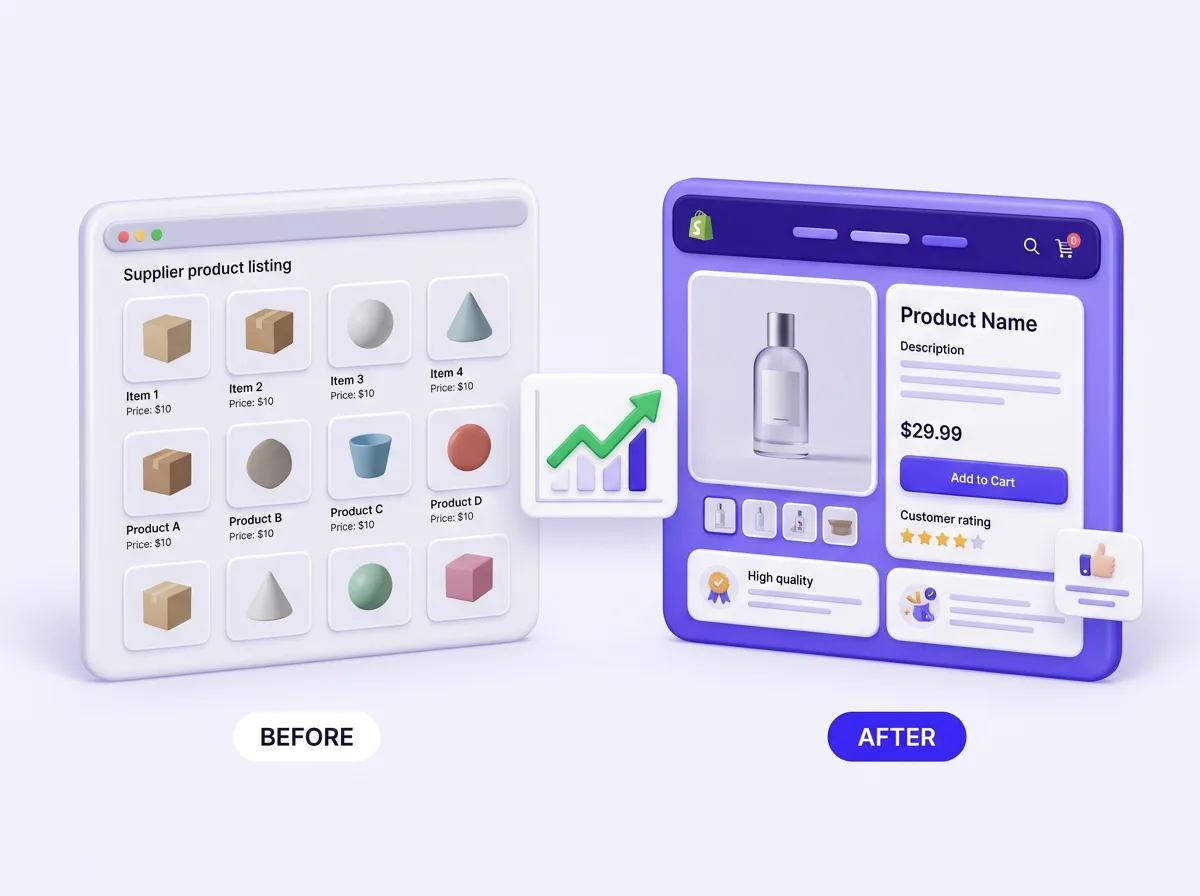
Supplier listings are written to sell on a marketplace: crowded titles, generic photos, and the same description on every store that imports them. On your own Shopify store, the product page is all that stands between a paid click and a closed tab, and it is the one part of the store you control completely.
It is also the slowest part of the setup by hand: rewriting copy, improving images, mapping variants, adding benefit and FAQ sections, and checking it all on mobile, for every product you test.
What PagePilot does, and what it does not
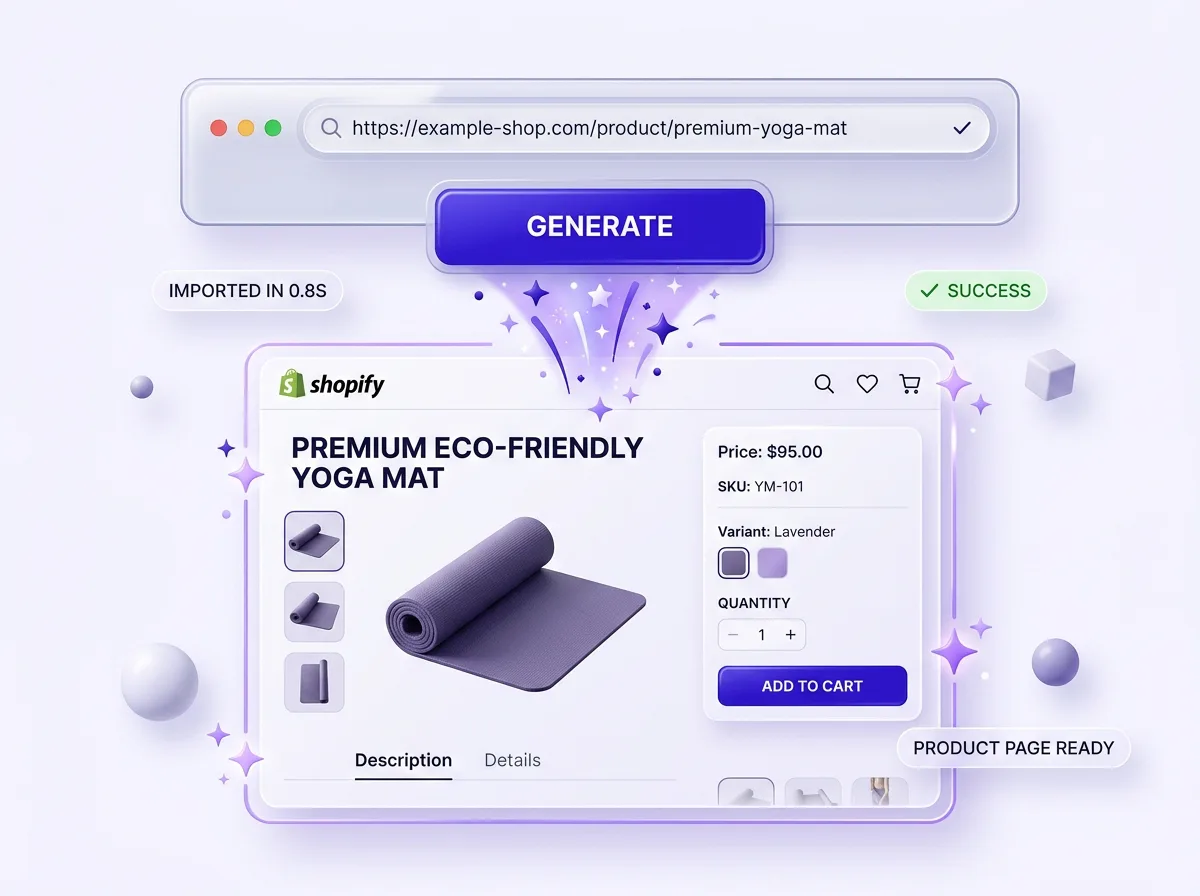
PagePilot handles this step and only this step. Paste a product link from AliExpress, Amazon, Etsy, TikTok Shop, or another Shopify store, and it builds a branded Shopify product page with rewritten copy, generated images, and proven sections. You edit it with drag and drop, then publish it to your store.
It does not source products, hold stock, or ship orders, so you still need Shopify and a supplier or fulfillment app. It fits best when you are testing many products and the page work is what slows you down.
Shopify Dropshipping Guides By Topic
This page is the overview. Each guide below goes deeper on one part of the journey, so pick the one that matches where you are.
Choose what to sell
- Dropshipping nichesHow to pick a niche, with sub-niche ideas and margin notes.
- Best dropshipping productsWhat makes a product worth testing, by category.
- Dropshipping product finderFind products scored on demand, margin, and competition.
- Daily winning productsA fresh set of hand-picked products every day.
Niche playbooks
- Pet dropshippingWhy the pet niche works, and how to launch a store in it.
- Jewelry dropshippingWhat sells, where to source, and how to build trust.
- Beauty dropshippingSkincare and beauty products, and a branded launch plan.
- Clothing dropshipping suppliersApparel suppliers and how to build a branded clothing store.
Business models
Suppliers and tools
Run the numbers
Build faster with AI
Sources and notes
Facts on this page about Shopify, US shipping rules, and customs were checked in September 2026. The per-order example is hypothetical. This page is general information, not legal, tax, or financial advice.
- Shopify Help Center: Dropshipping: Seller responsibilities, safety, pricing transparency, and EU changes. Checked September 2026.
- Shopify pricing: Plan prices, payment rates, third-party gateway fees, and the trial offer. Checked September 2026. Figures vary by country.
- FTC: Business Guide to the Mail, Internet, or Telephone Order Merchandise Rule: The 30-day shipping rule and how it applies to the seller taking the order.
- Federal Register: Indefinite Suspension of the De Minimis Exemption: US Customs and Border Protection interim final rule, published 24 June 2026.
- European Commission: EU customs reform: End of the EUR 150 duty exemption on 1 July 2026 and the temporary EUR 3 duty.
Shopify Dropshipping FAQs
What Is Shopify Dropshipping?
Shopify dropshipping is a way to run an online store on Shopify without holding any stock. You list products on your store and set your own prices. When a customer orders, you pass the order to a supplier, who packs and ships it directly to the customer. You keep the difference between what the customer paid you and what the supplier charged you, minus payment fees, advertising, and other costs.
How Does Dropshipping Work On Shopify?
A customer pays at your Shopify checkout. You then place the same order with your supplier and pay the wholesale price, either by hand or through a fulfillment app that automates it. The supplier ships the item straight to the customer, and the tracking number goes back to your store so the customer gets updates from you. You stay responsible for support, refunds, and anything that goes wrong in transit.
Is Dropshipping On Shopify Legal?
Yes. Shopify allows dropshipping, and the business model itself is legal. What catches newcomers out is that you are treated as the seller. Shopify says you must follow the laws where your business is based and where your customers live, keep products safe and compliant, publish accurate shipping times and refund terms, and disclose import charges. This is general information and not legal advice, so check the rules for your country and the countries you sell to.
Is Shopify Dropshipping Still Worth It In 2026?
It can be, but it is not a shortcut. Starting is cheap because you do not buy stock, which lowers the cost of testing an idea. The hard part is earning a profit after product cost, shipping, payment fees, refunds, and ad spend in a market where many stores sell similar products. Work out the margin on each product before you spend on ads, and treat your test budget as money you may not get back.
How Much Does It Cost To Start Dropshipping On Shopify?
There is no single number, because the biggest costs depend on your choices. Fixed costs are your Shopify plan, which lists from $29 a month billed yearly or $39 billed monthly in the US, plus a domain and any apps. On each order you pay for the product, shipping, and payment processing. On top of that come product samples and, above all, advertising, which is usually the largest and least predictable cost.
Can You Dropship On Shopify For Free?
Not completely. Shopify offers a short free trial, three days when we last checked, followed by a low introductory price for the first few months. After that the plan fee applies, and payment fees, product costs, and any advertising are real costs. You can start with little upfront cash because you do not buy inventory, but you should not expect to run a store for nothing.
Does Shopify Take A Cut Of Dropshipping Sales?
Shopify charges a monthly plan fee and payment processing on each online sale. If you use an outside payment provider instead of Shopify Payments, it adds a transaction fee of 2% on the Basic plan, 1% on Grow, and 0.6% on Advanced. Card rates and plan prices vary by country, so confirm them on the Shopify pricing page for the country your store is based in.
Do I Need A Business Registration To Dropship On Shopify?
It depends on where you live and where you sell. Many people start as a sole trader or sole proprietor rather than forming a company, but you may still need a business registration, a tax ID, or sales tax or VAT registration. Rules differ by country and by state, so speak to a local accountant or your tax authority before you take your first order. This is general information, not legal or tax advice.
How Long Does Dropshipping Shipping Take?
It depends on where your supplier ships from. Products sent from overseas warehouses can take several weeks, while suppliers with stock in your customer country are usually much faster. Whatever the number, publish it honestly before checkout. In the US, the FTC rule requires you to ship within the time you state, or within 30 days if you state none, and to tell customers about delays.
What Is The Best Supplier For Shopify Dropshipping?
There is no single best supplier. Marketplace suppliers such as AliExpress have the widest range and the lowest barrier to entry, but the slowest shipping and the most variable quality. Suppliers with local warehouses ship faster but cost more per item. Private label manufacturers give you the most control and brand value but need more commitment. Whichever you choose, order a sample first and time the delivery yourself.
How Long Does It Take To Make Money Dropshipping?
There is no reliable timeline. Some products never clear break-even, and results depend on your margin, your ad costs, how well your product page converts, and how much testing budget you can afford. Rather than aiming for a date, set a test budget and a stop rule for each product in advance, and only scale a product once the numbers show it earns a profit on every order.
Where Does PagePilot Fit Into Shopify Dropshipping?
PagePilot handles the product page step. You paste a product link and it builds a branded Shopify product page with rewritten copy, generated images, and proven sections that you can edit and publish to your store. It does not source products, hold stock, or ship orders, so you still need Shopify and a supplier or fulfillment app.
Ready To Turn A Product Into A Page That Sells?
Once you have a product and a supplier, PagePilot builds the branded Shopify product page from a product link. Start free, and you will not need a credit card.
Start Free Trial