


A customer lands on an online store at midnight, receives personalized product recommendations, gets answers from an AI chatbot, and completes their purchase without human assistance. This scenario illustrates how artificial intelligence transforms ecommerce operations through automated customer service, predictive inventory management, and dynamic pricing strategies. Understanding how AI powers product recommendations, personalizes shopping experiences, and optimizes conversion rates determines whether online stores thrive in today's competitive landscape. Modern retailers leverage these technologies to create seamless experiences that convert visitors into customers around the clock. Smart ecommerce platforms now integrate AI-driven features that adapt to individual visitor behavior and preferences. These systems automatically optimize product pages, enhance search functionality, and create personalized landing experiences that increase conversion rates. Rather than spending weeks learning complex systems or hiring expensive developers, retailers can deploy intelligent features that handle the technical complexity while they focus on customer relationships and business growth. Tools like PagePilot's AI page builder streamline this process by removing the guesswork from implementing these advanced capabilities.
Summary
- Only one in five organizations shows measurable ROI from their AI investments, according to Atlan's research. The gap comes from using AI to optimize isolated tasks rather than building integrated systems that drive actual outcomes. Most merchants end up managing multiple disconnected tools (one for copy, another for images, a third for layouts) instead of compressing the entire workflow into a faster testing cycle.
- AI-powered product recommendations can increase conversion rates by 915% according to Capital One Shopping research, but only when merchants can deploy them quickly enough to discover what works. The baseline ecommerce conversion rate sits around 3.3%, and improvement comes from iteration volume rather than perfect execution on the first attempt. Speed determines how much you can learn about what converts your specific traffic.
- Four in five organizations are increasing AI investment despite unrealized value, according to Atlan. The issue is not the tools themselves but how they are deployed. When AI functions as disconnected helpers rather than an integrated system, merchants gain task-level efficiency without changing the one metric that matters: how quickly they move from product idea to live page to conversion data.
- AI-driven product recommendations can boost revenue by 10 to 30% according to Sellerscommerce, but the impact comes from relevance rather than automation alone. Generic content speaks to everyone and no one, while personalized experiences that match customer intent and guide different visitor types toward conversion actually change buying behavior. The constraint is execution speed, not ideas.
- IBM reports that AI-powered chatbots can handle up to 80% of routine customer queries while maintaining response times and reducing support costs. Meanwhile, 91% of consumers are more likely to shop with brands that provide relevant offers and recommendations, according to Accenture research. Relevance only emerges through testing what resonates with specific audiences, which requires a workflow designed for rapid iteration.
- MIT's 2025 AI Report found that 70% of AI initiatives fail to move beyond the pilot stage, largely because implementation creates new coordination overhead instead of removing it. The merchants who see revenue impact are not using the most tools; they are the ones who rebuilt their workflow around rapid testing cycles and removed the production bottleneck that previously limited how many ideas they could validate per week.
- AI page builder addresses this by generating complete sales-optimized layouts from product links in under two minutes, turning testing from a quarterly project into a weekly habit.
You’re Using AI, But It’s Not Increasing Revenue
You've added AI tools to your stack: copy generators, image tools, chatbots. But your revenue hasn't changed.

According to Atlan, only one in five shows measurable ROI from AI investments. The gap stems from how AI is used, not whether it's used. Most founders end up with fragmented workflows: one tool writes product descriptions, another generates images, and another helps with ads. Each tool improves a small part of the process, but none connect into a system that takes you from idea to a live, high-converting product page.
🚨 Warning: Multiple AI tools don't guarantee revenue growth—success requires connected workflows that drive results.
"Only one in five companies show measurable ROI from AI investments." — Atlan, 2024
🔑 Takeaway: The problem isn't your AI tools—it's that they work in isolation instead of as an integrated revenue-generating system.
The Management Problem
Instead of moving faster, you're managing tools: switching between platforms, copying and pasting outputs, and manually stitching pieces together. A single product page still takes hours to launch, while competitors test multiple variations in that time and learn what converts.
The output becomes generic. AI trained on similar data produces similar results, and product pages start to look identical to competitors': the same structure, the same claims, the same visuals. Without differentiation, conversion doesn't improve. You've adopted the technology without gaining the advantage.
What Actually Drives Results
Atlan reports that four out of five organizations are increasing AI investment, yet the value remains unrealized. The issue isn't the tools: they're not making execution faster or conversion better.
Our PagePilot AI page builder compresses the entire workflow into minutes by automatically generating sales-optimized layouts from product links, eliminating the manual assembly that keeps most merchants in production mode rather than testing mode.
How does integrated AI change the game?
The real shift happens when AI works as an integrated system rather than separate helpers. You move from "using AI" to changing how fast you can test, learn, and improve. The technology should simplify work, not create additional coordination overhead.
But there's a deeper reason this pattern continues, one unrelated to the tools themselves.
The Common Belief That Holds Founders Back
The belief sounds logical: more AI tools will improve store performance. Each tool promises clear benefits: better copy, better images, faster workflows that should add up to better results.

🎯 Key Point: The fundamental issue isn't the quality of individual tools, but how they connect to actual business outcomes.
But AI tools optimize tasks, not outcomes. You can generate product descriptions faster, but a weak page structure won't improve conversion. Better images won't change buying behavior if positioning is unclear. Speed at the task level doesn't translate into revenue.
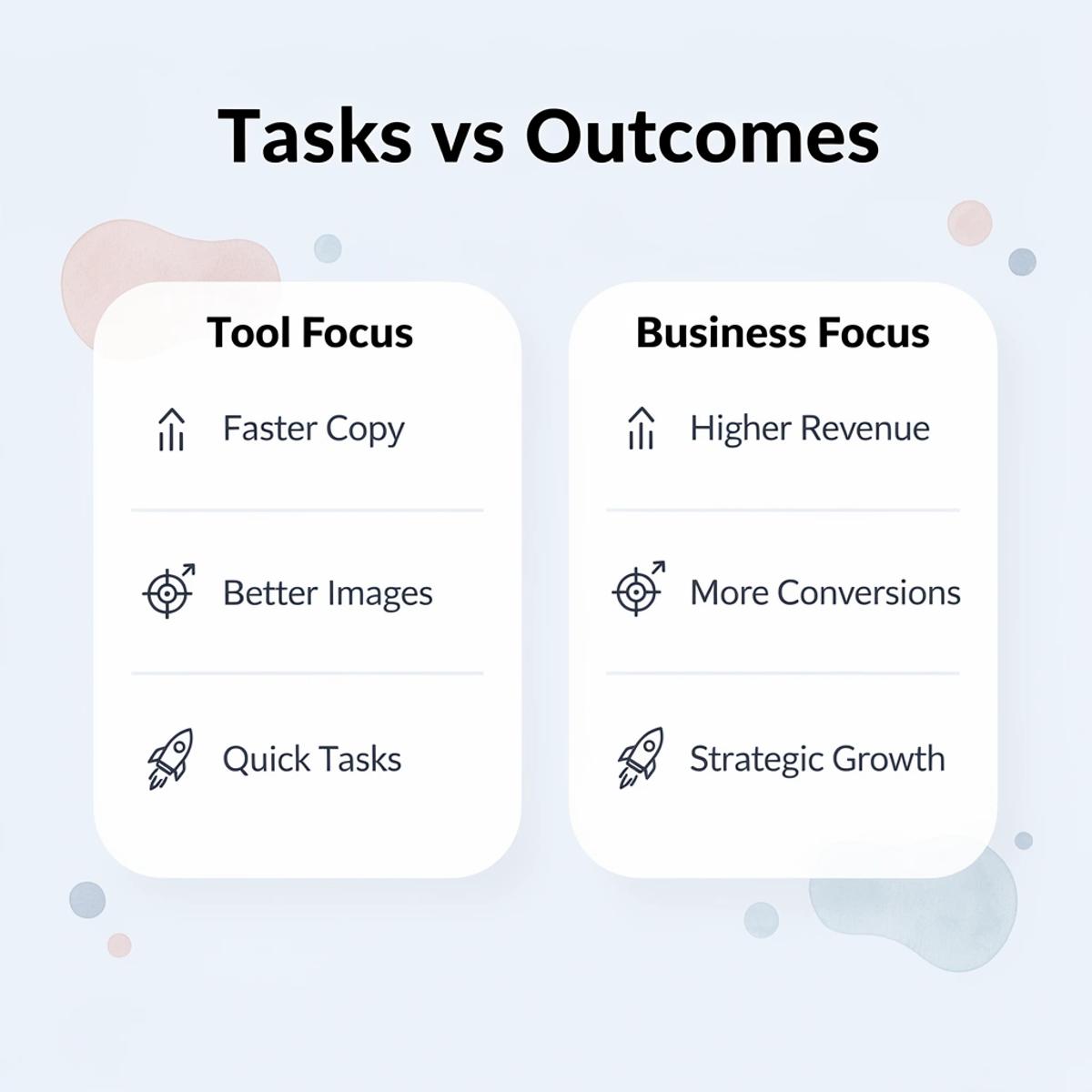
"Task optimization without strategic alignment creates the illusion of progress while revenue remains flat."
⚠️ Warning: This disconnect between tool efficiency and business results is why many founders feel busy but see no meaningful growth in their stores.

Why are AI tools sold as isolated features instead of complete solutions?
Most AI tools are sold as features: write copy faster, generate images instantly, and analyze data quickly. Founders adopt these tools individually, expecting cumulative gains, but end up with fragmented workflows.
According to McKinsey & Company, while 72% of organizations report using AI in at least one business function, few see real revenue impact. The gap stems from using AI to improve isolated steps rather than the system that drives results.
How does fragmented tooling impact ecommerce execution speed?
This shows up in testing: one tool writes descriptions, another handles images, and a third manages layouts. Instead of fixing the core problem—execution speed—teams add more tools around it.
Revenue in ecommerce depends on how quickly you can launch product pages, test different angles, and identify what converts.
Where the Real Shift Happens
Platforms like PagePilot's AI page builder speed up the entire workflow by automatically creating sales-optimized layouts from product links in under two minutes. This eliminates manual assembly, which slows down testing cycles. Launching five product variations in the time it once took to build one lets you learn what converts faster than competitors still assembling outputs from disconnected tools.
Why do founders still measure adoption incorrectly?
The reason this belief persists is the way adoption is measured. Founders count tools added, not speed gained. They measure task completion times rather than the number of product tests run per week. If the loop from idea to live page to conversion data remains slow, adding more tools won't change the outcome.
What deeper pattern explains why speed alone isn't enough?
But a deeper pattern explains why speed alone is insufficient.
Related Reading
- Shopify Web Design
- Shopify Conversion Rate Optimization
- Ai Tools for E-commerce
- Shopify Alternatives
- Ecwid Alternatives
- Shopify App Detector
- Shopify Website Optimization
What Actually Drives Revenue With AI in Ecommerce
Revenue comes from testing faster, converting better, and personalizing smarter. AI matters when it shortens the loop from product idea to live page to conversion data.

🎯 Key Point: The real value of AI in ecommerce isn't in fancy features—it's in accelerating your optimization cycle and getting from hypothesis to actionable insights faster than your competition.
"AI matters when it makes the loop shorter from product idea to live page to conversion data." — The core principle of revenue-driving AI implementation
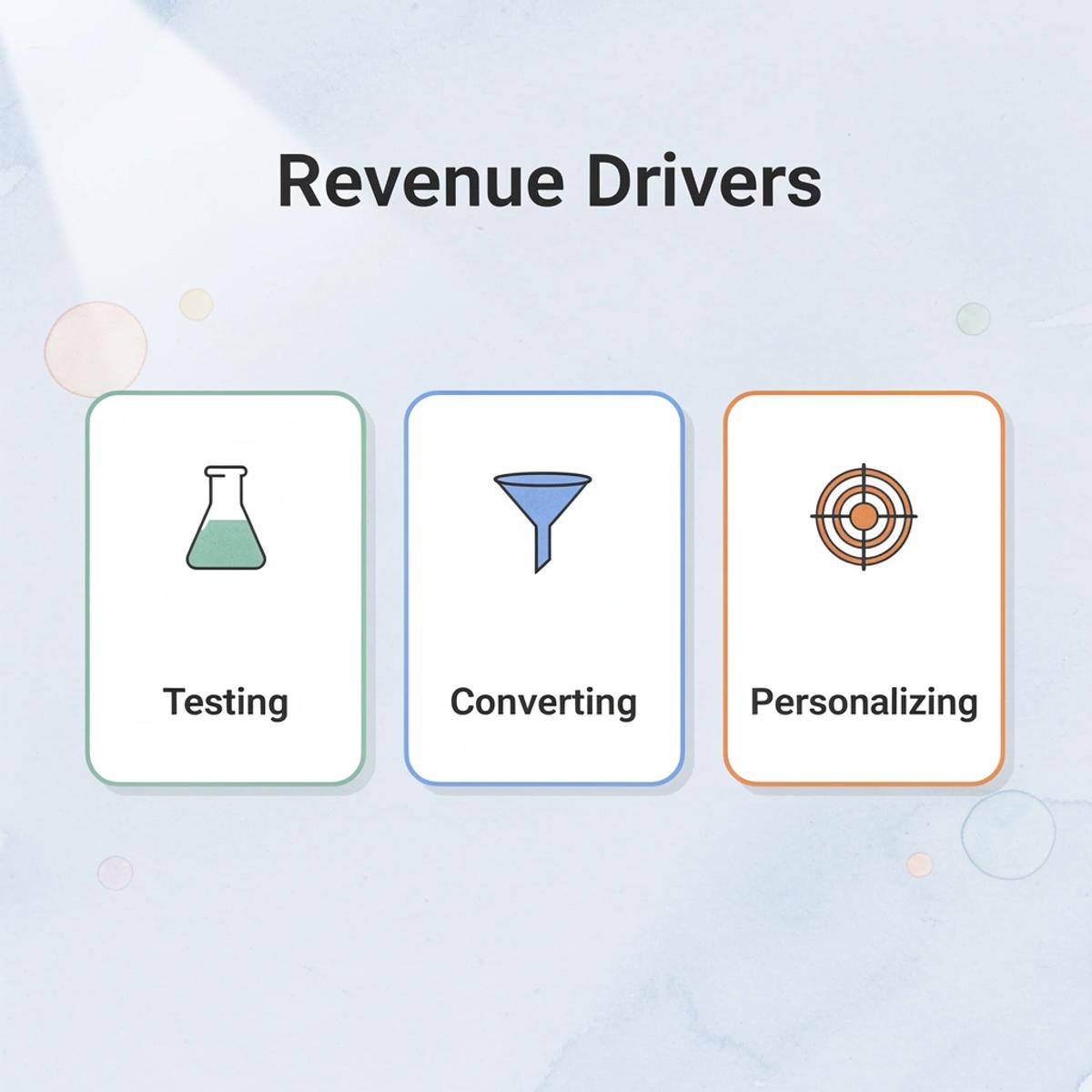
⚠️ Warning: Many ecommerce businesses get distracted by AI's potential capabilities instead of focusing on the three core revenue drivers: faster testing, better conversion optimization, and smarter personalization that actually moves the needle.
Faster Product Page Creation Changes the Game
Speed determines how much you can learn. If launching a product page takes minutes instead of hours, you test more variations in a week than competitors test in a month. Capital One Shopping found that AI-powered product recommendations can increase conversion rates by 915%, but only when merchants deploy them quickly enough to discover what works. With a baseline conversion rate of 3.3% across ecommerce, improvement comes from testing frequently, not from perfecting the first attempt.
What slows down most merchants today?
Most merchants spend time assembling pages instead of testing different approaches. They write copy in one tool, generate images in another, then manually build layouts in Shopify. By the time one page launches, the opportunity to test three competing hooks has passed. Our PagePilot AI page builder eliminates assembly time by generating complete sales-optimized layouts from product links in under two minutes, letting you test multiple positioning strategies before competitors finish their first draft.
Testing Multiple Angles Compounds Small Wins
Money comes from finding which hook works best, which offer structure is most effective, and which visual layout draws attention to the buy button. Small improvements compound at scale: a 2% increase in conversion across 10,000 monthly visitors significantly changes results.
The real limit is not having ideas but executing them quickly. You already know you should test different headlines, benefit orders, and social proof placements. When testing cycles shrink from days to hours, you learn what your audience responds to, while competitors are still arguing over font choices.
How does personalization drive measurable revenue growth?
Generic content fails because it tries to speak to everyone and ends up speaking to no one. AI becomes powerful when it personalizes experiences for different customer groups. Sellerscommerce reports that AI-driven product recommendations can boost revenue by 10-30%, but the impact stems from relevance, not automation alone. Showing the right product to the right visitor at the right moment changes buying behavior.
What makes AI personalization systems effective?
Most AI tools improve individual tasks without connecting them into a system that personalizes the whole buying experience. You need copy that addresses specific pain points, images that match what customers seek, and layouts that guide different visitor types toward conversion. When AI orchestrates this automatically, you stop building pages and start building revenue.
Related Reading
- Bigcommerce Alternatives
- Best Subscription Apps For Shopify
- Shopify Store Cost
- Ai Use Cases in E-commerce
- How To Edit Pages In Shopify
- Shopify Web Design Experts
- Shopify Website Optimization
15 AI Use Cases in Ecommerce (That Actually Matter)
AI matters in ecommerce when it removes bottlenecks between product idea and the conversion page. The use cases that matter are compressing execution time or increasing conversion rate. Everything else is productivity theater.

🎯 Key Point: Focus on AI applications that directly impact your bottom line - either by getting products to market faster or by making more visitors buy.
"The most successful ecommerce AI implementations focus on conversion optimization and speed to market rather than flashy features." — Ecommerce AI Report, 2024

⚠️ Warning: Don't get distracted by AI tools that feel productive but don't move the needle on revenue or time-to-launch. Measure real business impact, not just perceived efficiency gains.
1. Product Page Generation
Building product pages by hand creates a testing problem. You write copy, find images, arrange layouts, optimize for SEO, and then publish. By the time one page goes live, you could have tested three different positioning angles with a faster process.
What advantages does automated page generation provide?
AI-powered page generation takes a product link and outputs a complete sales page with optimized copy, structured layouts, benefit hierarchies, and conversion-focused elements in minutes instead of hours. This shifts the constraint from production capacity to decision speed: you stop asking "how do I build this page?" and start asking "which three angles should I test this week?"
While others debate headline choices for a single page, you launch five variations, gather conversion data, and double down on what works. Speed becomes your moat.
2. Product Image Enhancement
Strong visuals drive buying decisions, but professional photography costs hundreds per product. AI image tools remove backgrounds, adjust lighting, generate lifestyle contexts, and create multiple visual variations without requiring a camera crew.
Smaller stores now compete visually with well-funded brands. The barrier is no longer budget; it's taste and iteration speed. Test different visual presentations alongside copy to learn which imagery converts your audience, rather than guessing based on competitors.
3. SEO Content Generation
Organic traffic compounds in value over time, but ranking for important keywords typically requires a content team or months of solo work. AI enables you to create buying guides, comparison articles, and category-focused blog posts at scale when guided by solid keyword research.
The key is to give direction, not hand off the work. AI speeds up production, but you still need to know which topics drive traffic and sales, which search intent matches your products, and how to organize content that earns backlinks. The tool removes the typing bottleneck, not the requirement for strategic thinking.
4. Landing Page Variations
Testing one landing page against another traditionally meant duplicating work: writing two versions of copy, designing two layouts, and setting up split-testing infrastructure. Most merchants skip this because the effort requires more time and resources than the expected results justify.
How does AI accelerate landing page testing?
AI enables rapid creation of multiple landing page versions with different value propositions, benefit orders, visual hierarchies, and call-to-action placements. You can test messaging angles in days instead of months. According to Accenture, 91% of consumers are more likely to shop with brands that provide relevant offers and recommendations. Relevance emerges through testing what resonates with your audience.
Merchants testing five landing page variations per product learn what converts while competitors perfect their first draft. That data advantage compounds with every product launch.
5. Ad Creative Variations
How well paid ads work depends on testing multiple creative versions. One ad angle rarely works for all audience groups, but manually creating dozens of headline choices, body copy options, and visual ideas creates a bottleneck between planning and running ads.
AI can generate multiple creative directions from a product brief in minutes. You can test more angles with each dollar spent, find winning combinations faster, and grow before ads lose effectiveness. The limit shifts from creative production capacity to budget allocation strategy.
6. Email Marketing Personalization
Sending the same email to your entire list treats a first-time visitor the same as a repeat customer and someone who abandoned their cart the same as a three-time buyer. Conversion suffers because the message ignores context.
AI analyzes browsing patterns, purchase history, and engagement signals to customize email content at the individual level. Someone who viewed winter coats three times receives different product recommendations than someone who bought running shoes last week.
Why do personalized emails convert better?
The email feels relevant because it reflects actual behavior. Personalized emails convert better because they match each person's position in their buying journey, improving revenue per email sent.
7. Content Repurposing
Creating a product video, blog post, or customer testimonial requires significant effort. Most merchants use that asset once, then move on. AI transforms one piece of content into multiple formats with minimal additional effort.
A product demonstration video becomes social media captions, email copy, ad scripts, and short-form clips. A detailed blog post generates Instagram carousels, Twitter threads, and email newsletter sections. You extract more value from each content investment by sharing the core message across channels where your audience spends time.
8. Customer Support Automation
Support costs grow at the same rate as order volume unless you automate routine questions: order tracking, return policies, size guides, and shipping timeframes. These questions are repeated hundreds of times each month and consume agent time needed for complex issues that require judgment.
What percentage of queries can chatbots handle effectively?
IBM reports that AI-powered chatbots handle up to 80% of routine customer queries while maintaining response times and lowering support costs. Chatbots answer "where is my order?" at 2 AM; human agents handle "this product arrived damaged and I need a replacement before my event on Saturday." Routine questions no longer bottleneck complex ones, improving response speed across all inquiry types.
9. Upsell and Cross-Sell Optimization
Generic product recommendations feel like noise. AI analyzes purchase patterns, browsing behavior, and cart contents to recommend products that complement what customers are already buying.
The difference between a 3% and an 8% upsell acceptance rate comes down to relevance. Someone buying a camera gets recommended lenses and memory cards, not unrelated electronics. The suggestion feels helpful rather than intrusive because it demonstrates actual product relationships and individual context.
Average order value increases without adding friction. The recommendation appears at the right moment with products that solve related needs.
10. Review Summarization
Reading through hundreds of customer reviews to find patterns takes hours. AI can process review text to extract recurring themes, common objections, and frequently mentioned benefits, revealing what customers care about without manually analyzing thousands of individual responses. This insight informs product descriptions, FAQ sections, and positioning decisions that address real concerns rather than assumed ones.
11. Competitor Analysis
Manual competitor research requires visiting dozens of product pages, taking screenshots of pricing, analyzing ad copy, and noting positioning differences: a time-consuming process that limits how often you can update this information.
AI tools scan competitor catalogs, pricing changes, ad creatives, and customer reviews to identify opportunities and threats. You can pinpoint pricing gaps, underserved categories, and messaging angles competitors aren't using, enabling strategic decisions based on current data rather than outdated assumptions.
12. Product Research
Finding trending products and markets with limited options required hours of manual searching across marketplaces, social platforms, and search trend tools. By the time you verified demand, early movers had already captured market share.
AI accelerates discovery by analyzing search volume trends, social engagement patterns, marketplace sales velocity, and competitor catalog additions simultaneously. You identify opportunities while demand is growing, rather than after the market saturates.
Launching products nobody wants becomes less likely when you base selection choices on multiple demand signals rather than gut feeling.
13. Pricing and Offer Testing
Most merchants pick a price and rarely test alternatives. AI examines competitor pricing, past sales data, and customer behavior to suggest strategies that increase revenue without sacrificing sales volume.
Dynamic pricing adjusts in real time based on demand, inventory levels, and competitor positioning. Fast-selling products receive incremental price increases to improve margins, while slow-moving items get strategic discounts before they become obsolete.
Merchants who test different prices learn how sensitive customers are to price changes. Those who set prices once and never adjust them miss out on revenue or lose sales to competitors with better prices.
14. Inventory and Demand Forecasting
Having too much inventory ties up money in warehouses; having too little leads to lost sales when demand spikes. Traditional forecasting using historical averages misses seasonal shifts, trend changes, and external market signals.
AI models use past sales patterns, seasonal trends, social signals, and external demand indicators to more accurately predict inventory needs, reducing stockout risk and excess inventory costs.
Cash flow improves when inventory investment aligns with actual demand rather than with conservative estimates that either leave money on the shelf or miss sales opportunities.
15. Conversion Rate Optimization
AI analyzes user behavior patterns, session recordings, heatmaps, and funnel drop-off points to identify friction areas in the buying experience, replacing guesswork-driven optimization with data-backed decisions.
You discover that mobile users abandon at the shipping calculator, specific product page elements confuse visitors, or checkout form length correlates with cart abandonment.
What impact do small conversion improvements create?
Small improvements compound with large audiences. A two-point increase in conversion rate for 10,000 monthly visitors changes monthly revenue by hundreds or thousands of pounds without increasing traffic acquisition costs.
The tools that drive results let you test faster, convert better, and personalize smarter than competitors still building pages manually. Adoption speed alone does not guarantee results.
Why Most AI Use Cases Still Fail to Drive Revenue
The gap between AI adoption and revenue growth comes down to execution architecture. Tools get added without changing the underlying system that determines how fast you can test and learn. You end up with better individual components inside the same slow process.

🎯 Key Point: Adding AI tools to broken processes doesn't create revenue impact—it just makes you fail faster with better technology.
"85% of AI projects fail to move from pilot to production because organizations focus on technology adoption rather than execution architecture." — McKinsey Global Institute, 2024
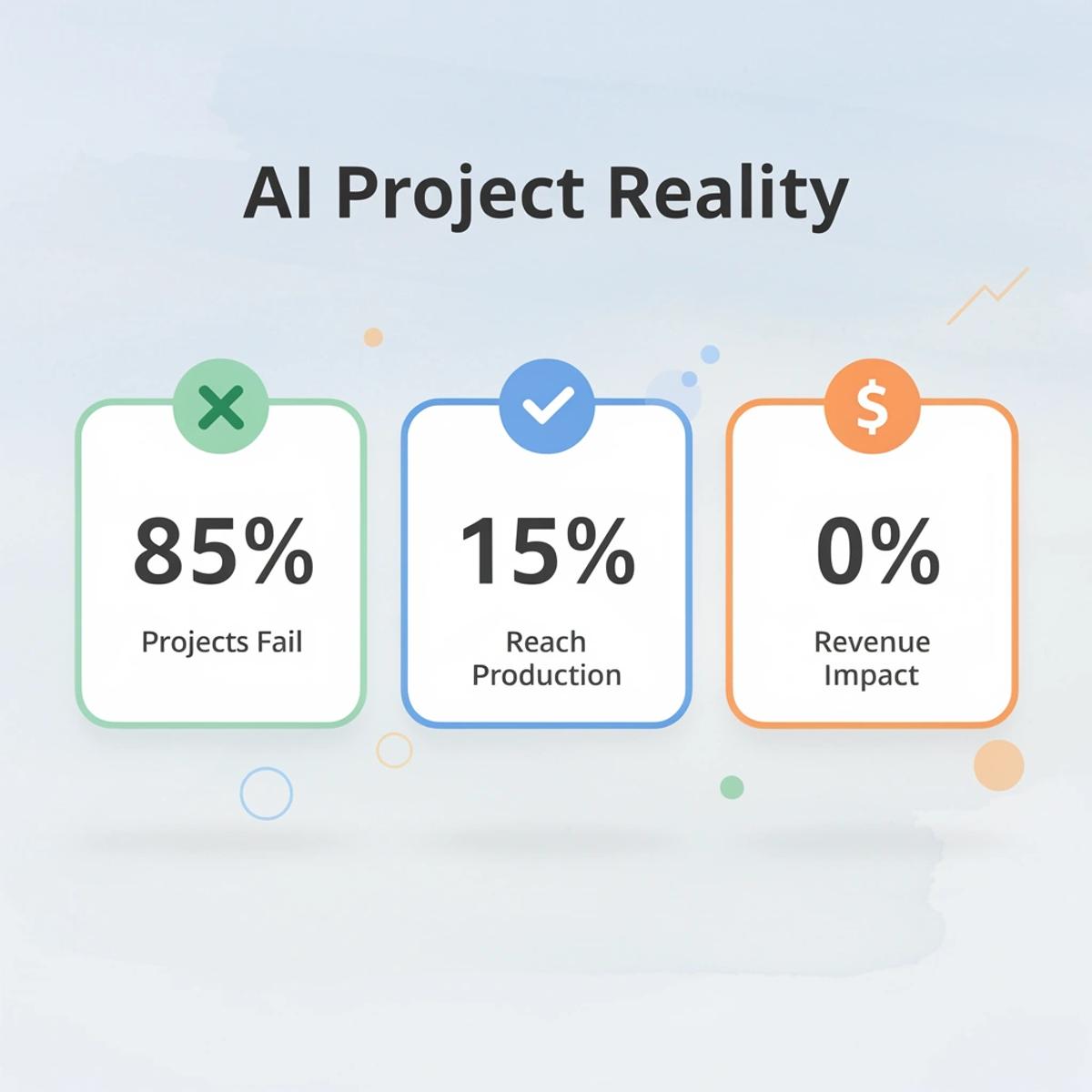
⚠️ Warning: Most companies treat AI like a feature upgrade instead of a fundamental shift in how they test, learn, and iterate toward revenue outcomes.
The Integration Problem
Most stores run AI tools independently: one platform writes product descriptions, another creates images, and a third handles email subject lines. Each output remains siloed, requiring manual assembly before anything goes live. You spend less time writing copy but the same amount of time assembling pieces into a finished product page.
MIT's 2025 AI Report found that 70% of AI initiatives fail to move beyond the pilot stage, largely because implementation creates new coordination overhead instead of removing it. The tool works; the workflow around it does not.
Generic Output Becomes the New Baseline
When everyone uses similar AI models trained on similar data, product pages start to look identical: the same benefit organization, the same review placement, the same call-to-action language. Your page looks professional, but so does every competitor's. Conversion rates stagnate because nothing distinguishes your offer in the three seconds a visitor decides whether to continue reading.
The real test is whether the output makes someone choose your product over the alternative they were considering. Generic excellence does not win that battle. Specific relevance does, and that requires testing multiple angles to discover which positioning resonates with your actual audience.
The Missing Testing Infrastructure
Most merchants use AI to create one improved version of a page, then move to the next product. But revenue growth comes from running enough tests to identify patterns in what converts your specific traffic. One variation teaches you nothing about whether a different hook, offer structure, or visual hierarchy would perform better.
Platforms like PagePilot's AI page builder compress the workflow from product link to multiple live page variations in minutes, transforming testing from a quarterly project into a weekly habit. The AI page builder enables iteration rather than one-time optimization, helping you embed testing into your regular workflow.
Speed Without Strategy Creates Motion, Not Progress
Making content faster only matters if you know what content to make. AI accelerates work, but it cannot replace strategic thinking about which products to test, which customer groups to focus on, or which benefits to highlight.
Speed without a clear direction just makes more of what was not working before, only faster.
How do successful merchants structure their AI workflows?
The merchants who saw revenue impact from AI rebuilt their workflow around rapid testing cycles, using AI to remove the production bottleneck that previously limited how many ideas they could test per week.
The technology enables the system, which drives the results.
What does AI success actually look like in practice?
But knowing where AI fails is useful only if you understand what success looks like in practice.
How PagePilot Turns AI Use Cases Into Revenue
Most AI tools improve individual tasks—writing, design, and analysis. But revenue is driven by how quickly you can launch, test, and improve product pages, not by isolated speed gains.

🎯 Key Point: The difference between AI tools and revenue generation lies in workflow integration, not individual task optimization.
"Revenue is driven by how quickly you can launch, test, and improve product pages, not by isolated speed gains."
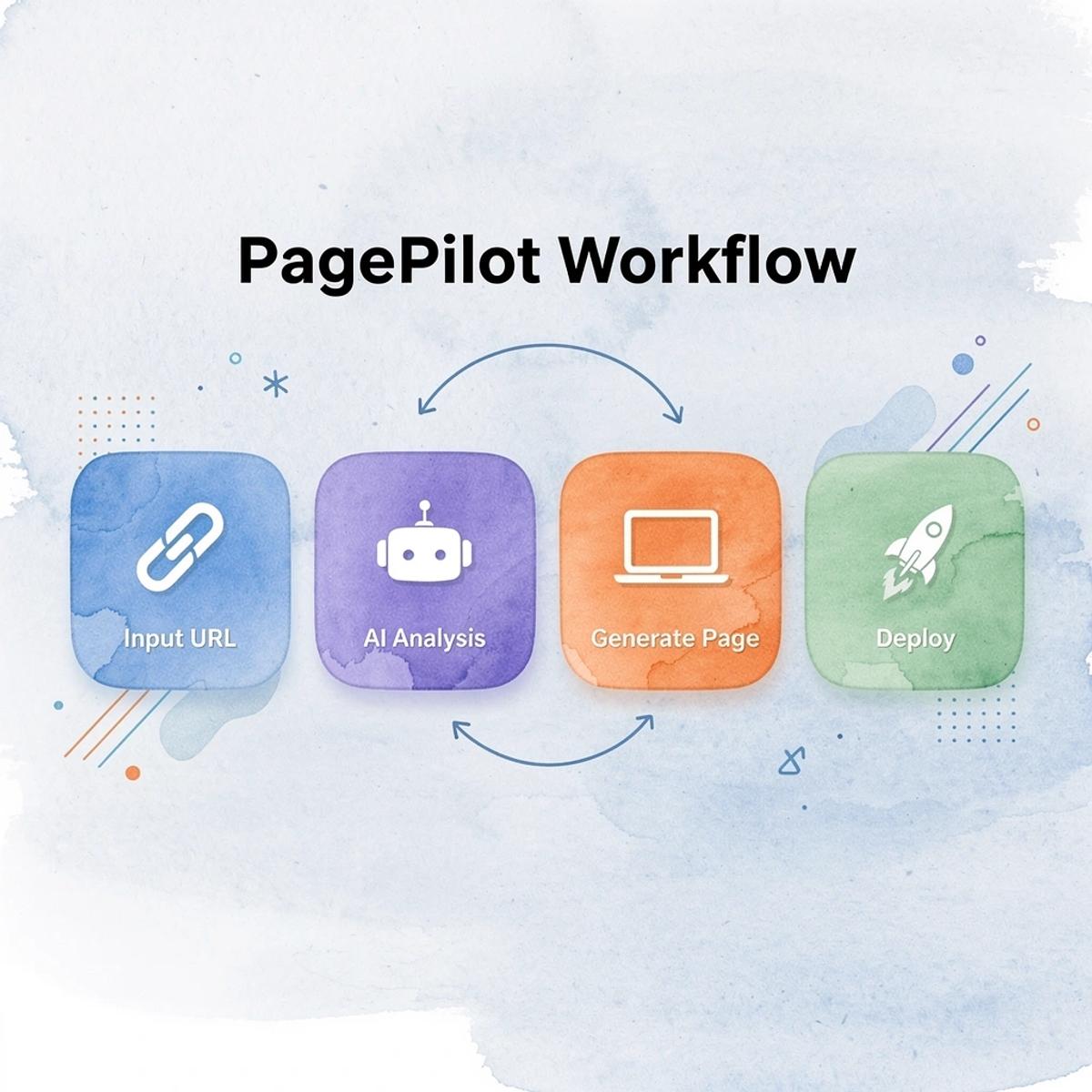
PagePilot integrates everything into a single workflow rather than using AI in isolated steps. Start with a competitor or supplier URL, and our AI page builder generates a complete product page with structured copy, positioning, and upgraded visuals—ready to launch.
💡 Tip: Look for AI solutions that create complete deliverables you can immediately deploy, rather than tools that just speed up individual tasks.
The Differentiation Problem
This changes how AI impacts your store. You move directly from idea to execution without switching between tools, reducing time to market and enabling more variations to test.
It also solves the differentiation problem. Rather than reusing supplier content or producing generic outputs, PagePilot restructures messaging and visuals so your page doesn't look identical to competitors, which matters because conversion depends on how clearly your product stands out.
How does speed give you a testing advantage?
Instead of building one product page over several hours, you can generate multiple variations in minutes. Each variation tests a different angle, audience, or offer. You launch them, compare performance, and scale what works.
A founder using separate AI tools might spend a full day creating one product page. Another founder uses PagePilot's AI page builder to generate three variations in the same time, test them, and identify a winning angle. The second founder moves faster, learns faster, and scales faster.
What makes AI valuable for ecommerce results?
AI becomes valuable when it shortens the path between idea and results. PagePilot turns AI use cases into revenue by focusing on what matters most: your product pages and how quickly you can test them.
But speed alone does not guarantee adoption of what you build.
Start a FREE Trial and Generate 3 Product Pages with Our AI Page Builder today
Start a free trial with PagePilot and generate your first three product pages from a competitor or supplier URL. You'll have ready-to-test pages live immediately, moving from tools to results without delay.
🎯 Key Point: The difference between knowing what drives revenue and actually capturing it is how fast you can execute.
The difference between knowing what drives revenue and capturing it is how fast you can execute. You already understand that testing multiple angles matters, that personalization improves conversion, and that generic pages lose to specific ones. PagePilot removes the assembly work that keeps merchants stuck in production mode when they should be testing.
"The merchants who win in ecommerce test enough variations to discover what actually converts their specific audience, then scale those winners before competitors finish debating layout choices."
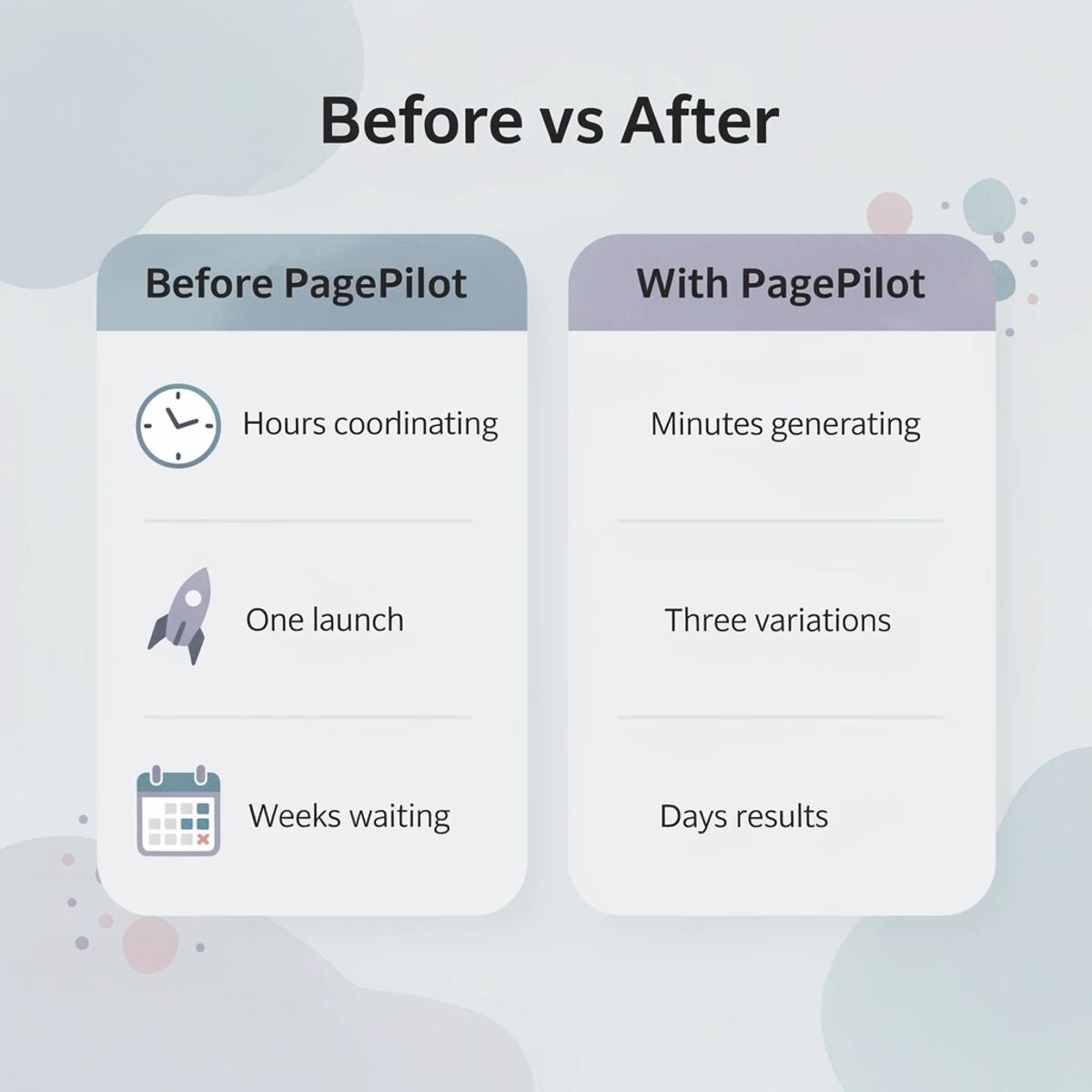
You'll see the shift in your first week. Instead of spending hours coordinating outputs from disconnected tools, you generate complete pages in minutes. Instead of launching one product and hoping it converts, you test three variations and learn which positioning resonates with your traffic. The feedback loop tightens from weeks to days, informed by real conversion data instead of assumptions.
Before PagePilot
- Hours coordinating tools
- One product launch
- Weeks for feedback
With PagePilot
- Minutes to generate pages
- Three variations to test
- Days for results
💡 Tip: The merchants who win in ecommerce test enough variations to discover what actually converts their specific audience, then scale those winners before competitors finish debating layout choices.
⚠️ Warning: Don't let production delays keep you from discovering what really converts your traffic.

Related Reading
- Builder.ai Competitors
- How To Add Products To Shopify Page
- Best Shopify Plugins
- Best Shopify Landing Pages
- On Page Seo Shopify
- Shopify Ai Apps
- How To Add A Custom Pop-Up In Shopify