

For Shopify merchants, understanding visitor behavior is not optional. Tools like Lucky Orange offer session recordings, heatmaps, and conversion tracking, but they are not the right fit for every store. Pricing, feature gaps, or integration limitations push many brands to explore alternatives that better match their needs.
Choosing the right analytics tool is only part of the equation. The insights gathered still need pages capable of converting that traffic, which is where a well-built AI page builder like PagePilot turns behavioral data into high-performing Shopify landing pages without the drag of manual design.
Table of Contents
- Why Businesses Look for Lucky Orange Alternatives
- What to Look for in a Lucky Orange Alternative
- 10 Best Lucky Orange Alternatives
- The Biggest Limitation of Analytics Tools Alone
- Why Product Pages Have a Bigger Impact on Conversion Rates Than Most Analytics Tools
- How PagePilot Helps Ecommerce Brands Launch Higher-Converting Product Pages Faster
- Start a FREE Trial and Generate 3 Product Pages with Our AI Page Builder today
Summary
- Visitor behavior analytics tools are genuinely useful for surfacing friction, but they are diagnostic instruments rather than building tools. A heatmap can confirm that visitors scroll past an add-to-cart button, and a session recording can show where attention drops off, but neither one rewrites the copy, restructures the page, or fixes the underlying architecture that caused the problem. The data reveals what happened; it does not close the gap between insight and execution.
- Lucky Orange's free plan caps out at 5,000 sessions per month, which means fast-growing Shopify stores hit a pricing decision before they have had a chance to fully evaluate whether the platform fits their longer-term needs. That ceiling is not just a budget issue. It forces an upgrade conversation at the exact moment when a brand is scaling and most needs reliable behavioral data.
- The average documented cart abandonment rate is 70.19%, according to the Baymard Institute (2023), yet most stores that identify this problem through funnel analytics still lack the internal capacity to act on it within a reasonable timeframe. The bottleneck is rarely the data. It is the lag between spotting friction and rebuilding the page that caused it, a gap that can stretch from days to weeks on lean teams.
- Landing pages with product videos can increase conversions by up to 80%, according to Involve.me's landing page research, which points to something important about page structure. A single well-chosen element, placed deliberately within a page designed to guide decisions, can outperform months of incremental optimization on a poorly structured page. Piecemeal edits rarely address the root issue when the page was never built around a conversion architecture in the first place.
- The right visitor behavior tool depends entirely on the most expensive gap in a store's current setup. Hotjar fills the qualitative feedback gap through surveys and user interviews. Mouseflow connects session replays directly to funnel drop-off steps. Microsoft Clarity removes the pricing barrier entirely with no session cap. VWO closes the loop between behavioral observation and validated A/B testing. Each platform solves a different problem, and choosing based on feature lists rather than specific friction points leads to tools that collect data without changing outcomes.
- Conversion rate problems in ecommerce are almost always page problems wearing the costume of traffic problems. Merchants invest in ad spend, email campaigns, and influencer partnerships, then send that traffic to product pages that were never designed to close. The analytics tools dutifully report the drop-off, but the compounding cost accumulates across every campaign and every returning visitor who encountered the same friction and left the same way.
- PagePilot's AI page builder addresses this at the source by generating brand-matched, conversion-optimized Shopify product pages in minutes, so the behavioral data collected from tools like Clarity, Hotjar, or Mouseflow measures a page that was already built to perform rather than one patched after the fact.
Why Businesses Look for Lucky Orange Alternatives
Lucky Orange's free plan caps at 5,000 sessions per month, forcing fast-growing Shopify brands into a pricing decision before fully evaluating long-term fit. According to the Heatmap.com Blog's 2025 review of Lucky Orange alternatives, this limitation becomes particularly acute around 20,000 monthly sessions, a threshold many scaling eCommerce stores reach faster than expected.
"Lucky Orange's free plan caps at 5,000 sessions per month, a limit that becomes critically restrictive around 20,000 monthly sessions for fast-growing brands." — Heatmap.com Blog, 2025
🚨 Warning: If your Shopify store is already approaching 5,000 monthly sessions, you face a forced pricing decision rather than a strategic one. Factor in long-term scalability before committing.
🔑 Takeaway: A session cap as low as 5,000/month locks high-growth brands out of proper tool evaluation, making the search for a Lucky Orange alternative a necessity rather than a preference.

How do business questions outgrow what Lucky Orange can answer?
Businesses don't leave Lucky Orange because heatmaps stopped working; they leave because their questions changed. Early-stage teams ask, "Where are people clicking?" Mature teams ask, "Why does this product page convert at 1.4% when competitors probably hit 3%?" That shift requires deeper funnel analysis, better segmentation, and reporting that connects behavior to revenue.
Ecommerce brands feel this gap strongly. A general analytics tool shows visitors are dropping off, but not why: product description, image sequence, trust signals, or price anchor? Shopify merchants need behavior data mapped to product pages, cart abandonment triggers, and checkout friction, not overall scroll depth.
Why does adding more tools make the reporting problem worse?
Adding more tools—session recorder, funnel builder, live chat—creates reporting chaos, with no single view connecting visitor behavior to conversion. Teams using our AI page builder sidestep this by building pages structured to convert from the start, making behavior data diagnostic rather than remedial.
Workflow efficiency is the underrated factor in platform switches. Collecting behavioral data is easy; closing the loop between insight and action quickly is hard. When a team spots friction in a session recording, redesigning, rebuilding, and testing often take days to weeks, and the conversion opportunity disappears during that lag.
What to Look for in a Lucky Orange Alternative
Choosing the right visitor behavior platform requires knowing what you need. The gap between a platform that looks comprehensive on a features page and one that moves your conversion rate is wider than most people expect.

Session Recordings and Heatmaps
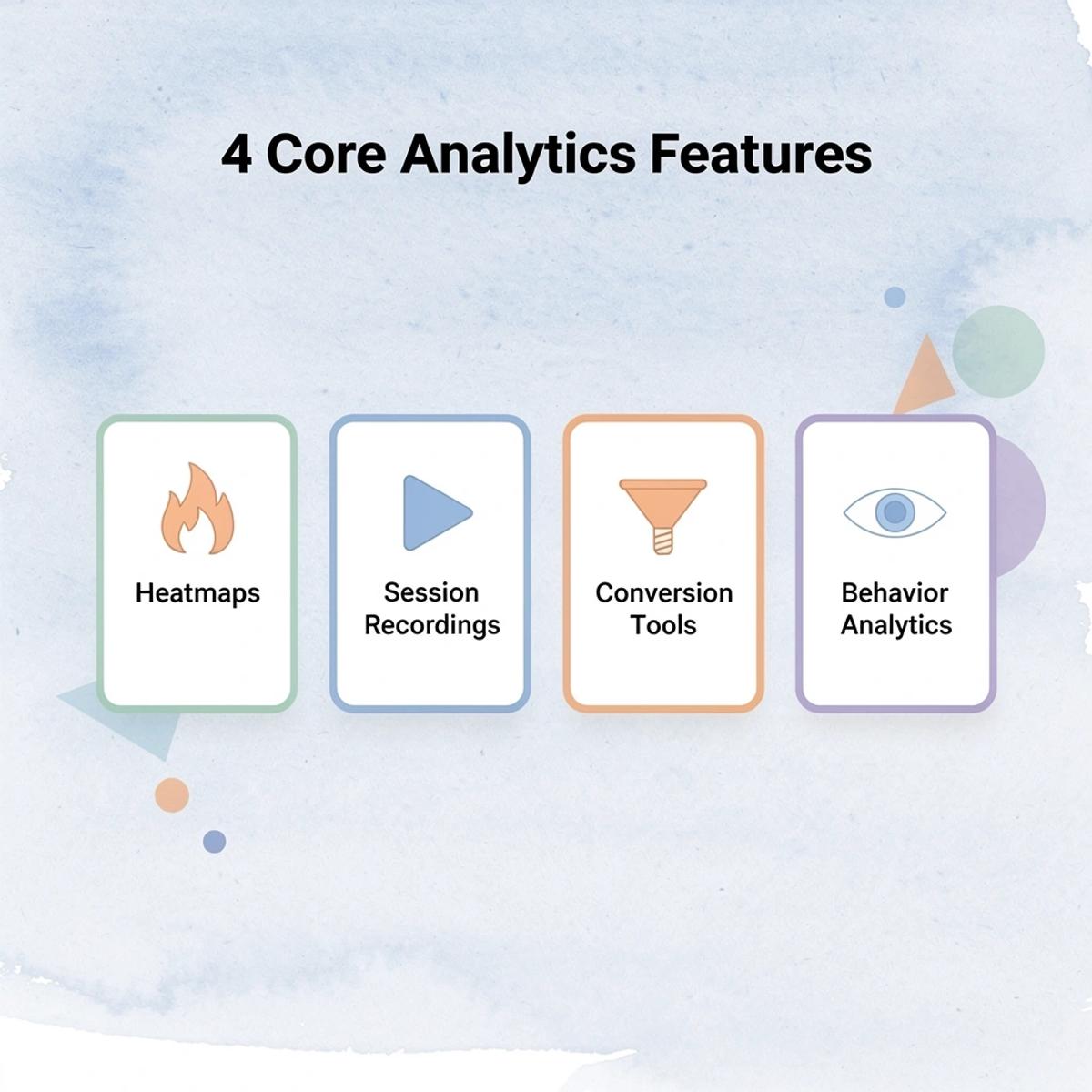
Session recordings let you filter by device type, traffic source, conversion status, or exit behavior, so you watch sessions that show real friction rather than random ones. Heatmaps extend visibility across your entire page: click maps show whether calls-to-action get attention, scroll maps reveal where interest drops off, and movement maps expose hesitation patterns that click data alone would miss. Together, they provide behavioral insight no dashboard metric can replicate.
What does funnel analysis reveal about the buying journey?
Funnel analysis shows where visitors abandon the buying journey: a product page that lacks confidence-building elements, an ignored add-to-cart button, or a checkout step that's too difficult. Paired with behavioral tracking across your site, this reveals the complete customer path before purchase or exit, enabling faster problem resolution.
Why does reacting to failure put optimization in reverse?
Most teams review session recordings after a traffic drop and then rebuild pages based on their observations. This cycle runs backward: you wait for failure, then spend days redesigning an underperforming page. PagePilot's AI page builder changes this by generating brand-matched, conversion-ready Shopify pages before traffic arrives, so you optimize from a stronger starting point rather than fix weaknesses after the fact.
How do A/B testing and integrations close the loop between insight and action?
Behavior analytics shows you what is broken. A/B testing shows you whether your fix works. A platform that bundles both capabilities or integrates cleanly with a dedicated testing tool creates a closed loop between observation and validation. For Shopify merchants, ecommerce integrations matter equally: a platform that connects cart activity, checkout behavior, and purchase data to your behavioral insights transforms observations into revenue-linked decisions rather than UX opinions.
How does scalability affect which platform will best fit your store in the long term?
According to the Heatmap.com Blog, at least 7 trusted Lucky Orange alternatives offer different strengths across heatmaps, session recording depth, funnel visualization, and ecommerce-specific reporting. Pricing and scalability vary: some platforms are affordable at low traffic volumes but become expensive as session volume grows, while others charge by features rather than usage. The right fit depends on whether the platform can scale with your store without requiring migration or a second tool.
The platforms that earn a permanent place in a merchant's stack are those that shorten the path from insight to action.
Related Reading
- Shopify Marketing Automation
- Shopify Email Marketing Vs Klaviyo
- Shopify Social Media Marketing
- How To Advertise a Shopify Store
- Shopify Social Media Marketing
- Seo Marketing Shopify
10 Best Lucky Orange Alternatives
The ten tools below each help close the gap between insight and action in different ways, depending on what your store needs — from heatmaps and session recordings to conversion optimization and user behavior analytics.
"The right analytics tool doesn't just show you what happened — it shows you why it happened and what to do next."
💡 Tip: Not every tool fits every store. Identify your biggest gap first — whether that's traffic analysis, checkout drop-off, or user experience — then match the tool to that specific need.
🎯 Key Point: Each of the ten tools below targets a different pain point, so the best Lucky Orange alternative for your store depends entirely on your goals, budget, and traffic volume.
1. Hotjar
Hotjar combines behavioral data with direct user feedback in a single workflow. Beyond heatmaps and session recordings, its surveys, feedback widgets, and user interview tools let you ask visitors what confused them rather than inferring it from click patterns alone. According to the Heatmap.com Blog, Hotjar's free plan is limited to 35 daily sessions, meaning that growing stores will hit that ceiling sooner than expected and will need to budget for a paid tier before the data becomes statistically reliable.
The platform suits UX researchers and product teams who treat qualitative feedback as seriously as quantitative behavior data.
2. Microsoft Clarity
Microsoft Clarity completely removes the pricing barrier. Heatmaps, session recordings, click tracking, and behavioral insights are all available at no cost, with no session cap. For a Shopify merchant testing a new product page or validating a store redesign, Clarity provides a low-risk entry point with clean reporting.
The tradeoff is depth. Clarity shows what happened on a page, but not why conversion rates differ between traffic sources or how to fix funnel leaks.
3. Mouseflow
Mouseflow is built for teams that think in funnels. Its session replay tools connect directly to funnel analytics, letting you watch exactly where visitors abandon checkout and pull recordings for specific drop-off steps without manually hunting through hours of footage. Form analytics reveal which fields cause hesitation or repeated corrections.
Most analytics setups fail because heatmaps and recordings are kept separate from funnel data. Mouseflow closes that gap by keeping behavioral evidence attached to the conversion event it explains.
4. FullStory
FullStory captures every user interaction with sufficient detail to reproduce exact experiences. Its AI-powered behavioral analytics surface patterns across thousands of sessions without manual review, and customer journey mapping shows how visitors move across multiple visits and touchpoints before converting or leaving.
This depth comes with enterprise pricing and implementation complexity, making FullStory better suited for larger organizations with dedicated analytics teams than for solo ecommerce operators managing a Shopify store.
5. Crazy Egg
Crazy Egg goes beyond identifying problems. While most behavior analytics tools stop at problem detection, Crazy Egg's built-in A/B testing lets you build and measure fixes within the same platform. Scroll maps, heatmaps, and click reports feed directly into test ideas, shortening the time between observation and validated change.
For conversion rate optimization teams, this integrated workflow eliminates the need to export data into separate testing tools.
6. Contentsquare
Contentsquare is built for organizations managing high-traffic digital properties across multiple regions and product lines. Its digital experience analytics map how content performance, page zones, and customer journeys interact at scale. Major ecommerce brands use it to identify which content elements generate revenue and which consume attention without contributing to conversions.
The platform's reporting depth is impressive, but it is priced and structured for enterprise digital teams rather than solo merchants or early-stage stores.
7. Smartlook
Most analytics tools treat web and mobile as separate problems. Smartlook combines session recordings with product analytics across both platforms, enabling teams to track users from mobile browsing through desktop checkout without losing context.
For Shopify merchants with companion apps or product teams managing cross-platform experiences, Smartlook's unified view eliminates a critical reporting blind spot.
8. Inspectlet
Inspectlet's strength is segmentation. Its filtering tools let you isolate recordings by device type, traffic source, geographic location, or behavior trigger, so you can focus on the exact visitor group causing a conversion problem rather than watching random sessions. That specificity saves hours of review time and makes behavioral evidence far more actionable.
It occupies a practical middle ground between entry-level tools like Clarity and enterprise platforms like FullStory, making it suitable for growing stores that need more control without a steep learning curve.
9. Plerdy
Plerdy takes a broader view of optimization, bundling heatmaps, session recordings, SEO analysis, popup builders, event tracking, and conversion rate optimization tools into a single subscription. For ecommerce stores, this reduces context-switching and keeps optimization workflows unified.
The platform lets merchants act on behavioral data immediately, using built-in pop-up and CRO tools rather than exporting insights to separate systems.
10. VWO
VWO is the most complete experimentation platform on this list. A/B testing, multivariate testing, personalization, behavioral analytics, and session recordings all live within one system. This means a hypothesis born from a heatmap observation can become a live experiment within the same workflow. For businesses building a structured testing program rather than running one-off experiments, this continuity matters.
Is the page you're optimizing actually worth optimizing?
Most teams optimize by layering analytics tools on existing pages, watching recordings, adjusting copy, and iterating toward better performance. But this assumes the underlying page merits optimization. When a product page is built from a generic template with no brand alignment, no conversion architecture, and no understanding of its specific audience, behavioral data becomes a map of a broken road. Our PagePilot AI page builder takes a different approach, generating brand-matched, conversion-structured Shopify product pages in minutes so that your analytics tools measure a page already built to perform.
How do you choose the right platform for your store?
Choosing between these ten platforms comes down to one question: what is the biggest gap in your current setup? If you lack qualitative feedback, Hotjar fills it. If you need funnel-level visibility, Mouseflow or VWO makes more sense. If pricing is the constraint, Clarity offers a serious starting point at zero cost. The right visitor behavior analytics tool is the one that removes the specific friction slowing down your store, not the one with the longest feature list.
But knowing which tool to pick is only part of the decision; the part that trips up most merchants is the quieter one.
The Biggest Limitation of Analytics Tools Alone
Analytics tools diagnose. They do not build. This critical distinction explains why many stores collect months of behavioral data yet see flat conversion rates.
"Analytics tools tell you what is broken: they cannot fix it. The gap between diagnosis and execution is where conversions are lost." — Core CRO Principle
🎯 Key Point: Collecting data is not the same as taking action. A tool that only diagnoses leaves the hardest work entirely to you.

A session recording confirms visitors scroll past the add-to-cart button, a heatmap shows zero engagement on the hero image, and funnel data flags a 70% drop-off at the product page. The merchant knows what is broken — but knowing is not fixing. Copywriting, visuals, and page structure still need to change — none of which happens inside a heatmap tool, session replay software, or conversion funnel tracker.
⚠️ Warning: Merchants who stop at data collection without acting on structural page changes will see no improvement in conversions — no matter how many months of behavioral data they accumulate.
Session Recording
- What It Shows: Visitors scrolling past the add-to-cart button.
- What It Cannot Do: Rewrite the button copy or reposition the element for you.
Heatmap
- What It Shows: Zero engagement on the hero image.
- What It Cannot Do: Replace or redesign the visual asset to better capture attention.
Funnel Tracker
- What It Shows: A 70% drop-off at the product page.
- What It Cannot Do: Fix the underlying page structure or persuasive copywriting issues causing that drop-off.
🔑 Takeaway: Analytics tools are essential for identifying problems — but conversion growth only happens when those insights are translated into real changes to copy, design, and page architecture.
Where the real bottleneck lives
The frustration stems not from the data itself, but from the gap between understanding what it shows and acting on it. Many ecommerce operators spend considerable time refreshing analytics dashboards and debating what the data means, only to discover the harder problem: fixing a product page requires design skill, copywriting judgment, and often development time. For solo merchants or small teams running multiple products, that gap closes slowly. According to research from the Baymard Institute (2023), the average cart abandonment rate sits at 70.19%, yet most stores that identify this problem through funnel analytics lack the internal capacity to act on it within a reasonable timeframe.
Why does the optimization backlog keep growing?
Most teams handle this by queuing optimization tasks that grow faster than they shrink. Every new product launch expands the backlog of pages needing attention. The hidden cost is opportunity cost: each week a product page underperforms represents lost paid traffic, organic visitors, and ad spend absorbed by a page never built to convert. Our AI page builder addresses this by generating brand-quality, publish-ready Shopify product pages in minutes, allowing merchants to act on behavioral insights immediately rather than waiting for design or development resources.
What analytics cannot replace
The critical difference between stores that improve and those that stagnate is how quickly and effectively they act on data, not whether they have access to better data. Behavioral analytics tools—session recorders, scroll maps, conversion funnel software—identify problems effectively. But they are diagnostic instruments, not building tools. A doctor who identifies a problem still needs a surgeon to fix it. In ecommerce, the surgeon is the page itself, and a page built without conversion architecture from the start will keep generating the same insights no matter how many recordings you watch.
Most merchants don't consider this until after spending significant time in analysis mode.
Why Product Pages Have a Bigger Impact on Conversion Rates Than Most Analytics Tools
Product pages help customers decide whether to buy while they are actively looking at them — making them the single most critical conversion lever in your entire store. Analytics tools, by contrast, only tell you what already happened after customers visited, leaving you reacting to outcomes instead of shaping decisions in real time. This difference is far more important than most store owners realize — because optimizing the moment of decision is infinitely more powerful than analyzing the aftermath.
"Your product page is where the buying decision is made or lost — analytics only show you the score after the game is already over."
🎯 Key Point: Product pages operate in the present — they actively influence purchase decisions as they happen, while analytics tools only report on the past.
⚠️ Warning: Relying solely on analytics data to improve conversions means you're always one step behind — fixing problems after customers have already left.
When they act
- Product Pages: In real time, during the visit.
- Analytics Tools: After the visit is over.
Primary role
- Product Pages: Influence the buying decision.
- Analytics Tools: Report on past behavior.
Impact on conversion
- Product Pages: Direct and immediate.
- Analytics Tools: Indirect and retrospective.
Store owner control

- Product Pages: High — you can directly optimize content, layout, and copy.
- Analytics Tools: Low — you observe and analyze rather than manipulate.
What the data actually measures
The failure point is usually invisible until you look at it directly. Most analytics dashboards measure behavior, not causality: they tell you visitors left, but not why—whether the copy felt unconvincing, the images looked cheap, or the offer seemed vague. KISSmetrics reports that product pages with behavioral analytics data show measurable improvements in conversion when optimized for image performance, review impact, pricing display, and CTA placement. The tool surfaces the opportunity; the page captures it.
Watching session recordings of bounced visitors produces a list of things to fix, but that list only shrinks when someone rebuilds the page.
Why does conversion architecture matter more than individual tweaks?
Most teams fix individual parts—changing headlines, adjusting button colors—hoping these small changes will improve results. This misses the real problem: the page was never built with conversion architecture in mind. According to the involve.me blog's landing page research, landing pages with product videos increase conversions by up to 80%. A single well-chosen element, purposefully placed within a page designed to guide decisions, outperforms months of small improvements on a poorly structured page.
What does starting with a conversion-ready foundation actually look like?
Tools like PagePilot offer a different approach: the AI page builder generates brand-matched, conversion-ready product pages in minutes, with built-in structural logic from the start. The difference lies not in speed alone but in starting with a foundation designed to convert rather than fixing a flawed one.
The compounding cost of getting this wrong
Conversion rate problems are almost always page problems that look like traffic problems. Merchants spend money on ads, email sequences, and influencer partnerships, then send that traffic to product pages never designed to make sales. Analytics tools report where people leave. The pages keep underperforming.
Why does underperformance compound over time?
What makes this costly is the compounding effect. Every week a product page underperforms, the cost is not lost revenue from that week alone—it is a cumulative loss across every campaign, traffic source, and returning visitor who encountered the same friction. Better pages improve the return on everything else you are already spending.
What question changes everything about this problem?
The question most merchants have not asked yet changes everything about how they approach this problem.
How PagePilot Helps Ecommerce Brands Launch Higher-Converting Product Pages Faster
Many online stores use analytics tools to identify where shoppers abandon product pages. However, finding conversion problems is only half the work; implementing solutions becomes the biggest challenge. Once a business identifies an underperforming page, it must create a better version, improve the offer, strengthen messaging, upgrade visuals, and test new approaches.

How does PagePilot speed up the move from insight to execution?
PagePilot helps Shopify brands move quickly from insight to execution by making it easier to build, launch, and test product pages that convert. Our AI Page Builder creates product pages by analyzing a competitor or supplier URL, generating conversion-focused pages in a fraction of the time required for manual builds. This proves especially useful for brands that regularly test new products or experiment with different positioning angles.
PagePilot solves a major ecommerce problem: product differentiation. Many stores selling similar products use identical supplier photos and marketing materials, making it difficult to stand out. Our AI Product Images upgrade visuals and create unique creative assets. High-quality product images help customers understand products more clearly, reduce uncertainty, and build buying confidence, leading to higher conversion rates.
Who benefits most from using PagePilot for product page testing?
The platform suits dropshippers testing multiple products, ecommerce brands checking new offers, Shopify merchants launching quickly, and marketers trying different angles without requiring designers and developers for every test.
The biggest advantage is speed. In ecommerce, opportunities disappear when execution takes too long. The faster a business can launch pages, test offers, and gather performance data, the faster it can identify winning products and scale campaigns. By combining AI-powered page generation, upgraded visuals, and streamlined testing workflows, PagePilot lets merchants spend less time building pages and more time optimizing performance.
Related Reading
- Best Shopify Marketing Agency
- Best Shopify Marketing Apps
- Shopify Marketing Strategies
- Best Shopify Email Marketing Apps
- How To Advertise a Shopify Store
Start a FREE Trial and Generate 3 Product Pages with Our AI Page Builder today
If your pages aren't built to convert from the first visit, behavioral data becomes a record of a problem rather than a solution. Start a free PagePilot trial today, generate three product pages at no cost, and see what conversion looks like when you address it at the source.
"The gap between finding a problem and fixing it is where revenue disappears—this closes it."
🎯 Key Point: If your pages aren't already optimized to convert, every analytics tool documents lost revenue instead of recovering it.

Enter a competitor or supplier URL, and PagePilot produces brand-quality, publish-ready pages in minutes with AI-powered imagery. No credit card required. The gap between finding a problem and fixing it is where revenue disappears — this closes it.
💡 Tip: Use a competitor URL to instantly generate pages that benchmark against what's already working in your market — then publish faster than they can react.
✅ Best Practice: Don't wait for more data to confirm what you already suspect. Three free pages are enough to see the difference AI-built conversion pages make from the very first visit.
PagePilot Features and Usage
- Pages generated for free: 3 product pages
- Input required: A competitor or supplier URL (e.g., AliExpress, Amazon, Shein, or another Shopify store)
- Time to publish-ready page: Under a minute
- AI-powered imagery: Included (limits vary by plan)
- Credit card required: No (for the free trial)
Related Reading
- Best Marketing Tools For Shopify
- Best Shopify Theme For Seo
- Best Seo App For Shopify
- Yotpo Alternatives