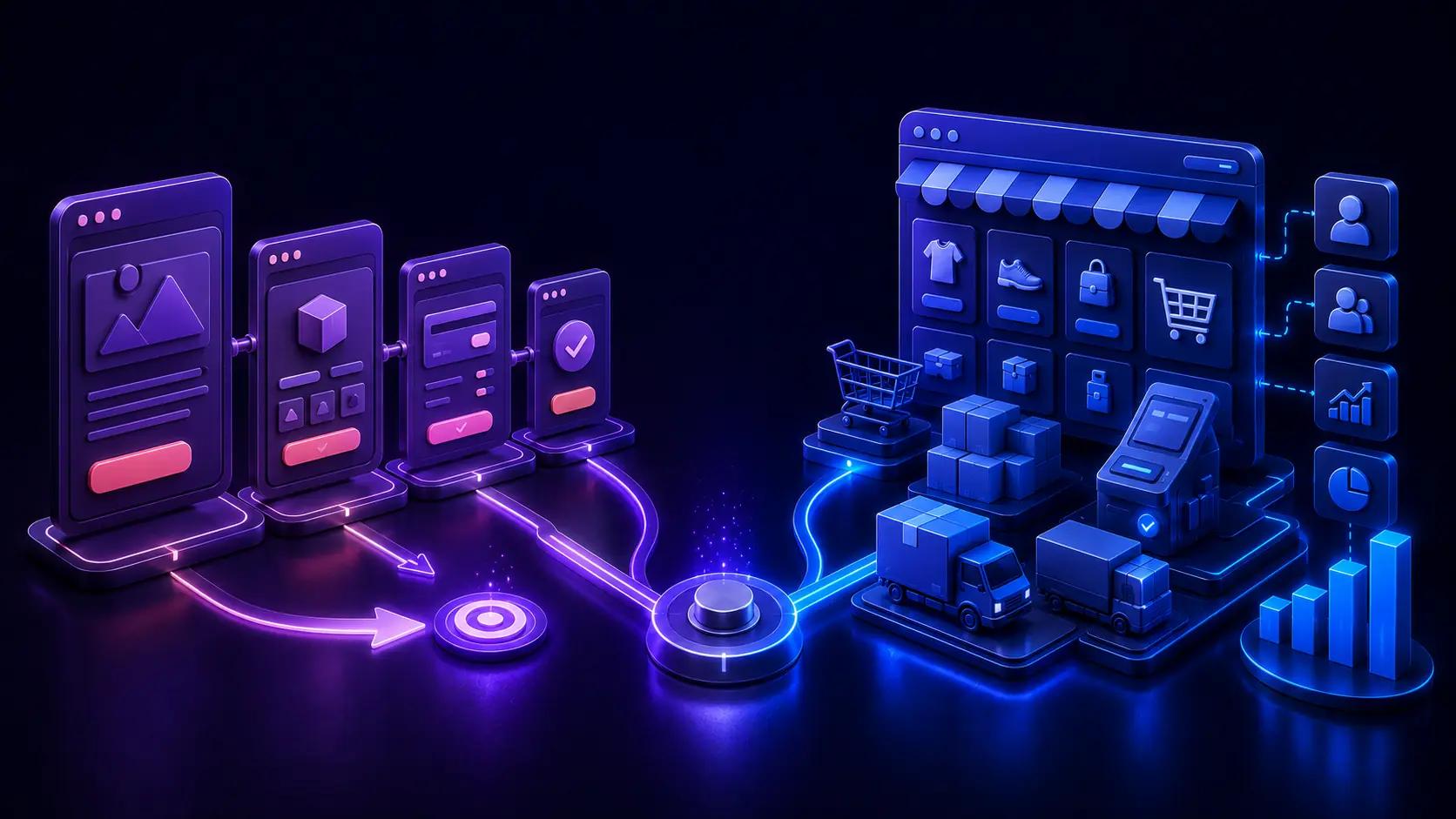

A funnel and a store solve two different problems, even when they are selling the same product.
A funnel is built around one path: land, pitch, upsell, checkout, done. A store is built around a foundation: a catalog, collections, search, repeat customers, and a business that can outlive a single offer. ClickFunnels was built for the funnel path. Shopify was built for the store foundation.
The ClickFunnels vs. Shopify decision usually is not about which platform is better in the abstract. It is about which one matches how you really plan to sell.
If you are launching one offer, one price point, and one aggressive sales sequence, ClickFunnels was built for exactly that. If you are building a catalog of products, running ads to more than one offer, or planning to sell for years instead of one launch cycle, Shopify gives you the foundation a funnel tool was never meant to carry.
ClickFunnels vs. Shopify: The Short Answer
Pick ClickFunnels if your business is a single offer or a small number of offers sold through a scripted funnel, with upsells, order bumps, and a checkout built around one path. Use Shopify if you are building a store with a real product catalog, collections, search, and long-term ecommerce infrastructure. Choose Shopify with PagePilot if you want AI-generated product pages and visuals that make a Shopify store convert closer to a tight, funnel-style single-product page.
What Is ClickFunnels?
ClickFunnels is a funnel and landing page builder built around getting one visitor through one scripted path toward one purchase decision.
Its 2026 plans start with Launch at $97 a month, Scale at $197 a month, Optimize at $297 a month, and Dominate at $5,997 a year for larger operations, with lower annual pricing available on the monthly-priced tiers. Every plan includes a drag-and-drop editor, Smart Checkout, A/B testing, email and automation tools, and a Store Funnels feature that lets sellers add a basic ecommerce storefront on top of the funnel builder. ClickFunnels does not take a percentage of sales on any plan.
ClickFunnels was built by marketers for marketers running launches, webinars, coaching offers, and single-product campaigns where the entire experience is scripted from ad click to upsell. It is not primarily a catalog tool, even with Store Funnels included.
What Is Shopify?
Shopify is a hosted ecommerce platform built around the store instead of the single path.
It includes product and inventory management, Shopify Checkout, payment processing, shipping and fulfillment tools, themes, and an app ecosystem built specifically for ecommerce, along with dropshipping and print-on-demand workflows baked into how merchants typically use it.
Shopify assumes a catalog even when a seller only lists one product to start. Collections, search, filtering, multi-product checkout, and long-term store management are part of the platform from day one, which matters once a business grows past a single offer.
ClickFunnels vs. Shopify: Key Differences at a Glance
Can Shopify Replace ClickFunnels?
For a lot of sellers, yes. Shopify can replace ClickFunnels once the business needs more than one offer, a real catalog, or long-term SEO and collection structure instead of a single scripted path. Shopify apps and well-built product pages can recreate much of what a funnel does: urgency, upsells, order bumps, and a tight checkout flow, without giving up the catalog, search, and collection features a pure funnel tool leaves out.
Where Shopify usually does not fully replace ClickFunnels is the scripted, step-by-step funnel sequence built around a single high-ticket offer, webinar registration, or coaching launch. That specific workflow is what ClickFunnels was designed around, and rebuilding it on Shopify takes more app stacking and manual setup. Can Shopify replace ClickFunnels for most ecommerce sellers running product-based businesses? Usually. For a pure single-offer launch funnel? Only partially, and often with added app costs.
Which Converts Better for a Single Product?
This is where the ClickFunnels vs. Shopify debate gets specific instead of philosophical. For a single, tightly scripted offer with heavy upsells and one path to purchase, ClickFunnels was built to convert that exact scenario, and it usually does it well. For a single product sold as part of an ecommerce brand, meaning it still needs reviews, trust badges, shipping information, a real checkout, and room to add more products later, a well-built Shopify product page tends to convert better because it matches how shoppers already expect to buy online.
A focused one-product Shopify store built to test fast can behave a lot like a funnel while keeping the door open for a full catalog later. Which converts better for a single product usually comes down to whether the buyer expects a scripted pitch or a normal ecommerce purchase, and dropshipping traffic almost always expects the second one.
ClickFunnels vs. Shopify for Dropshipping
For dropshipping specifically, Shopify is usually the stronger platform. It was built around product catalogs, supplier integrations, and the app ecosystem dropshippers depend on for fulfillment, reviews, and testing. ClickFunnels can support a single dropshipping offer through Store Funnels, but it is not built around supplier syncing, bulk product imports, or ongoing catalog management the way Shopify is.
ClickFunnels for dropshipping
ClickFunnels can work for a single hero-product dropshipping offer sold through a scripted funnel with upsells and order bumps. It is a weaker fit once a seller wants to import, test, and manage more than a handful of products, since Store Funnels was added on top of a funnel builder rather than built as a dedicated catalog system.
Shopify for dropshipping
Shopify is the more natural fit for dropshipping because of its supplier apps, bulk import tools, dropshipping products with high profit margin sourcing workflows, and reviews and fulfillment apps that were purpose-built for the model. A full dropshipping platform designed around fast product testing usually beats stacking funnel software on top of a catalog it was not built to manage.
ClickFunnels vs. Shopify Pricing
ClickFunnels pricing runs Launch at $97 a month, Scale at $197 a month (its most popular tier), Optimize at $297 a month, and Dominate at $5,997 a year, with reduced rates when billed annually on the lower tiers. None of the plans take a percentage of sales. Shopify pricing runs from roughly $29 a month on its entry plan up toward $299 a month and beyond on higher tiers, and third-party transaction fees can apply if a merchant skips Shopify Payments.
Anyone deciding between the two on price alone should look past the sticker number. A deeper ClickFunnels pricing breakdown is worth reading before committing, since funnel software and store software are priced around different assumptions about what you are truly building.
Which Is Easier for Beginners?
Shopify tends to feel easier for beginners who are building a store, since hosting, checkout, and catalog tools are already structured around ecommerce. ClickFunnels tends to feel easier for beginners who are building one offer, since the funnel steps are pre-built and the whole experience is designed around a single scripted path rather than an open-ended catalog.
Why ClickFunnels feels easier for a single offer
Everything is arranged around one goal: get the visitor from the ad to the checkout with as few decisions as possible. Templates, upsell steps, and order bumps are pre-built into the funnel structure, so sellers with one clear offer do not need to design a full storefront.
Why Shopify feels easier for a real store
Shopify's ecommerce app ecosystem, best Shopify page builders, and catalog tools are built for sellers who expect to add products, test offers, and grow past a single launch. Non-technical sellers can set up products, collections, and checkout without stitching funnel software onto a store it was not designed to run.
ClickFunnels vs. Shopify for Building a Real Store
Once a seller wants more than one product, the gap widens quickly. ClickFunnels's Store Funnels feature lets sellers list products and take orders, but it was layered onto a funnel builder rather than designed from the ground up as a catalog platform. Shopify was built the other way around: the catalog came first, and funnel-style tactics like upsells and urgency were added through apps and themes.
For a seller planning to run a real store, meaning collections, search, filtering, repeat customers, and SEO built around product pages, Shopify is almost always the stronger foundation. A funnel is not indexed or structured the way Google's own ecommerce SEO best practices describe, since it is built around one path rather than a crawlable catalog. For a seller who only ever plans to sell one offer through paid ads, that foundation is more infrastructure than the business needs.
Do I Need ClickFunnels If I Have Shopify?
Usually not, and this is one of the more common questions sellers ask once they already run a Shopify store. Do I need ClickFunnels if I have Shopify depends mostly on whether you need a separate, heavily scripted funnel sequence for something like a webinar launch or a high-ticket coaching offer that sits outside your normal catalog. If your business is built around products, Shopify plus strong product pages usually covers what a funnel would do, without paying for a second platform.
Where ClickFunnels still earns its place alongside Shopify is a narrow one: a one-time launch, a lead-generation funnel that feeds a separate offer, or a scripted upsell sequence that would be awkward to build inside a normal store theme. For everyday ecommerce and dropshipping, most of what a funnel does, urgency, order bumps, a tight single path, and a fast checkout, can be built directly into a Shopify product page instead of running two platforms at once. That is also where PagePilot fits: it helps Shopify sellers build product pages with funnel-style focus and urgency built in, so the store does not need a second funnel tool bolted on beside it.
Where PagePilot Fits
Choosing Shopify gives you the store foundation. PagePilot helps with the part that decides whether that foundation really sells: the product page itself. Instead of a flat, generic template, PagePilot helps Shopify sellers generate product copy, images, and layout with the same urgency and clarity a good funnel page would use, including AI-generated Shopify product descriptions built to sound like a person wrote them instead of a template.
It also helps close the gap ClickFunnels sellers worry about most when they move to Shopify: reducing bounce rate on Shopify product pages, tightening the path to checkout, and giving single-product and dropshipping stores a page that reads with funnel-level focus.
Reviewing best Shopify homepage examples is a quick way to see how far a store page can go before it needs a separate funnel tool at all. Keeping an eye on Core Web Vitals matters here too, since a slow product page loses the same visitors a funnel is built to squeeze every ounce of conversion out of.
Sellers weighing page builders instead of full funnel software might also compare best PageFly alternatives or best GemPages alternatives before settling on a workflow.
A side-by-side of PagePilot vs GemPages or PagePilot vs Shogun tends to answer the page-builder question faster than testing each one manually.
Comparing GemPages pricing against Shogun page builder pricing helps narrow that shortlist further.
Anyone comparing AI store builders rather than page builders can start with PagePilot vs DropMagic or BuildYourStore vs PagePilot.
The Atlas AI store builder pricing breakdown is worth a look if Atlas made your shortlist too, and a broader AI store builder pricing comparison rounds out the research before you commit a monthly budget to either a funnel tool or a store platform.
The general AI store builder pricing overview is worth a skim too if you want the wider landscape before narrowing down.
Sellers still deciding whether to run ads into a funnel or straight into a product page should also look at best practices for high-converting landing pages, and the same thinking applies when you optimize a landing page for lead generation.
Anyone stacking apps on top of either platform should also check best Shopify apps to increase conversion rates and best apps for dropshipping before assuming a funnel tool is the only way to add urgency.
Once the store side of the budget is settled, it helps to know how much it costs to build a Shopify website and to compare that against a GemPages vs PageFly style breakdown.
Writing copy with how to write high-converting Shopify product descriptions with AI closes out most of what a funnel page was doing anyway.
ClickFunnels vs. Shopify: Pros and Cons
ClickFunnels Pros and Cons
Shopify Pros and Cons
ClickFunnels vs. Shopify: Final Verdict
ClickFunnels is built for the funnel path: one offer, one script, one checkout, tested and optimized around a single decision. Shopify is built for the store foundation: a catalog, collections, and an ecommerce system that can grow well past one product. Neither platform is wrong for the other's job. The mismatch happens when a store business tries to run on funnel software, or a single-offer launch tries to force its way through full store infrastructure it does not need yet.
If you are building a Shopify store and want your product pages to carry the same urgency and clarity a good funnel page has, do not settle for a default template. PagePilot helps you build Shopify product pages with AI that read with real focus, so a store foundation can convert like a tight, well-tested funnel without giving up the catalog you are building it on.