
ClickFunnels is worth it in 2026 for businesses that regularly sell through multi-step sales funnels, particularly those using order bumps, one-click upsells, downsells, and dedicated follow-up campaigns.
Its Launch plan costs $97/month, and the current platform supports ecommerce storefronts, product collections, inventory tracking, and physical-product fulfillment.
For merchants already using Shopify, the decision is more complicated.
Shopify handles products, checkout, inventory, and fulfillment, while specialized apps can add landing pages, product-page generation, and upsell functionality.
Adding ClickFunnels may introduce another subscription, checkout system, and set of customer records without solving a genuine business problem.
Here's where ClickFunnels earns its cost, where Shopify makes more sense, and how to compare the actual expenses.
Is ClickFunnels Worth It in 2026? The Short Answer
ClickFunnels is worth paying for when sales funnels are a significant part of how your business acquires and converts customers. It's less compelling when you're already running a Shopify store and primarily need better product pages or occasional promotional landing pages.
ClickFunnels can replace several tools when a business genuinely uses its combined functionality.
But if you already have a Shopify store, an email platform, and a page builder, paying for ClickFunnels may simply duplicate features you're already funding.
What Does ClickFunnels Actually Do for Ecommerce?
ClickFunnels 2.0 is an ecommerce and marketing platform built around sales funnels.
Its core functionality includes landing pages, checkout pages, order bumps, upsells, downsells, A/B testing, email marketing, and customer-management tools.
It also supports online stores, physical and digital products, product variants, collections, inventory tracking, and fulfillment integrations.
That last distinction is important: ClickFunnels isn't limited to digital products or isolated sales pages.
How a ClickFunnels Sales Funnel Works
Consider a business selling a $79 fitness accessory through paid social advertising.
A typical sales funnel might look like this:
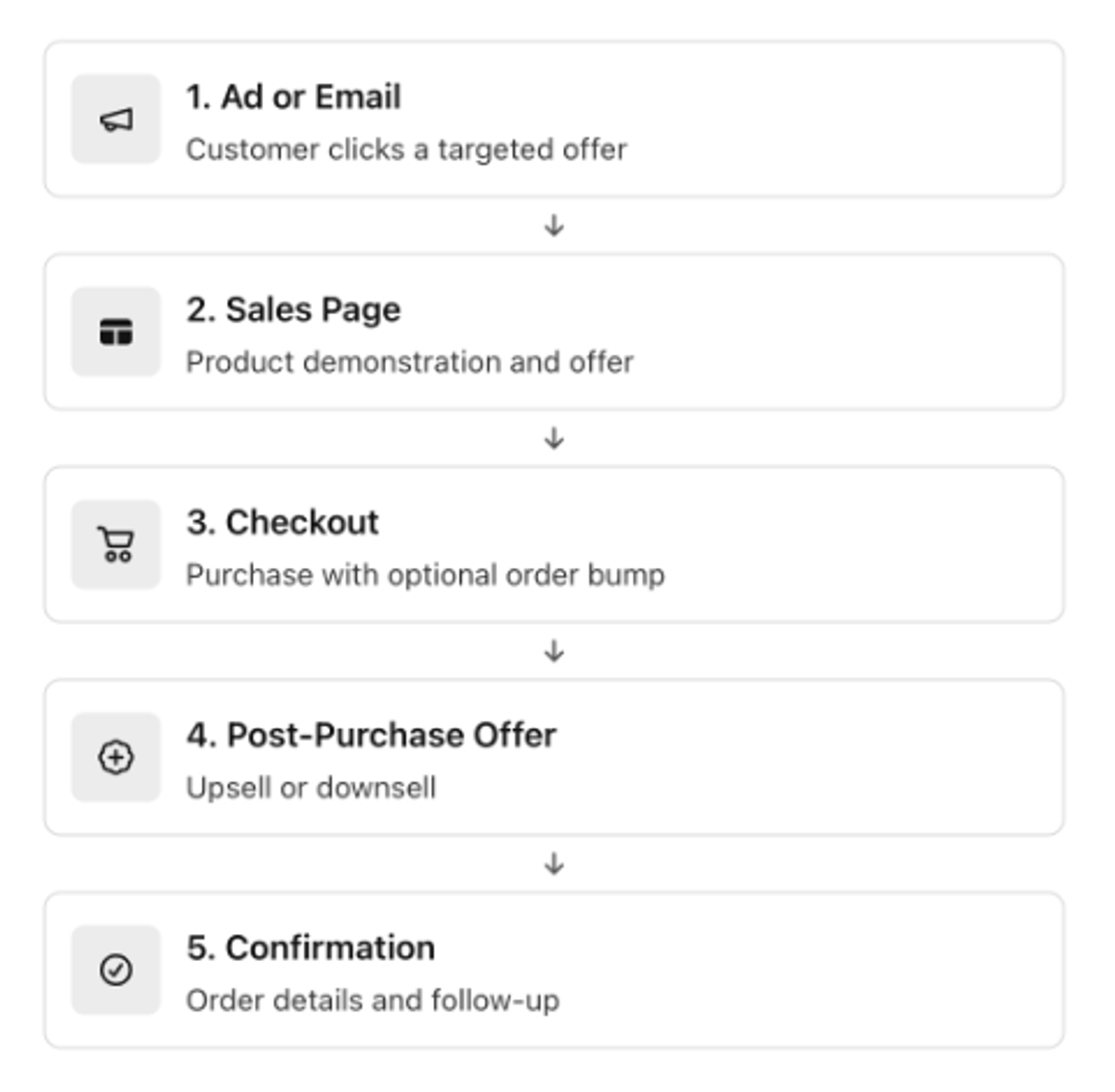
The order bump appears during checkout. After the initial purchase, the customer can receive another offer without going through a separate full checkout process.
ClickFunnels calls these post-purchase offers One-Time Offers, or OTOs.
For instance, the business could offer a replacement accessory after the initial purchase, then present a lower-priced alternative if the customer declines.
ClickFunnels documents support for multiple upsell and downsell steps, with configuration requirements for products, payments, and funnel pages.
See its one-click upsell and downsell documentation.
Can ClickFunnels Run a Normal Online Store?
Yes. ClickFunnels 2.0 has a Store app that supports product browsing, collections, carts, and purchasing.
Its product tools also support variants, inventory management for eligible products, shipping-related settings, and fulfillment workflows.
For inventory tracking, ClickFunnels documents a specific requirement: the product must have fulfillment enabled in its settings.
The platform also supports integrations with services including Zendrop and Supliful for particular fulfillment workflows.
These are genuine ecommerce capabilities.
The difference from Shopify is that ClickFunnels' wider product remains centered on coordinating marketing and sales journeys, while Shopify offers a much larger ecosystem devoted to everyday retail operations.
How Much Does ClickFunnels Cost in 2026?
ClickFunnels has four current plans: Launch, Scale, Optimize, and Dominate.
Launch costs $97/month with monthly billing. Scale costs $197/month, Optimize costs $297/month, and Dominate costs $5,997/year with annual billing only.
ClickFunnels Pricing Plans Compared
The annual equivalents are calculations based on the full annual charges, not standalone month-to-month subscription options.
ClickFunnels also advertises unlimited funnels across the plans, but currently labels this as a limited-time offer. Merchants should not assume that promotional wording guarantees an unchanged allowance indefinitely.
What Does Each Plan Include?
All four plans advertise landing pages, websites, stores, funnel building, and core checkout functionality.
However, the feature comparison distinguishes email marketing from certain automation and advanced workflow capabilities. Don't assume every automation, calendar, API, or custom-code feature is included in Launch.
For a complete breakdown, see our ClickFunnels pricing guide.
Official source: ClickFunnels pricing.
Which ClickFunnels Plan Makes Sense for Ecommerce?
Launch is the most reasonable starting point for a merchant running one business, a limited number of core offers, and campaigns within its contact and email allowances.
Scale becomes relevant when the business needs more workspaces, additional users, larger contact limits, the custom code editor, or the documented API and webhook access.
Optimize and Dominate target substantially larger operations.
There's little reason for a new single-product seller to begin with a $297/month subscription when Launch already covers the primary funnel-building use case.
What Are the Additional ClickFunnels Costs?
The subscription isn't necessarily the complete operating expense.
Merchants may also pay for:
- Payment processing through their configured provider.
- Domain registration.
- Fulfillment and supplier services.
- External applications and integrations.
- Development or data synchronization.
- Marketing software that ClickFunnels doesn't fully replace.
- Additional operational work when maintaining multiple systems.
ClickFunnels states that it doesn't take a percentage of sales simply for using the platform. That doesn't eliminate ordinary payment-processing or fulfillment expenses.
The other important cost is duplication.
A merchant paying for ClickFunnels while retaining Shopify, Klaviyo, another page builder, and an upsell application should calculate the combined software bill before deciding that the funnel platform is worth it.
ClickFunnels vs. Shopify: Which Is Better for Ecommerce?
ClickFunnels and Shopify can both operate ecommerce storefronts, but they prioritize different workflows.
ClickFunnels is built around creating and managing sales funnels. Shopify is built around managing an ecommerce business across products, customers, inventory, checkout, and sales channels.
Neither platform should be dismissed as incapable of selling physical products.
ClickFunnels vs. Shopify Feature Comparison
Where ClickFunnels Has the Advantage
ClickFunnels brings the sales page, checkout, order bump, post-purchase offers, and follow-up process together.
That can simplify operations for a business that runs repeated direct-response campaigns.
For example, a company selling one premium educational product with several related offers may find it easier to organize the entire customer journey inside ClickFunnels than to assemble separate tools for each step.
ClickFunnels also makes sense when the business uses courses, memberships, and physical-product offers together.
Where Shopify Has the Advantage
Shopify provides a more extensive retail ecosystem.
It offers product and inventory management, collection merchandising, storefront themes, order management, multiple sales channels, and a large selection of ecommerce applications.
For a retailer carrying hundreds of products, customers may need to browse categories, compare options, use filters, and return to purchase additional items.
That buying behavior is different from arriving through an advertisement for one specific offer.
Shopify is generally the more practical choice for these catalog-oriented operations.
For a detailed platform comparison, see our ClickFunnels vs. Shopify guide.
Shopify Can Also Support Post-Purchase Upsells
It's incorrect to suggest that Shopify merchants need ClickFunnels to offer customers additional products after checkout.
Shopify allows compatible post-purchase applications on Basic and higher plans.
Merchants can install a supported app, configure it, and select the app that controls the post-purchase page.
There are restrictions.
Only one post-purchase app can control that placement at a time, and certain payment methods or checkout situations may prevent the offer from appearing.
Shopify also reserves some pre-purchase checkout customization capabilities for Shopify Plus.
These constraints matter when a merchant is considering a particularly complex checkout sequence.
See Shopify's checkout app documentation and its product-offer limitations.
Can You Use ClickFunnels With Shopify?
Yes, ClickFunnels and Shopify can be used together, but the integration method matters.
ClickFunnels Classic has documented Shopify integration instructions. Those instructions shouldn't automatically be applied to ClickFunnels 2.0.
This distinction is especially important for merchants planning to collect payment through ClickFunnels while fulfilling orders through Shopify.
ClickFunnels Classic and Shopify
The official Classic integration documentation describes a workflow where a merchant connects Shopify, maps products, and sends orders from ClickFunnels to Shopify for fulfillment.
That is a specific, documented Classic integration.
It is not proof that ClickFunnels 2.0 includes an identical built-in connection or equivalent automatic synchronization.
See the ClickFunnels Classic Shopify integration instructions.
What About ClickFunnels 2.0?
ClickFunnels 2.0 documents several integration methods, including its REST API, webhooks, page SDK, and supported third-party workflows.
Its September 2026 integration documentation distinguishes these methods according to what a developer is trying to accomplish.
For example, its REST API can manage supported records, while the Page SDK supports checkout functionality on appropriately configured external pages.
Neither capability, by itself, establishes an automatic two-way Shopify integration.
If you're considering a combined setup, establish exactly how orders and customer information will move between the systems.
Running two systems also means maintaining their connection.
If a product price changes in Shopify, don't assume the ClickFunnels offer updates automatically. The same applies to inventory, cancellations, discounts, and shipping settings unless the integration specifically handles them.
Official source: ClickFunnels 2.0 integration options.
Is ClickFunnels Worth It for Dropshipping?
ClickFunnels can support dropshipping, but Shopify is generally the more practical starting platform for merchants importing, testing, and managing products from multiple suppliers.
That recommendation isn't based on an absence of ClickFunnels supplier integrations.
ClickFunnels officially documents integrations with Zendrop and Supliful.
Its Zendrop integration supports importing products and transmitting relevant orders for supplier fulfillment.
When ClickFunnels Can Work for Dropshipping
Consider a merchant already selling one profitable consumer product through a carefully managed advertising funnel.
The merchant may want to:
- Create a dedicated sales page.
- Offer an additional item during checkout.
- Present a post-purchase upsell.
- Send follow-up emails.
- Have a supported supplier fulfill the order.
ClickFunnels can support that style of operation.
Its documented Zendrop integration covers importing product data, sending order details, and managing fulfillment through the supplier.
However, the merchant must still handle supplier charges and operational exceptions.
For example, ClickFunnels documentation notes that canceling fulfillment in Zendrop doesn't automatically cancel the corresponding ClickFunnels order.
That creates a process the merchant must manage.
When Shopify Makes More Sense
Shopify is generally more suitable for a dropshipping merchant who regularly changes products, uses several supplier applications, or manages a growing catalog.
Its supplier-app ecosystem and core product-management tools are directly relevant to those operations.
The merchant can also use specialized tools for individual tasks without introducing another ecommerce platform.
For example, a store may use Shopify for products and orders, a supplier app for fulfillment, and PagePilot to create product-page drafts from supported supplier links.
For someone still validating products, that's a more focused purchasing decision than immediately adopting a complete second funnel system.
The important difference is operational fit, not whether ClickFunnels is capable of dropshipping.
Official source: ClickFunnels' Zendrop integration.
What Is a Cheaper Alternative to ClickFunnels for Shopify?
For Shopify merchants, a cheaper alternative to ClickFunnels is often an existing Shopify store plus the specific application needed for the job.
But not every alternative reproduces the full ClickFunnels feature set.
A product-page generator, for example, doesn't automatically replace ClickFunnels' checkout order bumps, post-purchase funnels, or customer-management tools.
The following examples compare four different software configurations using current US prices.
Shopify-Based Alternatives Compared
All subtotals use monthly billing, not introductory offers or annual-billing equivalents. They exclude payment processing, other applications, fulfillment, and integration expenses.
The table makes one thing clear: a lower software subtotal doesn't mean two configurations have identical functionality.
Option 1: Shopify With a Free Theme
Cost: $39/month
This setup includes Shopify Basic with a free theme such as Dawn.
The merchant can create products, manage checkout and inventory, and publish a storefront without paying for another page-building subscription.
It's appropriate for sellers who don't need advanced funnel sequences.
The limitation is that specialized order bumps, experimentation, complex campaign pages, or custom post-purchase offers may require additional applications.
This is a baseline ecommerce setup, not a full ClickFunnels replacement.
Option 2: Shopify + PagePilot
Cost: $78/month
This configuration combines:
- Shopify Basic: $39/month.
- PagePilot Lite: $39/month.
PagePilot Lite includes ten product pages per month, 50 AI images, and support for one Shopify store.
It also includes AI-assisted product-page creation, editable templates, CRO sections, and Shopify publishing.
For merchants regularly preparing products from supplier links, that can remove repetitive work from the page-creation process.
PagePilot Starter costs $59/month and includes unlimited product-page generation, 200 AI images monthly, and three Shopify stores.
Combined with Shopify Basic on monthly billing, the Starter configuration would cost $98/month.
Neither PagePilot plan is a standalone replacement for ClickFunnels' full multi-step funnel functionality.
The product-page builder and the ecommerce platform serve different roles.
Current pricing: PagePilot plans.
Option 3: Shopify + GemPages Optimize
Cost: $98/month
This setup combines:
- Shopify Basic: $39/month.
- GemPages Optimize: $59/month.
GemPages provides visual Shopify page building and customization. Its Optimize plan adds access to functionality including sales funnels and post-purchase upsells.
This makes it a more direct comparison for Shopify merchants whose main requirements are customized landing pages and supported post-purchase offers.
GemPages also advertises unlimited published pages on its paid plans.
However, its features operate within the Shopify environment.
That means applicable Shopify checkout and post-purchase restrictions still matter.
GemPages also doesn't automatically replace the entire ClickFunnels email, CRM, and automation environment.
Official source: GemPages pricing.
Option 4: ClickFunnels Launch
Cost: $97/month
ClickFunnels Launch costs approximately the same as the Shopify Basic and GemPages Optimize combination when both are billed monthly.
It also provides an integrated funnel environment, stores, checkout functionality, and email marketing within its applicable limits.
For a business that doesn't already require Shopify, this could eliminate the need to maintain another storefront platform.
For a merchant keeping Shopify and adding ClickFunnels, however, the bill could instead rise to $136/month before other apps and expenses.
That is the real comparison: whether ClickFunnels replaces software and operational work or becomes another layer of cost.
What About Replo, PageFly, and Other Alternatives?
Replo, PageFly, and other Shopify page builders are worth considering when the merchant needs different landing-page or design capabilities.
Replo emphasizes broader commerce campaigns and AI workflows.
PageFly supports multiple Shopify page types, visual editing, and AI-assisted generation, with publishing and AI allowances depending on the selected plan.
Neither should be treated as an identical substitute for every ClickFunnels checkout and automation feature.
For a wider shortlist, see our ClickFunnels alternatives for Shopify sellers.
Does ClickFunnels Convert Better Than Shopify?
There is no independently established universal conversion-rate winner between ClickFunnels and Shopify.
A focused sales funnel can be effective when the customer arrives through a particular campaign, sees a specific offer, and follows a clear purchasing sequence.
A Shopify storefront can be equally appropriate when visitors need to browse products, evaluate options, compare variants, and make repeat purchases.
The key is to measure the customer journey rather than assume one platform converts better.
What Should You Compare?
An upsell can increase revenue per order while reducing contribution profit if discounts or product costs are too high.
Likewise, a funnel conversion rate may look attractive because visitors arrive from a narrowly targeted advertising campaign rather than ordinary store traffic.
For a meaningful comparison, evaluate equivalent offers, audiences, traffic sources, attribution windows, and costs.
Don't compare a warm email funnel against a Shopify store receiving broad, low-intent social traffic and attribute the difference to the software.
When Is ClickFunnels Worth Paying For?
ClickFunnels becomes a stronger investment when several of its features are integral to how the business sells.
Consider it when:
- Your business regularly operates multi-step sales funnels.
- One or a few offers generate a substantial share of revenue.
- Checkout order bumps and post-purchase offers are central to the sales process.
- You're already paying for several tools ClickFunnels could genuinely replace.
- Your team regularly measures and optimizes funnel performance.
- You also sell courses, memberships, coaching, or related offers.
- The business can support the additional software and operational work.
These conditions provide concrete reasons to use a funnel-oriented platform.
When ClickFunnels Is Unnecessary
ClickFunnels is harder to justify when your current Shopify setup already handles the tasks you need.
For example:
For an established Shopify store, the first step should be identifying the specific limitation of the current setup.
Paying for ClickFunnels makes more sense when it solves that limitation and the business can measure the benefit.
How Do You Calculate Whether ClickFunnels Will Pay for Itself?
ClickFunnels is financially worthwhile when the additional contribution profit or verifiable software savings exceed its additional cost.
Start by calculating how much the business would actually spend after adopting it.
Step 1: Calculate the Additional Monthly Cost
Suppose a Shopify merchant already pays for a small $7/month tool that ClickFunnels would replace.
The merchant keeps Shopify but adds ClickFunnels Launch:
This doesn't include any integration work or additional processing expenses.
Step 2: Calculate Contribution per Incremental Order
Suppose the business earns $30 in contribution profit from each additional order after deducting product costs, shipping, processing fees, expected refunds, and incremental advertising costs.
The break-even calculation is:
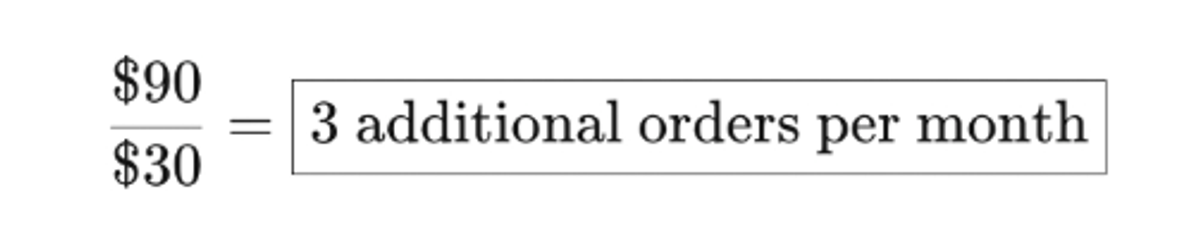
The business would need three genuinely incremental orders per month to cover the additional $90 software cost.
That is a hypothetical illustration, not an expected ClickFunnels performance result.
Step 3: Don't Count Orders That Would Have Happened Anyway
Suppose the funnel generates 20 orders.
That doesn't mean all 20 are additional sales.
Some customers may have purchased from the existing Shopify store without the new funnel.
A proper analysis needs to account for customers redirected from existing purchase paths, promotional discounts, acquisition spending, and any extra administrative work.
The same principle applies to post-purchase upsells: measure the contribution from accepted additional offers, not just the extra revenue shown in a dashboard.
Step 4: Include Replaced Software and Labor Savings
ClickFunnels may also create value by reducing the number of separate tools a team manages.
But those savings should be specific.
If the business still needs its existing email platform, Shopify store, and inventory systems, don't count them as eliminated expenses.
The correct decision is based on actual incremental profit and operational savings, not the number of features advertised.
Final Verdict: Is ClickFunnels Worth Buying?
ClickFunnels is a credible ecommerce platform with substantial funnel-building, checkout, email, and store functionality. Businesses that repeatedly run direct-response campaigns have a legitimate reason to evaluate its $97/month starting plan.
For an existing Shopify merchant, the case is narrower.
If the problem is product-page quality or launching new products efficiently, improve that workflow before adopting a second ecommerce system. PagePilot helps merchants generate editable Shopify product pages from supported product links.
Choose ClickFunnels when you need its full funnel capabilities, can manage the integration requirements, and have a clear way to measure whether the additional cost pays for itself.