
Every Shopify store owner has watched potential customers browse, add items to their cart, and disappear without buying. Choosing the right email platform is one of the most effective ways to recover that revenue, but deciding between Shopify Email and Klaviyo for a Shopify Email Marketing vs Klaviyo strategy is not always straightforward. Both tools promise automation, segmentation, and higher conversions, yet they serve different needs and budgets.
The email platform a store uses is only part of the equation. Landing pages and product pages need to convert the traffic those emails drive, or the effort is wasted. For stores that want optimized pages without the cost of a developer, PagePilot offers an AI page builder that generates high-converting pages in seconds.
Table of Contents
Why Most Store Owners Choose the Wrong Email Platform
The Biggest Misconception About Shopify Email Marketing vs Klaviyo
Shopify Email Marketing vs Klaviyo: Feature-by-Feature Comparison
Why Your Product Page Often Impacts Revenue More Than Your Email Platform
How to Choose the Right Platform Based on Your Growth Stage
How PagePilot Helps You Improve the Pages Your Emails Send Traffic To
Start a FREE Trial and Generate 3 Product Pages with Our AI Page Builder today
Summary
- Most store owners pick email platforms based on popularity or affordability rather than strategic fit. They scan Facebook groups, read influencer recommendations, and choose what everyone else is using without considering their growth stage, internal resources, or actual marketing objectives. This creates predictable problems where businesses pay for sophisticated automation capabilities they never activate, spend weeks configuring complex workflows that generate minimal revenue, or eventually face expensive migrations that require rebuilding customer segments and entire automation sequences from scratch.
- Performance differences between brands stem primarily from how effectively they use segmentation and automation, not which platform they subscribe to. According to Klaviyo's 2025 Ecommerce Benchmark Report, abandoned cart flows generate an average $3.65 in revenue per recipient while standard promotional emails produce approximately $0.11 per recipient. Two stores using identical software can generate completely different outcomes depending on whether they build targeted customer segments based on purchase behavior, browsing history, and customer lifecycle stage.
- Product page optimization drives significantly more revenue than email platform selection. HubSpot Marketing Statistics show that 68% of revenue is attributed to product page optimization, compared with 15% from email. A store receiving 10,000 monthly visitors at 2.5% conversion rate generates 250 orders, but at 5% conversion rate, that same traffic generates 500 orders. No email platform change alone creates that kind of revenue lift if the landing experience fails to convert visitors who click through from campaigns.
- Generic supplier images make differentiation nearly impossible, especially in dropshipping environments where competitors source from the same catalogs. Salsify's Consumer Research Report found that 87% of shoppers rate product content as extremely or very important when deciding to purchase, with product images consistently ranking among the most influential content types. When every competitor shows the same visuals, the only differentiator becomes price, which erodes margins and makes customer acquisition more expensive.
- The right platform depends on operational capacity and growth stage, not feature count. New stores need speed and simplicity to validate offers and generate early sales. Scaling brands requires behavioral segmentation and customer lifecycle marketing to maximize customer value. A platform with 200 features means nothing if you only need 15 and lack the time to configure the rest, which is why a clear retention plan, executed on simpler tools, often outperforms sophisticated platforms with no coherent strategy guiding their use.
- PagePilot's AI page builder creates complete product pages in under two minutes from competitor URLs or supplier links, letting merchants test different messaging angles and value propositions without spending hours on manual page assembly for each variation.
Why Most Store Owners Choose the Wrong Email Platform
Most store owners choose email platforms by asking what others use: scanning Facebook groups, reading influencer recommendations, and comparing pricing. They pick based on popularity or cost rather than strategic fit, growth stage, internal resources, or actual marketing objectives.
"Choosing an email platform based on popularity rather than strategic fit is one of the most expensive mistakes a store owner can make." — Email Marketing Best Practices
⚠️ Warning: Picking a platform because it's popular in your niche is not a strategy—it's a shortcut that costs you money down the line.
💡 Tip: Before committing to any platform, evaluate it against your growth stage, team resources, and specific marketing goals, not what the loudest voices in Facebook groups recommend.

This approach creates predictable problems: businesses pay for sophisticated automation they never turn on, spend weeks setting up complex workflows that generate minimal revenue, or eventually outgrow their choice and face expensive migrations requiring complete rebuilds of customer segments, templates, and automation sequences.
Paying for Unused Automation
What Happens
- Features sit idle, budget drains
Real Cost
- Wasted monthly spend
Over-Engineered Workflows
What Happens
- Weeks of setup, minimal ROI
Real Cost
- Lost time + revenue
Outgrowing the Platform
What Happens
- Full migration required
Real Cost
- Complete rebuilds of segments, templates & sequences
🎯 Key Point: The real danger isn't choosing the wrong platform on day one — it's the compounding cost of staying on the wrong platform for months or years before switching.
🔑 Takeaway: Strategic fit matters far more than brand recognition or price point when selecting your email platform — the wrong choice leads to expensive migrations and lost revenue that far outweigh any initial savings.
The Real Driver of Email Performance
According to Klaviyo's 2025 Ecommerce Benchmark Report, performance differences stem from expertise in segmentation and automation, not platform choice. Two stores using identical software achieve vastly different results based on whether they create targeted customer segments, optimize key automations, and systematically test campaign variables.
Why does strategy matter more than software?
Abandoned cart flows generate an average of $3.65 in revenue per recipient, while standard promotional emails produce approximately $0.11 per recipient. The difference lies in strategy and execution. One brand sends occasional promotional blasts to its entire list. Another creates targeted campaigns based on purchase behavior, browsing history, and customer lifecycle stage. Same software. Vastly different revenue outcomes.
Email marketing has an average ROI of $42 for every $1 spent, yet returns vary dramatically based on how well companies use segmentation, automation, and customer data. The constraint is rarely the software; it's how effectively the business uses the tools it already has.
Matching Platform to Growth Stage
The right platform supports your current growth goals and makes it easier to send effective emails, not the one with the most features. A new store with a small subscriber base might prioritize simplicity and low cost. A fast-growing brand with thousands of customers needs advanced subscriber segmentation, multi-channel automation, and detailed reporting. An established online store needs advanced marketing capabilities across the customer journey and retention strategies, all integrated with existing systems.
Should you prioritize implementation speed over feature complexity?
Your platform choice should match your actual needs and available resources, not what you hope to do in the future. When brands prioritize conversions over feature overload, they spend less time configuring software and more time generating revenue. Building landing pages that convert and integrate smoothly with your email campaigns is as important as selecting the right automation platform. Our AI page builder creates optimized pages in seconds, letting you test different offers and designs that align with your email strategy without manual design work or expensive developer fees.
But picking the right platform is only half the battle.
Related Reading
- Shopify Marketing Automation
- How To Set Up Email Marketing On Shopify
- Shopify Social Media Marketing
- How To Advertise a Shopify Store
- Seo Marketing Shopify
The Biggest Misconception About Shopify Email Marketing vs Klaviyo
Klaviyo isn't automatically better just because it has more features. The right platform depends on whether you can use those features effectively enough to generate more revenue than they cost. For many stores — especially those in early growth stages — Shopify Email delivers better returns because it matches their operational capacity.
"The best email platform isn't the one with the most features — it's the one your team can actually use to drive consistent revenue." — Email Marketing Principle
Best For
Shopify Email
- Early-stage & growing stores
Klaviyo
- Scaling & advanced stores
Cost Efficiency
Shopify Email
- ✅ Lower overhead
Klaviyo
- ❌ Higher monthly cost
Ease of Use
Shopify Email
- ✅ Simple, fast setup
Klaviyo
- ❌ Steeper learning curve
Feature Depth
Shopify Email
- ❌ Limited advanced tools
Klaviyo
- ✅ Robust automation & segmentation
ROI for Small Teams
Shopify Email
- ✅ High (low complexity)
Klaviyo
- ❌ Requires expertise to unlock value
🎯 Key Point: More features only translate to more revenue if your team has the time, skills, and capacity to leverage them — otherwise, they're just added cost.
🔑 Takeaway: If you're in the early growth stage, Shopify Email's simplicity is a strategic advantage, not a limitation. Match your platform choice to your operational reality before upgrading.

The Reality of Features vs Usage
Klaviyo offers advanced segmentation, sophisticated automation workflows, predictive analytics, SMS marketing capabilities, and extensive integrations. However, many smaller ecommerce businesses underutilize these capabilities. A store sending weekly campaigns, abandoned cart emails, welcome sequences, and a handful of customer segments may use only 15-20% of what Klaviyo offers.
This pattern appears across ecommerce software. Businesses purchase tools based on aspirational future needs rather than current operational reality, paying for capabilities they never use.
Ease of Use Matters More Than Most Merchants Realize
Shopify Email's main advantage is its simplicity. Because it's built directly into Shopify, you can set it up in minutes instead of hours. Store owners create campaigns using information already in their store, customer details, and product lists without complicated integration work or technical setup.
For store owners focused on launching products, managing fulfillment, and generating sales, this simplicity is helpful. Klaviyo offers more features and options, but with added complexity. Advanced segmentation, automation logic, reporting, and customer journey design require time to learn and manage properly. For brands without a dedicated customer retention specialist, many of these features go unused.
The Learning Curve Carries Hidden Costs
Looking at software costs based solely on the subscription price overlooks an important factor: the learning curve. Time spent learning a platform is time not spent improving campaigns, optimizing offers, or testing products. For smaller ecommerce businesses, simplicity often delivers better results than advanced features.
According to industry data cited in a 2026 analysis, email marketing generates $42 in revenue for every $1 spent. This return on investment depends less on platform sophistication than on consistent execution. A simpler platform used fully often outperforms an advanced platform only partially configured.
Does the total cost of ownership change the equation?
Klaviyo pricing scales with subscriber count, while Shopify Email charges a flat rate that costs less for smaller lists. The question isn't whether Klaviyo has more features—it's whether those features generate enough additional revenue to justify the cost.
Which platform fits your business stage?
Newer stores with small customer bases benefit most from Shopify Email's simple campaigns, basic automations, and low setup costs. Growing brands earning significant revenue from repeat customers need advanced segmentation, sophisticated automation workflows, customer lifecycle marketing, multi-channel retention strategies, and detailed analytics. Choose software that matches your business's current stage, not what you hope it will become.
Understanding which platform fits your business is only half the decision. The features themselves show what you get for your money.
Shopify Email Marketing vs Klaviyo Feature-by-Feature Comparison
Both platforms send emails and track results. The real differences show up in how much control you have over targeting customers, how advanced the automation is, and whether you're just managing email or coordinating multiple channels to keep customers engaged. What makes a tool just okay versus really powerful is whether its features solve problems you actually deal with.
Email Sending
Shopify Email
- ✅ Core feature
Klaviyo
- ✅ Core feature
Audience Targeting
Shopify Email
- ⚠️ Basic segmentation
Klaviyo
- ✅ Advanced segmentation
Automation Depth
Shopify Email
- ⚠️ Limited flows
Klaviyo
- ✅ Sophisticated automation
Multi-Channel Coordination
Shopify Email
- ❌ Email only
Klaviyo
- ✅ Email, SMS & more
Problem-Solving Power
Shopify Email
- ⚠️ Entry-level needs
Klaviyo
- ✅ Complex use cases
"The gap between an okay email tool and a truly powerful one comes down to whether its features map directly to the real problems merchants face every day." — Core Comparison Insight
🔑 Takeaway: If you need basic email management, Shopify Email gets the job done — but if you're ready to unlock advanced targeting, multi-channel coordination, and deeper automation, Klaviyo is built for that next level of control.
💡 Tip: Before choosing a platform, audit your actual pain points. Targeting limitations, automation gaps, and channel restrictions are the three areas where these tools diverge most — and where your decision should be anchored.

Email Campaigns
Shopify Email handles promotional sends, product announcements, and seasonal offers with ease. You pull products directly from your catalog, choose a template, write your message, and send. The interface prioritizes speed over complexity, making it effective for campaigns targeting broad audiences with straightforward offers.
How does Klaviyo approach campaign personalization?
Klaviyo treats every campaign as a chance for personalization. You can add product recommendations based on customer browsing history, adjust messaging for different customer groups, and test multiple versions simultaneously. This flexibility matters when running campaigns for distinct segments (first-time buyers versus repeat customers, high spenders versus discount shoppers), but loses value when your team lacks time to build variations or your audience is too small to segment meaningfully.
Automation Workflows
Shopify Email supports core automations: welcome sequences, abandoned cart reminders, and post-purchase follow-ups. Setup is quick, but the platform's default assumptions work only until your business model demands something more specific.
How does Klaviyo's workflow builder handle complex customer journeys?
Klaviyo's workflow builder maps entire customer journeys with conditional logic, time delays, and behavioral triggers. You can send win-back emails to customers who have been inactive for 90 days and have opened your last 3 emails, trigger VIP upgrades at lifetime-value thresholds, or pause automations for recent support contacts. This control becomes essential when retention strategy moves beyond basic lifecycle marketing into territory where timing and context determine whether a message converts or annoys.
Customer Segmentation
Shopify Email offers 10,000 free emails per month and lets you segment customers by purchase history, location, or email engagement. This covers the needs of most new stores.
Klaviyo organizes customers using real-time behavioral data: those likely to stop purchasing within 30 days, browsers who never converted, or subscribers with declining average order values. Predictive analytics enable more relevant emails than simpler tools, but require a proper understanding of the data and targeted configuration.
Reporting and Analytics
Shopify Email shows open rates, click rates, and revenue attributed to each campaign, and it connects directly to your Shopify sales data. For stores focused on execution over analysis, this suffices.
Klaviyo provides cohort analysis, customer lifetime value tracking, and performance breakdowns by segment, automation, and channel. You can compare how different customer groups respond to campaigns, identify which flows generate the highest per-recipient revenue, and spot engagement trends over time. Data-driven retention teams use this depth to refine strategy, though smaller teams often find it overwhelming without dedicated analysts to interpret reports and act on insights.
SMS Capabilities
Shopify Email wasn't designed for SMS. Klaviyo brings together email and SMS into unified customer profiles, enabling you to coordinate messages across both channels. You can send an abandoned cart email, follow it with an SMS reminder two hours later if the customer doesn't respond, and track performance across the entire sequence. Brands investing in retention marketing often view multi-channel coordination as essential.
Most merchants choose based on current needs rather than future ones. That logic works until the gap between capabilities and requirements becomes too expensive to ignore.
Why Your Product Page Often Impacts Revenue More Than Your Email Platform
Email platform upgrades ignore a more fundamental bottleneck: your product page determines whether visitors buy after they click. Email software only controls what happens before that moment. A sophisticated Klaviyo campaign and a basic Shopify Email blast can both generate clicks, but if those visitors land on a weak product page with unclear messaging or generic supplier photos, neither platform will deliver the conversions you need.
"A sophisticated Klaviyo campaign and a basic Shopify Email blast can both generate clicks — but a weak product page ensures neither one converts." — Key Insight
🎯 Key Point: Your email platform is only responsible for the click — your product page is responsible for the sale. Upgrading your email tool without fixing your landing experience is like optimizing the road while ignoring the destination.
⚠️ Warning: Investing in premium email software while neglecting product page quality is one of the most common — and costly — mistakes in eCommerce. No amount of segmentation or automation can compensate for weak on-page messaging.
Audience Targeting
Email Platform Controls
- ✅ Yes
Product Page Controls
- ❌ No
Send Timing
Email Platform Controls
- ✅ Yes
Product Page Controls
- ❌ No
Post-Click Conversion
Email Platform Controls
- ❌ No
Product Page Controls
- ✅ Yes
Messaging Clarity
Email Platform Controls
- ❌ No
Product Page Controls
- ✅ Yes
Visual Trust Signals
Email Platform Controls
- ❌ No
Product Page Controls

- ✅ Yes
Why do product pages determine conversions more than email?
According to HubSpot Marketing Statistics, 68% of revenue comes from product page optimization compared to 15% from email. Email drives traffic and improves its quality, but product pages answer the questions that determine whether people buy: What problem does this solve? Why should I trust this? Why is it better than other options? Is it worth the price? When those questions go unanswered, conversion rates stagnate regardless of how well the email list is organized.
What does the conversion gap actually cost a merchant?
A store getting 10,000 monthly visitors converts at 2.5% (250 orders) versus 5% (500 orders): a difference of 250 extra orders from the same traffic. No email platform change alone creates that revenue boost if the landing experience fails to convert.
Why do product pages multiply performance across channels?
A stronger product page improves results across all traffic sources simultaneously. Email clicks, Facebook ads, TikTok campaigns, Google Ads, organic search, and influencer traffic all convert better when the destination page clearly communicates value. Changing email platforms affects only one channel; software can only amplify an offer that already converts.
What happens when competitors use the same supplier images?
Many stores struggle because they use the same supplier images, particularly in dropshipping environments where competitors source from identical catalogs. Research from Salsify's Consumer Research Report found that 87% of shoppers consider product content extremely or very important when deciding to buy, with product images ranking among the most influential content types. When competitors display identical visuals, differentiation becomes nearly impossible. Our PagePilot AI page builder addresses this by generating branded product pages in under two minutes, replacing generic supplier content with custom layouts that reflect your store's identity.
Why does testing positioning beat switching platforms?
The best brands continuously test headlines, product descriptions, value propositions, imagery, offer structures, and page layouts. Finding the right way to present your product often creates bigger revenue gains than switching to a new email platform. A benefit-focused headline, a stronger social proof section, or a clearer offer can improve conversion rates more than advanced segmentation features you might never fully use.
What is the fastest path to revenue growth?
The fastest way to grow your revenue is by improving the pages your emails direct people to. Even the best email platform cannot convert visitors into customers if they aren't convinced by what they see after clicking. Knowing which platform works best for your business and growth plans matters only once you've optimized those destination pages.
Related Reading
- Shopify Marketing Strategies
- Best Shopify Marketing Apps
- Best Shopify Email Marketing Apps
- Best Marketing Tools For Shopify
- Best Shopify Marketing Agency
How to Choose the Right Platform Based on Your Growth Stage
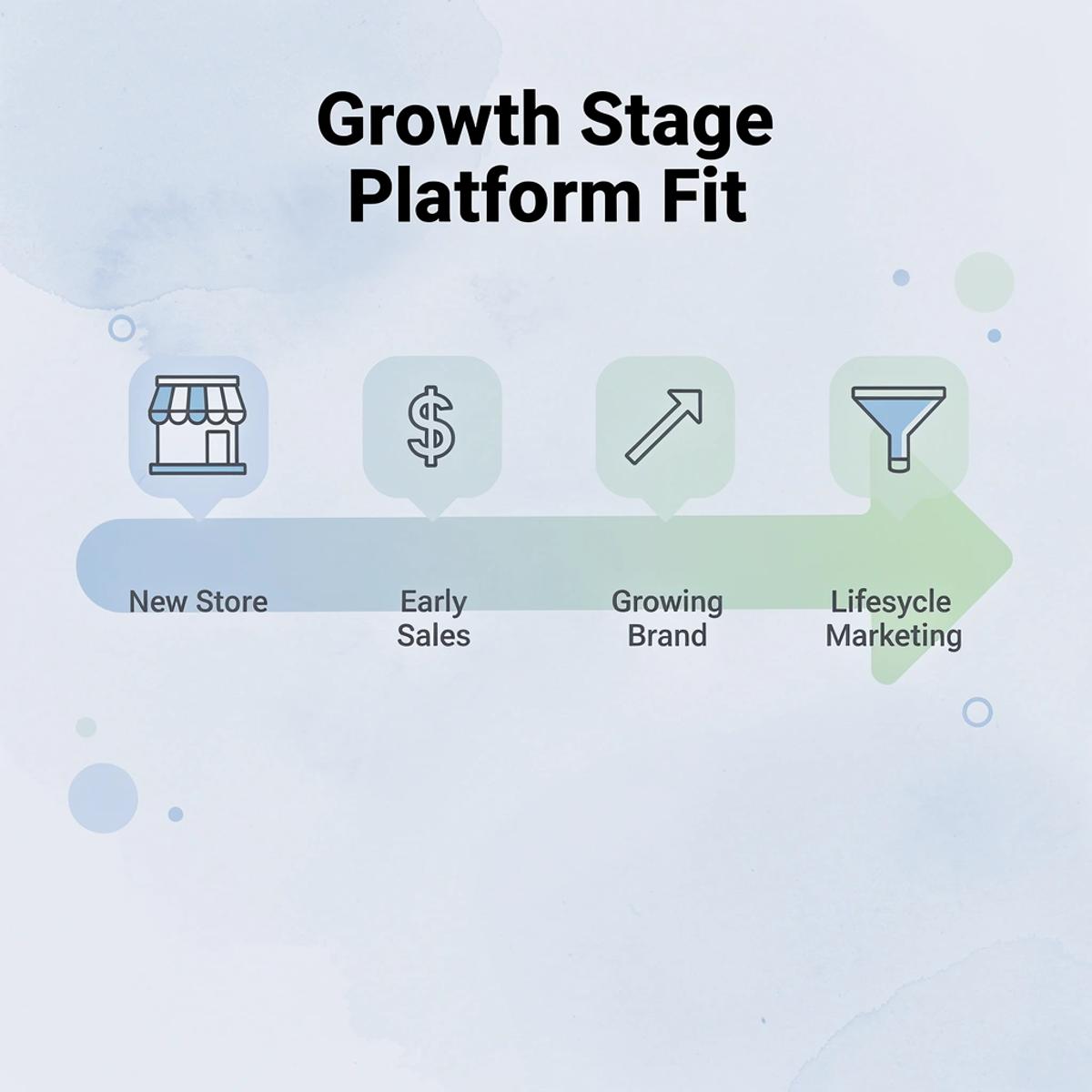
The platform that fits your business depends on what you're doing now, not what you hope to accomplish in six months. New stores need speed and simplicity to test offers and generate early sales. Growing brands require segmentation and lifecycle marketing to maximize value from customers. Choosing software for the business you want to become creates unnecessary complexity, higher costs, and unused features while fundamental problems remain unsolved.
"Choosing software for the business you want to become creates unnecessary complexity, higher costs, and unused features while fundamental problems remain unsolved."
New Store
Primary Need
- Speed & simplicity
Key Focus
- Testing offers, generating early sales
Growing Brand
Primary Need
- Segmentation & lifecycle marketing
Key Focus
- Maximizing customer value
Scaling Business
Primary Need
- Advanced automation & integrations
Key Focus
- Retention and revenue optimization
🎯 Key Point: Always match your platform to your current stage — not your future ambitions. Overbuilding your tech stack too early leads to wasted spend and stalled growth.
⚠️ Warning: Selecting a feature-heavy platform before you have the team or traffic to use it is one of the most common and costly mistakes early-stage store owners make.
New Stores Validate First, Automate Later
When you're still figuring out product-market fit, advanced email features won't move the needle. The real challenge isn't complicated segmentation or predictive analytics: it's generating enough sales to prove the business model works. You need basic campaigns, welcome emails, abandoned cart recovery, and simple customer communication without spending hours on conditional logic or behavioral triggers. Many merchants never reach the point where Klaviyo's advanced features become necessary because they haven't addressed conversion rates, customer acquisition costs, or repeat-purchase behavior. Shopify Email often provides sufficient functionality to support early growth without requiring dedicated retention marketers.
Early-Stage Brands Build Repeatable Systems
Once consistent orders arrive, email becomes a revenue channel. Focus on core systems that retain customers: welcome sequences, abandoned cart flows, post-purchase emails, and re-engagement campaigns. The goal is to build reliable systems that generate repeat revenue without constant manual effort, not to create dozens of automations. Whether Shopify Email or Klaviyo is a better fit depends on your growth rate and available resources. If your team can dedicate time to advanced segmentation and reporting, Klaviyo's capabilities create measurable value. Otherwise, simpler tools your team uses will outperform sophisticated platforms left half-configured.
Scaling Businesses Segmentation Starts Paying Off
Broad messaging loses effectiveness as customer lists grow. Someone who purchased yesterday shouldn't receive the same email as someone who hasn't bought in six months. Behavioral segmentation, customer lifecycle marketing, product-specific automations, and revenue attribution analysis become justified at scale. According to Sprinklr, 54% of social browsers use social media to research products, meaning your email subscribers evaluate your brand across multiple channels before engaging with your message. Klaviyo's segmentation capabilities let you send different messages based on browsing behavior, purchase history, and engagement patterns. The revenue gains from better targeting often outweigh additional software costs when you have sufficient customer data to leverage advanced features.
Established Brands Maximize Lifetime Value
Mature ecommerce businesses shift focus from generating sales to maximizing customer lifetime value. These organizations require sophisticated customer segmentation, predictive analytics, advanced automation workflows, SMS integration, multi-channel retention strategies, and detailed behavior analysis. For teams with dedicated marketing resources, Klaviyo's flexibility enables execution at scale. The Fortune Business Insights report projects the global customer data platform market will grow from $4.07 billion in 2026 to $17.03 billion by 2034, reflecting how established brands increasingly invest in tools that unify customer data and enable personalized experiences across every touchpoint.
Does your team have the capacity to use what you choose?
Most merchants choose email platforms based on features rather than capacity. They compare automation capabilities, reporting dashboards, and integration options without considering whether their team will use them. A platform with 200 features means nothing if you need only 15 and lack time to configure the rest. The best software decision is one your team can set up, consistently use, and get measurable results from without requiring expertise you don't possess. A clear retention plan executed on simpler tools will outperform sophisticated platforms with no guiding strategy.
But choosing the right email platform only matters if the pages those emails send traffic to convert visitors into buyers.
How PagePilot Helps You Improve the Pages Your Emails Send Traffic To
Your email platform gets clicks, but most revenue is lost after that click. Whether you use Shopify Email or Klaviyo, the real problem isn't automation or segmentation — it's the page that receives the visitor. That's where conversions happen, and that's exactly where PagePilot helps.
"The real problem isn't automation or segmentation — it's the page that receives the visitor. That's where conversions happen."
🎯 Key Point: Your email click-through rate is only half the battle. The landing page experience is what actually determines whether that traffic turns into revenue.
💡 Tip: If you're investing in email marketing through tools like Shopify Email or Klaviyo, pairing them with PagePilot ensures your post-click experience is never the weak link in your funnel.
Weak Landing Page Experience
What Fixes It
- PagePilot page optimization
Poor Email-to-Page Alignment
What Fixes It
- Targeted, conversion-focused pages
Relying on Automation Alone
What Fixes It
- Combining segmentation + page quality
Speed determines how many products you can test
Most merchants build product pages by hand, spending many hours on each product writing copy, formatting images, and assembling everything. This time cost limits how many offers you can test, which products you can launch, and how quickly you can respond to market opportunities. When your email list is ready to drive traffic but your product page isn't built yet, speed becomes the constraint that determines whether you capture revenue or miss the window.
How does PagePilot's AI page builder remove the manual bottleneck?
PagePilot's AI page builder converts competitor URLs or supplier links into complete product pages in under two minutes. Provide a reference page, and our platform generates branded copy, product descriptions, and layout structures that match your store's existing look, eliminating the manual assembly process that slows testing.
Why do generic supplier assets make differentiation nearly impossible?
Many stores use images and descriptions from their suppliers because creating custom assets requires design skills, photography budgets, or hiring creative professionals. When competitors use the same assets, customers see identical product presentations across multiple stores, making price the only differentiator. This race to the lowest price erodes profit margins and increases customer acquisition costs.
How can AI product imagery help merchants stand out from competitors?
PagePilot's AI product image feature helps merchants upgrade product photography without professional shoots or design expertise. When your email drives traffic to a product page that looks visually distinct from competitors, conversion rates improve because customers perceive greater value and trust in the product presentation.
Testing Different Angles Requires Multiple Page Versions
The most successful email campaigns test different messaging angles, value propositions, and positioning strategies to find what works with specific customer groups. One audience might respond to convenience benefits while another prioritizes quality or status. Creating separate landing pages for each angle traditionally requires duplicating the entire page-building process, making testing slow and costly.
Platforms like PagePilot allow merchants to quickly generate multiple page variations, each emphasizing different product benefits or customer pain points. Instead of spending hours building three versions of the same product page, you can launch all three variations in the time it previously took to build one. This speed transforms testing from an occasional experiment into continuous optimization that compounds improvements across your email marketing strategy.
Start a FREE Trial and Generate 3 Product Pages with Our AI Page Builder today
Choosing between Shopify Email Marketing and Klaviyo is part of the revenue equation—even the best email platform struggles when visitors land on weak product pages. Your emails can have a perfect open rate and flawless copy, but if the page they click through to fails to convert, that effort is wasted.
"The strongest email strategy in the world can't save a poorly optimized product page—your landing experience is where revenue is won or lost." — PagePilot
💡 Tip: Before choosing your email platform, audit your product pages first—they're the real conversion bottleneck most stores overlook.
⚠️ Warning: Sending high-volume email campaigns to underperforming product pages doesn't waste traffic—it trains your audience to ignore future sends.

With PagePilot, you can generate high-converting product pages from a competitor or supplier URL, create upgraded product visuals, and test new products and marketing angles faster than ever before. Start your free trial today and generate three product pages at no cost, with no credit card required.
Page Generation
What You Get
- High-converting pages from any competitor or supplier URL
Product Visuals
What You Get
- Upgraded, professional-grade imagery
A/B Testing
What You Get
- New products and marketing angles are tested rapidly
Free Trial
What You Get
- 3 product pages at zero cost — no credit card needed
🎯 Key Point: PagePilot removes the biggest bottleneck in your store's growth—turning weak product pages into conversion-ready landing experiences in minutes.
✅ Best Practice: Pair your Klaviyo or Shopify Email campaigns with PagePilot-generated product pages to ensure every click has the best possible chance of becoming a paying customer. Start your free trial and build your first 3 pages for free.
Related Reading
- Best Seo App For Shopify
- Best Shopify Theme for SEO
- Yotpo Alternatives
- Lucky Orange Alternatives