
Running a Shopify store means competing for attention every day, and even strong products can go unnoticed without a clear marketing plan. Shopify Marketing Automation helps store owners reach the right customers, build trust, and turn traffic into consistent revenue. Knowing which strategies actually work saves time and removes the guesswork from growing a business.
Traffic only matters when the pages it lands on are built to convert. Well-structured product pages close the gap between a visitor and a sale, making them just as important as any campaign. Store owners who want to build those pages faster, without needing a design background, can get a head start with an AI page builder.
Table of Contents
Growing a Shopify Store Has Become Increasingly Difficult
Why Many Shopify Stores Struggle to Scale
7 Most Effective Shopify Marketing Strategies
What High-Growth Shopify Brands Do Differently
Speed Has Become a Competitive Advantage in Ecommerce
How PagePilot Helps Shopify Stores Test and Scale Faster
Start a FREE Trial and Generate 3 Product Pages with Our AI Page Builder today
Summary
- Only 5% of Shopify stores survive past their first year, according to data from Chargeflow, and the competitive pressure compounds as the platform now hosts over 4.8 million live websites worldwide. The failure point for most merchants is rarely the product itself. It is the inability to convert traffic that is already arriving, often because product pages rely on supplier photos and generic copy that look identical to dozens of competing stores.
- Paid advertising costs have risen sharply, with Facebook ad CPMs reaching $16.06 on average in November 2025 and peaking above $28 during the holiday season, according to Shopify's own data. Paying more to reach buyers who then land on unconvincing pages does not improve outcomes. It accelerates losses while obscuring whether the real problem is the audience, the offer, or the page itself.
- Email marketing remains one of the highest-returning channels in ecommerce, delivering an average ROI of $42 for every $1 spent, according to Wisepops. Despite this, many growing stores invest the bulk of their budget in cold traffic acquisition while leaving retention flows half-built. Existing customers already trust the brand, require less convincing, and convert at rates that most paid campaigns cannot match.
- Content marketing generates three times more leads than outbound marketing at 62% less cost, according to the Shopify Blog. Stores that execute this well do not publish generic content. They target the specific searches buyers make before they are ready to purchase, such as ingredient comparisons, problem-focused queries, and product alternatives, intercepting buyers at the moment they are forming a preference.
- The average Shopify store converts at 1.4%, while top performers reach 3.3% or higher, according to Brenton Way. That gap is not a traffic problem. It comes from how consistently a store tests headlines, social proof placement, image sequencing, and benefit framing, treating product pages as living assets rather than finished work.
- Speed of iteration separates stores that scale from stores that plateau. Small businesses can make decisions up to 5x faster than large enterprises, according to TriNet, and in ecommerce that structural agility matters more than budget size. Stores running ten product tests per month accumulate performance data and sharpen their read on customer psychology twice as fast as stores running five, with U.S. e-commerce sales projected to reach $1.2 trillion in 2025, making the compounding effect of faster learning increasingly significant.
- AI page builder tools like PagePilot address the gap between deciding to test a product and having a live, brand-quality page ready to receive traffic, collapsing a process that typically takes days into minutes.
Growing a Shopify Store Has Become Increasingly Difficult
Growing a Shopify store today is harder than ever. Only 5% of Shopify stores make it past their first year, according to Artios - Shopify Statistics 2025, and Chargeflow reports that Shopify powers over 4.8 million live websites worldwide, creating relentless competitive pressure from day one.
"Only 5% of Shopify stores make it past their first year while 4.8 million live websites compete for the same customers." — Artios & Chargeflow, 2025
🚨 Warning: The odds are not in your favor. With 4.8 million stores on the platform, blending in is the fastest path to becoming part of the 95% that fail.
The failure point is rarely the product. Most merchants who shut down ran out of money because the cost of getting noticed kept rising while conversion rates stayed flat. Facebook ad CPMs hit $16.06 in November 2025 and peaked above $28 during the holiday season. Paying more to reach people who land on an unconvincing page is not a growth strategy; it is an expensive way to learn what isn't working.
🔑 Takeaway: Rising ad costs combined with flat conversion rates create a compounding problem. Every dollar spent on traffic becomes less valuable if your store experience isn't built to convert.
💡 Tip: Before scaling ad spend, audit your conversion rate first. Sending more traffic to a low-converting store only accelerates budget burn, not revenue growth.
Why do so many stores fall into the same competitive trap?
The pattern repeats across stores: a merchant finds a product, builds a page using supplier images and generic copy, runs ads, and watches click-through rates outperform conversion rates. When your store looks identical to a dozen others selling the same item, price becomes the only differentiator—a race nobody wins.
Most store owners respond by manually rebuilding pages, testing layouts, and sourcing better images across multiple tools over weeks of iteration. This slows testing velocity while teams remain in production mode. An AI page builder like PagePilot generates brand-quality product pages in minutes, enabling merchants to test new products and angles quickly without sacrificing the polish that builds buyer trust.
What makes the expectation gap so hard to close in 2025?
What makes this time period different is the expectation gap. Customers in 2025 have reviewed thousands of product pages and recognize supplier photos and generic writing. Standing out now requires showing products in a way that feels thoughtful, specific, and trustworthy before any trust is earned.
Even merchants who fix the page quality problem discover it removes only one obstacle from a longer list.
Related Reading
- Shopify Marketing Automation
- How To Set Up Email Marketing On Shopify
- Shopify Email Marketing Vs Klaviyo
- How To Advertise a Shopify Store
- Shopify Social Media Marketing
- Seo Marketing Shopify
Why Many Shopify Stores Struggle to Scale
Removing one obstacle rarely clears the path. It just makes the next one visible — and for most Shopify store owners, that cycle of surface-level fixes is exactly what keeps them from scaling with confidence.
"The stores that struggle to scale aren't lacking effort — they're lacking a systematic approach to identifying and eliminating the real bottlenecks."
⚠️ Warning: Fixing one problem at a time is a reactive strategy. Without a holistic view of your store's growth barriers, you'll always be one step behind.
🎯 Key Point: Sustainable scaling requires understanding that every obstacle removed simply reveals the next layer of friction — and that's not a failure; it's the process.
Traffic Problems
What It Reveals Next
- Conversion rate weaknesses
Conversion Fixes
What It Reveals Next
- Average order value gaps
Average Order Value Gaps
What It Reveals Next
- AOV improvements
Retention & Loyalty Issues
What It Reveals Next
- Retention gains
Fulfillment & Ops Bottlenecks
What It Reveals Next

- Operational scaling constraints
Why can't most Shopify stores test fast enough to stay competitive?
Most stores with page-quality problems face a structural issue: they cannot test quickly enough to stay competitive. A merchant might spend a week building a product page, run ads for three days, decide the angle is wrong, and spend another week rebuilding. By the time the second version is live, a competitor has cycled through four variations and found one that converts. Speed of iteration, not budget size, separates stores that scale from those that plateau.
The same issue surfaces in product validation and ad creative testing. According to Chargeflow's Shopify Statistics report, only 5% of Shopify stores survive their first year, and the gap between those that succeed and those that fail often hinges on how quickly they identify what works and double down on it. Stores requiring days to build new pages, generate product images, and produce ad creatives for each test operate at a structural disadvantage before spending a dollar.
How does a fragmented workflow become the real bottleneck?
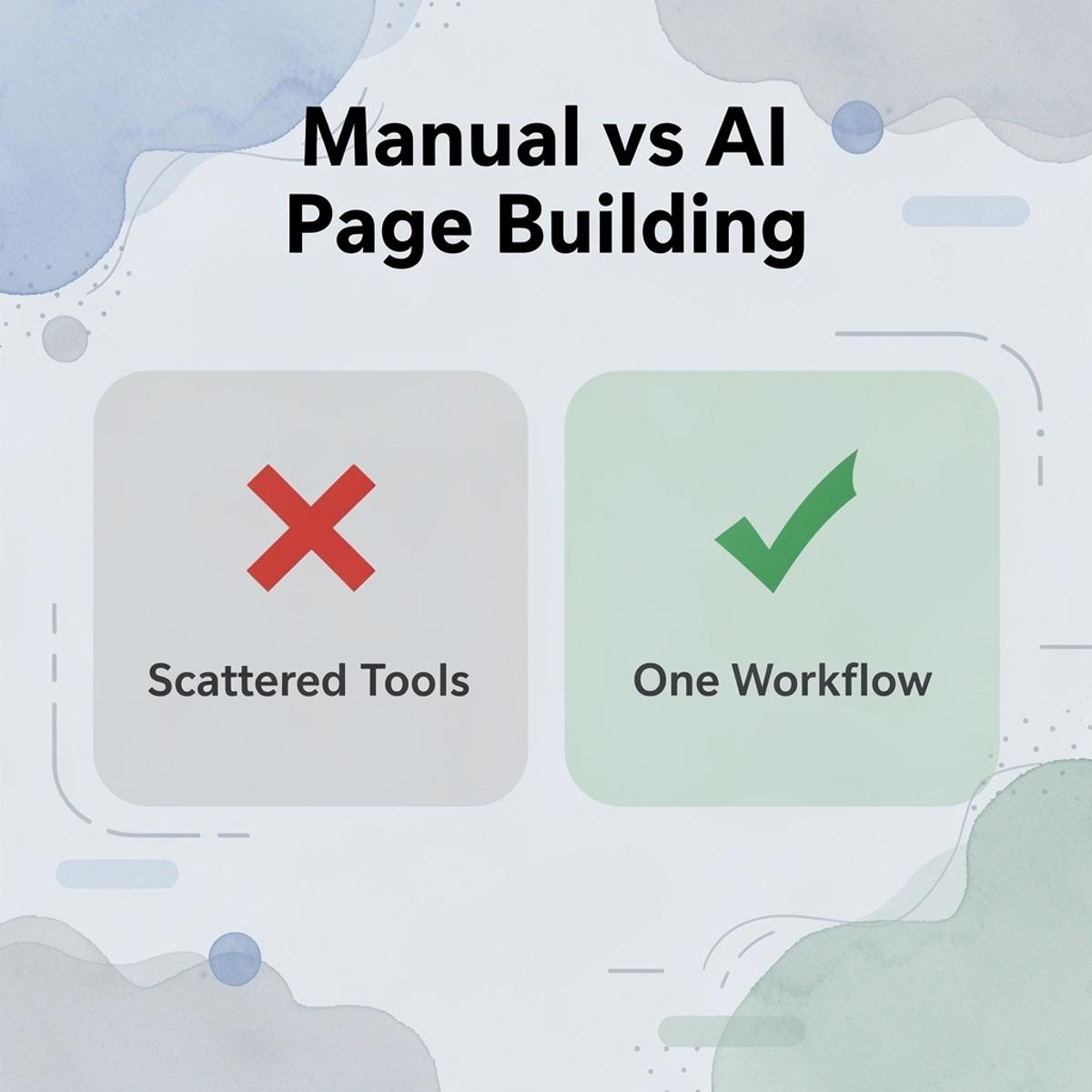
Most merchants batch their work: build the page, source images separately, brief a designer for ad creatives, then write copy for each channel. But as product testing accelerates, that workflow becomes the bottleneck. Each handoff adds delay, and the system breaks down when testing multiple products across markets simultaneously. Our PagePilot AI page builder combines page creation, product image generation, and ad creative production into a single workflow, shrinking the time between "I want to test this product" and "the page and ads are live" from days to minutes.
Many merchants assume their problem is product selection and spend weeks researching trends and sourcing samples. But a merchant who shared a detailed breakdown of how to achieve a $1,200 profit per day made it clear: the product mattered less than creative quality and how quickly losing angles were replaced with new ones. Scaling stores treat product pages and ad creatives as hypotheses rather than finished work, requiring infrastructure that supports rapid revision rather than careful construction.
Why does weak positioning compound every other scaling problem?
Positioning becomes a bigger problem when you treat it as a one-time decision. Two stores selling the same product perform differently, not because one has a better product, but because one has clearer benefit framing, better audience targeting, and messaging that speaks to what a specific customer wants rather than generic features. Without this upstream clarity, well-funded ad campaigns generate bouncing traffic, and merchants attribute the result to a product problem rather than a messaging problem.
The stores that figure this out stop thinking about scaling as spending more and start thinking about it as learning faster.
7 Most Effective Shopify Marketing Strategies
Learning faster than your competitors doesn't mean anything if you don't know which levers to pull.
💡 Tip: The 7 most effective Shopify marketing strategies below are exactly those levers — proven, actionable, and built for store owners who want real results.
"Knowing what to do is the critical difference between stores that scale and stores that stall." — Marketing Principle
Email Marketing
Primary Benefit
- High ROI, repeat buyers
Difficulty
- Low
SEO Optimization
Primary Benefit
- Organic traffic growth
Difficulty
- Medium
Social Media Ads
Primary Benefit
- Fast reach, brand awareness
Difficulty
- Medium
Influencer Partnerships
Primary Benefit
- Trust-building, new audiences
Difficulty
- Medium
Upselling & Cross-selling
Primary Benefit
- Higher-order value
Difficulty
- Low
Loyalty Programs
Primary Benefit
- Customer retention
Difficulty
- Low
Content Marketing
Primary Benefit
- Long-term authority building
Difficulty
- High
⚠️ Warning: Trying to implement all strategies at once is a common mistake — focus on mastering one lever at a time before scaling your efforts.
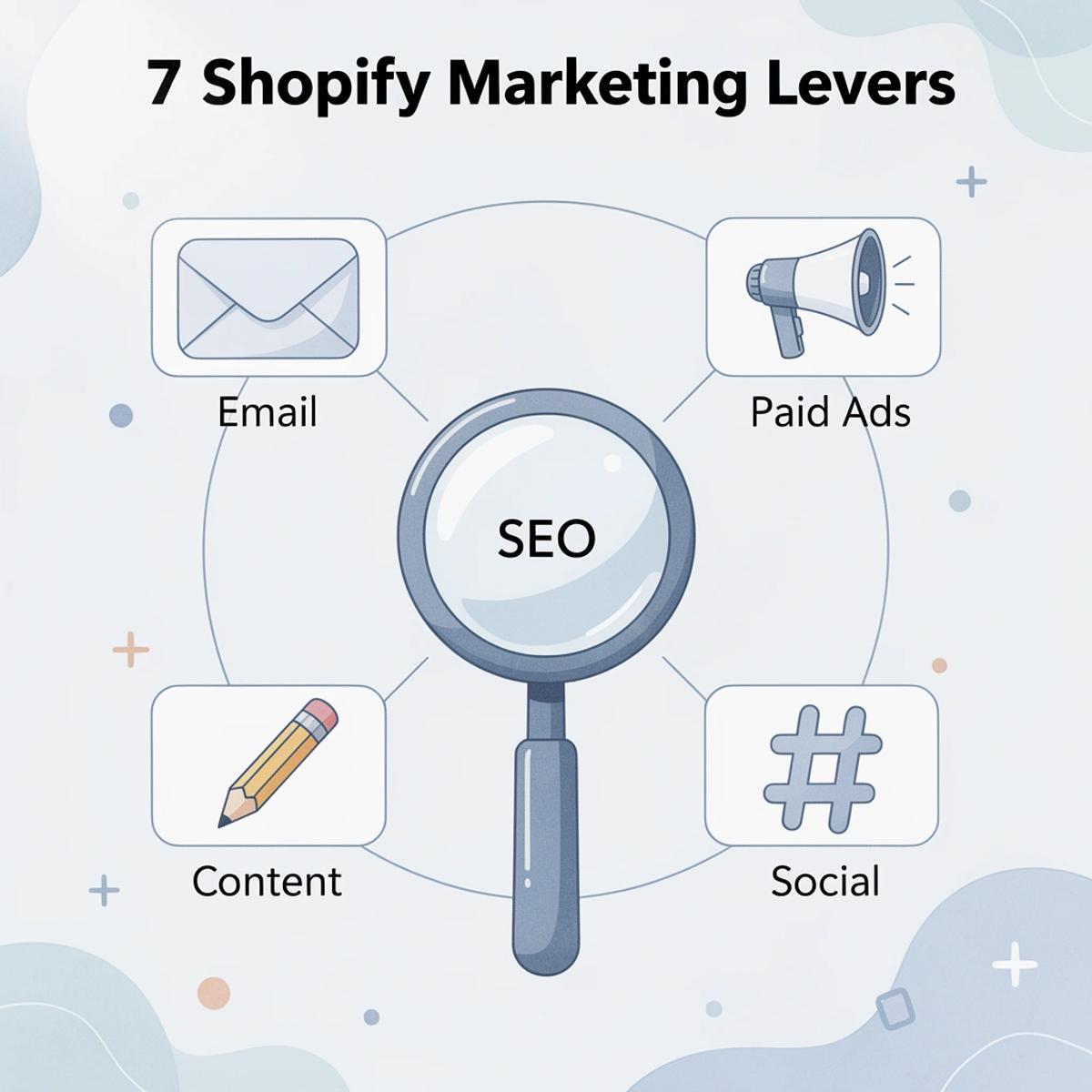
🔑 Takeaway: The right marketing strategy isn't about working harder — it's about pulling the right levers at the right time to drive sustainable Shopify growth.
1. Paid Advertising
Paid advertising is the fastest way to get traffic and test if your message connects with people. Platforms like Meta, TikTok, Google, and Pinterest can reach your target audiences within hours. However, speed without strategy wastes money.
Why do so many paid ad campaigns fail to convert?
The problem usually isn't the ad itself: it's where the ad takes people. Merchants run great-looking ads that drive clicks to product pages, fail to answer what buyers want to know, and then blame the audience. The audience was fine. The page was not.
Where should merchants focus their testing energy instead?
Most stores change ad copy and test new creative designs, but the real problem is what happens next. When a product page lacks headlines explaining benefits, trust signals, and clear calls to action, increased ad spending won't improve conversion rates. Merchants who test ads, offers, and pages simultaneously see better results. This is where AI page builder changes things: PagePilot helps merchants create professional-quality pages in minutes and run tests the same afternoon instead of spending days rebuilding.
2. Email and SMS Marketing
Stores that consistently outperform their acquisition costs treat email and SMS as infrastructure, not afterthoughts. According to Wisepops, email marketing delivers an average return of $42 for every $1 spent. This grows when you add abandoned cart sequences, post-purchase follow-ups, and reactivation campaigns.
A common pattern emerges across growing stores: subscriber lists exist, flows are half-built, and merchants focus entirely on acquiring new customers. Existing buyers already trust you and require far less convincing than cold traffic. Retention marketing multiplies acquisition rather than competing with it.
3. Influencer and UGC Campaigns
Trust is earned before the sale, not during it. Influencer partnerships and user-generated content provide social proof that product descriptions cannot match. A real person demonstrating a product in context carries more persuasive weight than any self-written headline.
Smaller creators with engaged, niche audiences often outperform accounts with 10 times as many followers because their recommendations feel personal rather than sponsored. User-generated content also extends beyond its original post: repurposed across product pages, ad campaigns, and email sequences, it becomes a lasting asset that continues generating value.
4. SEO and Content Marketing
Paid traffic is rented. The moment you pause the budget, the visitors stop. SEO and content marketing build something you own, with significant compounding effects over 12 to 24 months. According to the Shopify Blog, content marketing generates three times as many leads as outbound marketing at 62% lower cost.
Stores that execute this well target the specific searches their buyers make before purchase: ingredient comparisons, problem-focused queries, buying guides, and product alternatives. A skincare brand ranking for "niacinamide vs. retinol for acne" intercepts buyers as they form their preference.
5. Upsells and Retention Marketing
Selling to existing customers costs far less than acquiring new ones, yet most Shopify stores spend heavily on customer acquisition. After-purchase upsells, product bundles, subscription programs, and loyalty rewards distinguish profitable businesses from those locked into costly ad-spending cycles.
Reminders to buy again deserve special attention. For products that get used up, emails sent when customers are running low convert better than most cold traffic campaigns. The customer already knows the product works and needs only a gentle nudge to repurchase.
6. Product Page Optimization
Two stores selling the same products at the same price often convert at different rates. The difference lies in the product page. Headlines that explain benefits, high-quality visuals, product videos, real reviews, and clear guarantees remove the doubt that causes visitors to leave.
A 1% improvement in conversion rate across meaningful traffic can generate thousands in monthly revenue without increasing ad spend. Most merchants treat product page optimization as a one-time task rather than an ongoing practice, leaving this opportunity untapped.
7. Testing Multiple Offers and Positioning Angles
The same product appeals to different buyers depending on how you present it. A portable blender marketed for morning routines attracts different customers than one marketed for travel convenience or post-workout nutrition. Each angle speaks to people with different motivations.
Why do stores that iterate on positioning angles scale faster?
Stores that grow fastest test different positioning angles quickly to find what works before competitors do. Testing different headlines, pricing structures, bundle configurations, and emotional versus practical benefit framing is a system, not guesswork. Merchants who treat it systematically learn faster than those running a single creative indefinitely.
What separates stores that figure this out from those that stay stuck is the strategies they use.
What High-Growth Shopify Brands Do Differently
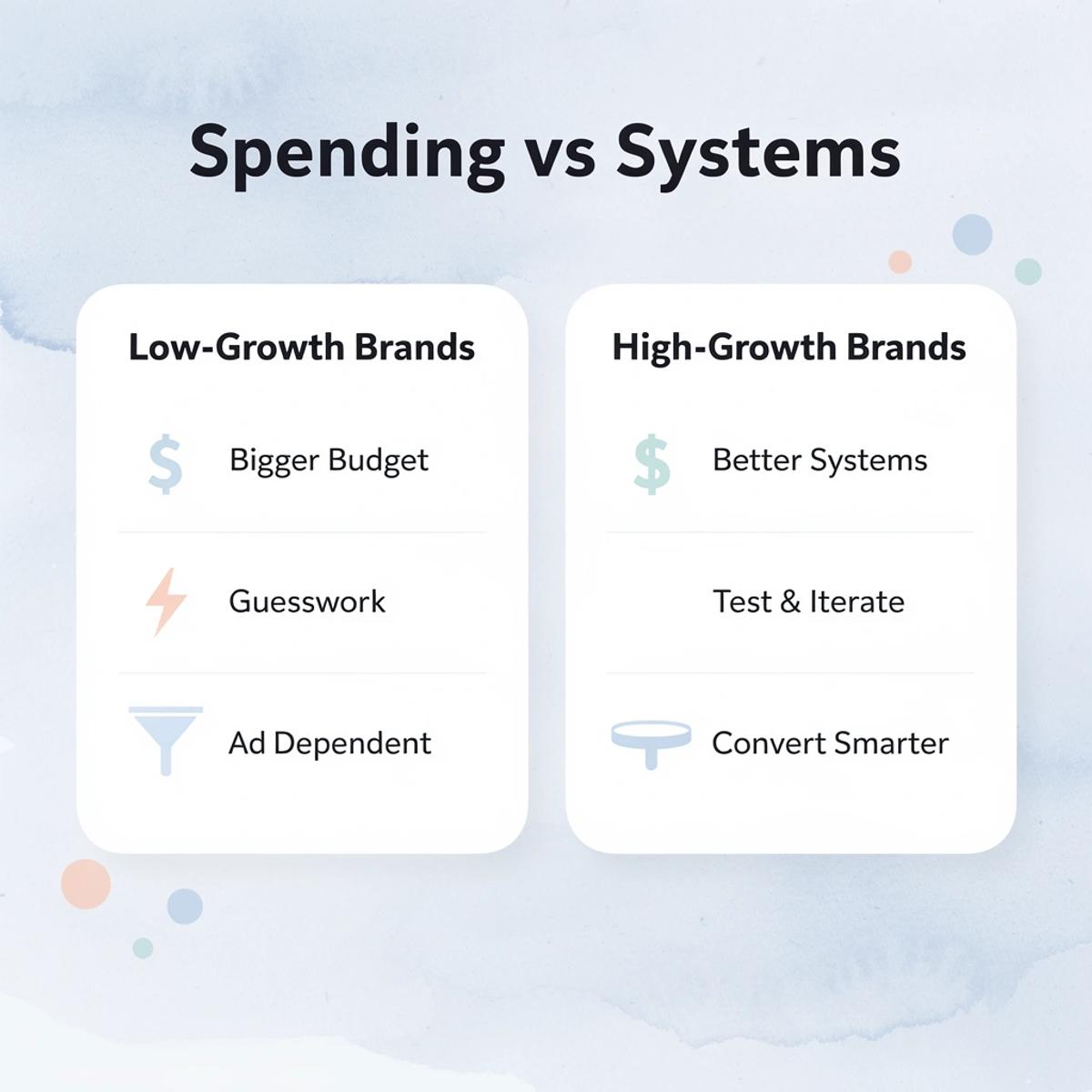
High-growth Shopify brands build better systems. The difference shows up in how they test, iterate, and convert, not in luck or ad budget.
🎯 Key Point: The brands pulling ahead aren't outspending competitors — they're out-systematizing them at every stage of the funnel.
"The difference between high-growth brands and stagnant ones isn't budget — it's the discipline to test, iterate, and convert with intention."
💡 Tip: Before scaling ad spend, audit your conversion systems first. More traffic to a broken funnel is just more wasted money.
What Average Brands Do
- Rely on the ad budget to drive results
- Guess at what converts
- Scale spend on weak funnels
- React to trends
What High-Growth Brands Do
- Build repeatable systems that compound
- Test and iterate with data
- Optimize conversion before scaling
- Proactively build infrastructure
Conversion is the real metric
Brenton Way reports that the average Shopify store converts at 1.4%, while top performers hit 3.3% or higher. This gap stems from page design, positioning, and testing, not traffic. Winning brands run structured experiments across product pages, headlines, pricing displays, and benefit framing. Most stores run one version of everything and plateau.
Winning stores treat product pages as living assets. They test benefit-focused headlines against feature-focused ones, experiment with social proof placement, image order, and urgency framing. Each test yields information that compounds into conversion rates no amount of ad spending can match.
Why do high-growth brands look different from the competition?
Most stores use supplier-provided images and descriptions, making their pages indistinguishable from competitors. High-growth brands invest in original imagery, compelling creatives, and messaging that addresses specific buyer concerns rather than listing features. When a page feels built for the visitor rather than assembled from a template, the purchase decision becomes easier.
How does collapsing the traditional workflow change what merchants can test?
Building a traditional page requires coordinating copywriters, designers, developers, and agencies, a process that takes days per test. Our AI page builder collapses that workflow into minutes, producing brand-quality pages with original visuals and persuasive copy without a dedicated team. Merchants can now run more experiments in a week than most stores run in a quarter.
How do you learn from competitors without copying them?
Study competitor stores the way a chess player studies past games: to understand the logic, not copy the moves. Notice which products they promote with paid ads, which emotional angles they focus on, and where problems exist on their pages. Then build something better. According to Brenton Way, Shopify merchants generated over $9.4 billion in sales during BFCM 2024, a 24% increase from the previous year. That growth came from stores that improved their positioning, educated customers earlier in the sales process, and converted better when traffic arrived.
Why is customer education an underrated conversion lever?
Teaching customers about your product drives sales. Buyers who understand what a product does, why it works, and who it's for are more likely to purchase. Fast-growing brands build education into their product pages using comparison sections, FAQ blocks, and use-case framing, reducing friction at the moment of purchase.
The brands that figure this out faster share one quiet advantage most people overlook.
Speed Has Become a Competitive Advantage in Ecommerce
That quiet advantage is speed. Not server speed or shipping times, though those matter. The speed at which you learn, build, and respond to market signals.
"The merchants who win aren't those with the most resources — they're the ones who spot a signal, build a page, run a test, and read results before competitors finish planning."
🎯 Key Point: Speed isn't operational alone—it's strategic. The ability to learn and act faster than competitors is a compounding advantage that grows over time.

New products surface on TikTok and spread to copycat stores within 72 hours. The merchants who win aren't those with the most resources — they're the ones who spot a signal, build a page, run a test, and read results before competitors finish planning. According to TriNet, small businesses make decisions up to 5 times faster than large enterprises, and in ecommerce, that structural agility is worth more than most marketing budgets.
🔑 Takeaway: A 5x faster decision-making cycle isn't a minor edge — it's a structural advantage that lets small merchants outmaneuver, outtest, and outlast larger, slower competitors.
Decision-Making Speed
Small Merchants
- Up to 5x faster
Large Enterprises
- Slow, multi-layer approval
Time to Test the New Product
Small Merchants
- Hours to days
Large Enterprises
- Weeks to months
Response to Trend Signals
Small Merchants
- Within 72 hours
Large Enterprises
- Often too late
Structural Agility
Small Merchants
- High
Large Enterprises
- Limited
⚠️ Warning: If your build-and-test cycle takes longer than 72 hours, you're already ceding ground to faster-moving competitors who spotted the same signal.
Why slow workflows cost more than you think
The failure point is almost always invisible. Most store owners don't realize how much time they lose between deciding to test a product and launching a live page. Design changes, copy rewrites, app conflicts, and mobile formatting issues each add hours. Multiply that across five product tests per month, and you've lost weeks of possible learning. The market doesn't pause while you polish.
How does batching page builds slow down your store's growth?
Most merchants batch their page builds, spending a weekend creating several pages at once. The problem is that batching separates insight from execution: by the time a page goes live, the original instinct has aged—trends have shifted, ad costs have moved. Stores that close the gap between idea and live page test far more angles per month and gather performance data faster. Our AI page builder helps merchants generate brand-quality product pages in minutes, not days, enabling more tests without sacrificing quality for speed.
Why does faster iteration create a compounding advantage?
Speed compounds. A store launching ten product tests per month learns what works twice as fast as one running five. This learning sharpens your understanding of customer psychology, pricing sensitivity, and which creative angles resonate with your audience—insights that inform every future campaign, email sequence, and ad creative.
Is outlearning rivals more valuable than outspending them?
With U.S. e-commerce sales projected to reach $1.2 trillion in 2025, according to Landmark Global, the opportunity is substantial, but competition is fierce. Winning stores learn faster than their competitors, not by spending more money. A larger budget applied to a slow process still results in a slow process.
The advantage goes to merchants who treat fast execution as a core strategy without sacrificing quality.
Related Reading
- Best Marketing Tools For Shopify
- Best Shopify Marketing Apps
- How To Advertise a Shopify Store
- Best Shopify Marketing Agency
- Best Shopify Email Marketing Apps
How PagePilot Helps Shopify Stores Test and Scale Faster
After learning about Shopify marketing strategies, many store owners face the same critical challenge: testing products and angles quickly enough to stay competitive in an increasingly crowded market. PagePilot addresses this directly — giving merchants the tools to move faster, iterate smarter, and scale winning concepts before the competition catches up.
"The stores that win aren't the ones with the best products — they're the ones that test fastest and scale smartest." — PagePilot
🎯 Key Point: Speed of testing is one of the most overlooked competitive advantages in Shopify eCommerce — the faster you validate, the faster you scale profitably.
💡 Tip: Use PagePilot to rapidly generate and deploy landing page variations, so you're never waiting on design or development bottlenecks to find your next winning angle.
Product Testing Speed
Without PagePilot
- Slow, manual page builds
With PagePilot
- Rapid page generation
Angle Iteration
Without PagePilot
- Costly redesigns
With PagePilot
- Quick, low-friction updates
Scaling Winners
Without PagePilot
- Delayed by bottlenecks
With PagePilot

- Fast deployment at scale
🔑 Takeaway: For Shopify store owners serious about staying ahead, PagePilot transforms the painful process of testing and scaling into a streamlined, repeatable system — turning speed into your biggest competitive edge.
How does PagePilot remove the bottleneck of product page creation?
One of the biggest bottlenecks in ecommerce is page creation. Building a product page from scratch requires gathering supplier assets, writing copy, editing images, and coordinating with designers. By the time of launch, competitors may already be testing the same product. Our AI-powered page builder eliminates this friction: store owners provide a competitor or supplier URL, and PagePilot generates a high-converting product page, letting merchants test and validate ideas without manual creation.
How does PagePilot help stores stand out from competitors using the same assets?
Speed matters, but standing out matters more. Many stores struggle to grow because they use the same supplier images and copy as their competitors. Customers see nearly identical stores, making differentiation difficult. PagePilot's AI Product Image function improves visuals so merchants aren't competing with the same assets used across hundreds of stores.
Copy and positioning drive conversion. A product often succeeds or fails based on how it's presented. PagePilot helps merchants create unique copy and explore different positioning angles, testing various benefits, audiences, and offers without having to rewrite pages from scratch.
How does PagePilot enable rapid experimentation and faster learning?
This flexibility enables rapid experimentation. Rather than spending days perfecting one page, merchants can test multiple approaches, refine what resonates with customers, and make changes based on performance. Faster learning produces better results than perfecting a single page before launch.
PagePilot helps stores avoid a problem that holds back many ecommerce brands: competing with identical products, images, and messaging. Instead of copying supplier assets, merchants can stand out with better visuals, unique positioning, and faster testing cycles.
Start a FREE Trial and Generate 3 Product Pages with Our AI Page Builder today
PagePilot delivers execution speed with brand-quality output. If you've manually assembled product pages, sourced images, and written copy across separate tools, you know how much time vanishes before a single test launches. Paste a competitor or supplier URL and generate three complete, brand-quality product pages in minutes—no credit card required, no setup friction.
Start your free AI page builder trial today and run your first test before the end of the week. Winning stores build, test, and learn faster than competitors can react.
Related Reading
- Best Seo App For Shopify
- Best Shopify Theme for SEO
- Yotpo Alternatives
- Lucky Orange Alternatives