
Many Shopify store owners invest heavily in product selection, pricing, and design, yet overlook the search engine signals that actually drive organic traffic. Common SEO mistakes, from weak meta content to poor page structure, quietly suppress visibility and hurt conversion rates. Shopify Marketing Automation can help by freeing up time to focus on the keyword strategy and on-page optimization that search engines reward.
Fixing these issues does not require becoming an SEO expert. PagePilot is built for Shopify sellers who want product pages that rank well and convert visitors into buyers, handling the technical and copy elements that most store owners find time-consuming. Sellers looking for a faster path to better-performing pages can start with the AI page builder.
Table of Contents
- Why Most Shopify SEO Efforts Don't Generate Sales
- What Successful Shopify SEO Marketing Actually Looks Like
- 9 SEO Marketing Shopify Mistakes That Kill Revenue
- Why Product Pages Often Determine SEO Success
- How Faster Testing Creates Better SEO Results
- How PagePilot Helps Shopify Stores Turn SEO Traffic Into Sales
- Start a FREE Trial and Generate 3 Product Pages with Our AI Page Builder today
Summary
- Roughly half of all pages merchants build never receive a single click from Google. According to Speed Boostr's Shopify SEO analysis, 49% of pages get zero organic traffic, which means a significant portion of build and optimization effort produces no measurable return before conversion even becomes a factor.
- Earning a top ranking carries real value, but only when the page behind it is built to close. The number-one result in Google captures approximately 27.6% of all clicks, according to Ahrefs, yet most merchants send that intent-driven traffic to pages built around inventory logic rather than customer decision-making. The ranking works. The page does not.
- The average Shopify store converts between 1.4% and 3.3% of visitors, according to Brenton Way's analysis of Shopify marketing statistics. Stores at the top of that range are not generating more traffic. They are sending qualified visitors to pages that address objections, reinforce trust, and guide rather than confuse. The gap between those conversion rates compounds directly into revenue over time.
- Page speed is not a technical detail sitting outside the conversion conversation. Google and SOASTA research found that 53% of mobile users abandon sites that take longer than 3 seconds to load, and SEO Sherpa reports that pages that load in 1 second convert at 3 times the rate of pages that load in 5 seconds. Performance decisions made at build time have lasting consequences for every visitor who arrives afterward.
- Content without a conversion goal tends to produce traffic without revenue. Buying guides, product comparisons, and use-case articles move visitors toward a decision. Articles unrelated to the buying process may generate pageviews while contributing almost nothing to checkout. The distinction matters because most stores cannot tell the difference until they check what their blog readers actually do next.
- Testing speed determines how fast a store learns what works. Merchants running a two-to-four week page creation cycle test only a handful of ideas per quarter, leaving losing assumptions in place while paying traffic costs to sustain them. The stores that close the distance between a new idea and a live, measurable result are the ones compounding their SEO investment rather than slowly spending it.
- PagePilot's AI page builder addresses this directly by letting merchants generate brand-matched, conversion-ready product pages in minutes, removing the bottleneck between finding a winning product and having a page built to sell it.
Why Most Shopify SEO Efforts Don't Generate Sales
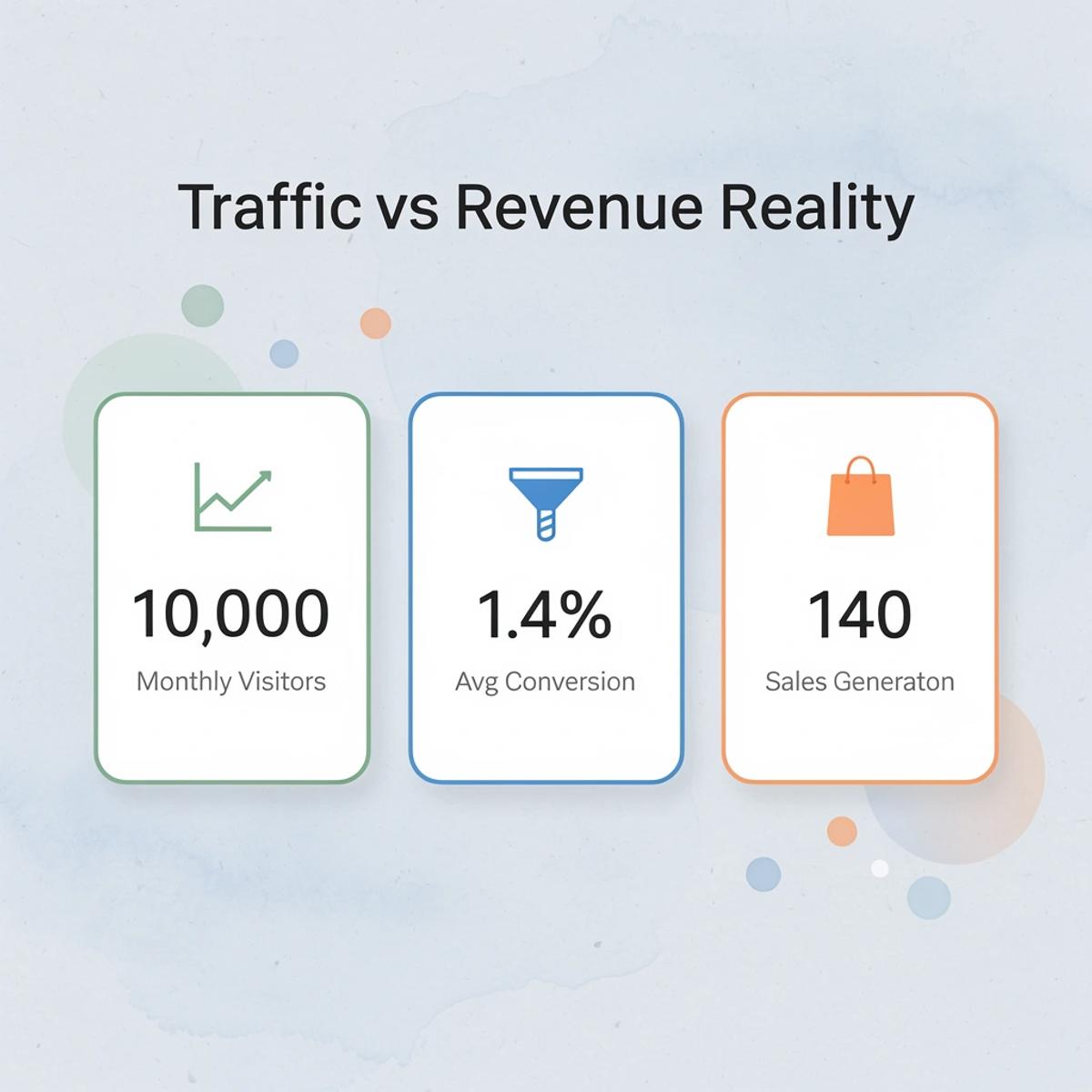
Traffic growth feels like progress. A store getting 10,000 monthly visitors and converting at the Shopify average of 1.4% makes roughly 140 orders, while 9,800 people leave without buying. The traffic number rises. The revenue number barely moves.
"A store converting at the Shopify average of 1.4% sends 9,800 out of every 10,000 visitors away without a single purchase."
🚨 Warning: Chasing higher rankings without fixing the post-click experience is one of the most expensive mistakes a Shopify store can make. You pay for the traffic but never collect the revenue.
🔑 Takeaway: SEO success is measured in orders, not rankings or visits. If your conversion rate stays at 1.4%, doubling your traffic only doubles the number of people who leave.
The failure point is not the ranking. It is what happens after the click.
💡 Key Insight: Rankings get you the visit. Your product pages, site speed, trust signals, and checkout experience determine whether that visit converts to revenue — and most Shopify SEO strategies never address those levers.
Why do visitors leave without buying after clicking your ranking page?
According to Speed Boostr's Shopify SEO analysis, 49% of pages get zero organic traffic from Google. For pages that do rank, visitors arrive with genuine intent only to encounter generic supplier copy, no clear differentiation from competitors, and layouts indistinguishable from other stores. These visitors don't need more traffic; they need better pages.
Most merchants respond to flat revenue by targeting more keywords or publishing more content, believing the answer lies upstream. The same pattern appears across stores: strong keyword rankings, respectable organic visibility, and a conversion rate that undermines every SEO win. A page built on a generic template with unedited descriptions cannot close that gap, regardless of ranking strength.
How does separating page building from SEO create a costly bottleneck?
The familiar approach treats page building and SEO as separate workstreams: one handled by a developer on a slow timeline, the other managed through keyword research. As product catalogs grow and winning products need live pages fast, this separation creates a bottleneck where speed and quality conflict. An AI page builder like PagePilot closes that gap by generating branded, conversion-ready product pages in minutes, with AI-written copy and automatic brand matching.
According to Speed Boostr, the number one Google result receives 27.6% of all clicks. However, this value depends on the page being built to convert. A first-place ranking sending traffic to a weak product page becomes an expensive way to generate bounces rather than an asset.
Traffic without conversion infrastructure is noise with good analytics.
But knowing what goes wrong is only half the picture. The stores that grow from organic search build something fundamentally different.
Related Reading
- Shopify Marketing Automation
- How To Set Up Email Marketing On Shopify
- Shopify Email Marketing Vs Klaviyo
- How To Advertise a Shopify Store
- Shopify Social Media Marketing
- Seo Marketing Shopify
What Successful Shopify SEO Marketing Actually Looks Like
Successful Shopify SEO is a revenue system where every element — from search visibility to product page copy — works as one connected system rather than isolated tactics.
"Successful Shopify SEO is not a checklist of one-off fixes — it's a fully integrated revenue system where each element amplifies the next." — SEO Best Practices
💡 Tip: Think of your Shopify SEO strategy as an ecosystem, not a to-do list. When search visibility, on-page content, and product page copy are aligned, the result is compounding growth — not just a one-time traffic spike.
🔑 Takeaway: The difference between stores that rank and stores that don't comes down to one thing — treating SEO as a connected system where every component, from technical structure to copy, serves a single revenue goal.
Keyword Strategy
- Isolated tactics: One-off keyword fixes
- Connected SEO system: Ongoing keyword strategy
Product Pages
- Isolated tactics: Disconnected product pages
- Connected SEO system: Optimized product page copy aligned with search intent
Business Results
- Isolated tactics: Traffic with no conversions
- Connected SEO system: Search visibility aligned with revenue generation
Growth Outcome
- Isolated tactics: Short-term ranking bumps
- Connected SEO system: Compounding long-term growth
How search intent shapes purchase behavior
Stores that grow steadily from organic search rank for good reasons. A visitor who finds a product page by searching "lightweight running shoes for flat feet" is already halfway through making a purchase decision. Traffic that matches what the person is looking for converts at a fundamentally different rate than traffic chasing high numbers, and that difference shows up directly in revenue.
What does the data say about Shopify conversion rates?
According to Brenton Way's analysis of top Shopify marketing statistics, the average Shopify store conversion rate ranges from 1.4% to 3.3%. Top-performing stores continue the conversation a search result started through copy that addresses objections, visuals that build trust, and structure that guides rather than confuses.
Why does the standard product page process create a bottleneck?
Most merchants build product pages like they're checking off a list: add images, write a description, set a price, publish. This process was designed around managing inventory, not driving sales. When a store tests three new products weekly, this approach creates bottlenecks. Tools like PagePilot's AI page builder exist because the gap between "page is live" and "page converts" once required a designer, copywriter, and days of iteration. Our AI page builder eliminates that friction, letting merchants move from finding a product to having an optimized, brand-matched page in minutes, not weeks.
Where category pages earn their place
Category pages catch shoppers comparing options before purchase. They rank for wider commercial keywords that individual product pages cannot target, bringing traffic earlier in the buying journey. Since over 70% of Shopify store traffic now comes from mobile devices, category pages need to be optimized for fast, thumb-friendly scanning instead of dense text blocks.
How does content reduce friction before the sale?
Buying guides, product comparisons, and FAQ-style articles answer the questions that prevent purchase decisions. A shopper who knows which product suits their situation won't leave to find more information. That reduction in friction separates content that generates revenue from content that merely attracts views.
What separates stores that get SEO right from those that don't?
The stores that succeed treat SEO as connective tissue between what customers search for and what the store delivers. Those who get this right rarely need to ask why their traffic isn't converting.
But knowing what works is only part of the picture. What breaks it is where the real surprises live.
9 SEO Marketing Shopify Mistakes That Kill Revenue
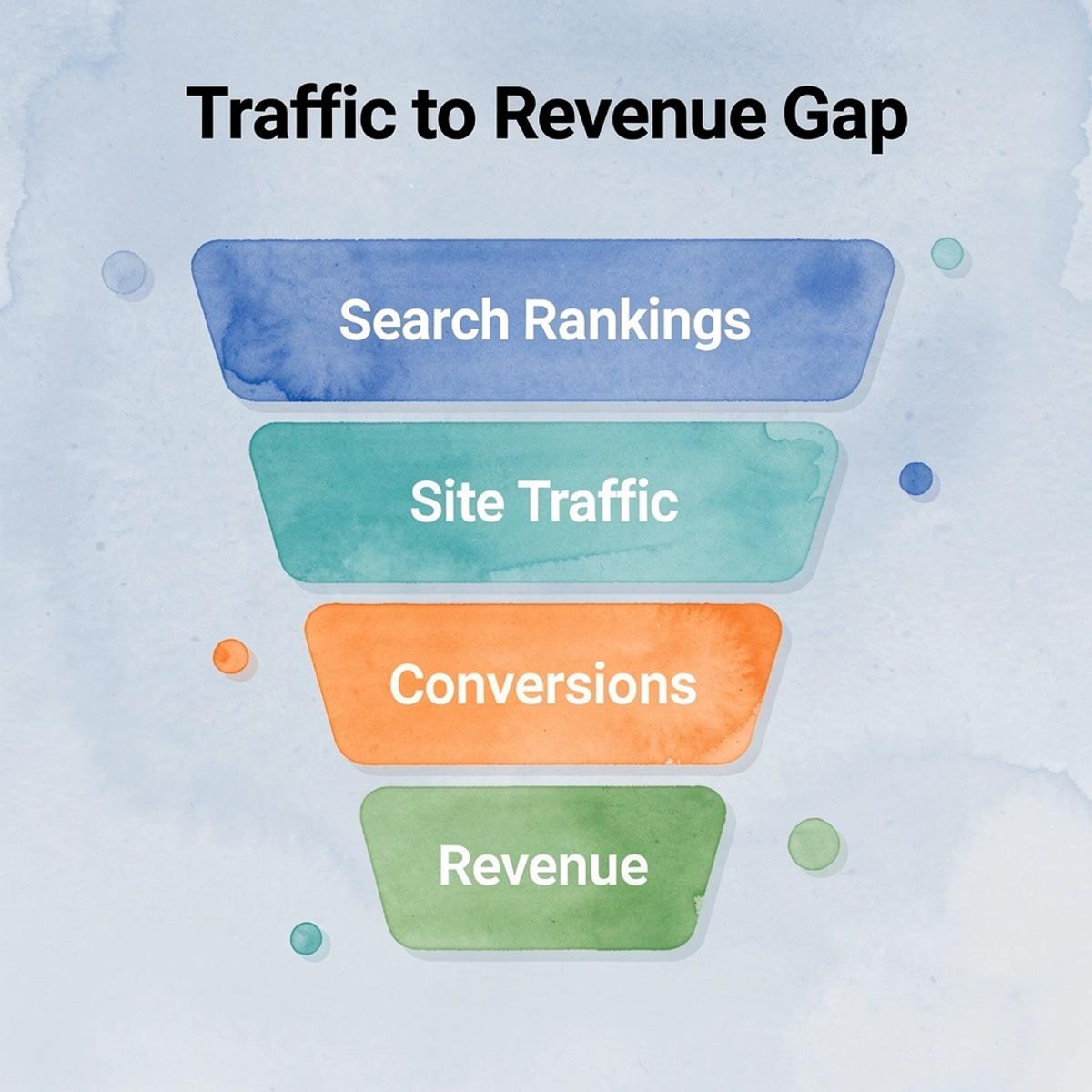
Most SEO failures follow a quiet pattern: rankings look fine, traffic grows, but revenue stalls between search results and checkout.
"Rankings and traffic are vanity metrics if they never convert — the real failure happens silently, in the gap between search results and checkout." — SEO Revenue Insight
⚠️ Warning: A growing traffic graph can mask a deeply broken funnel — don't let vanishing revenue be the first sign something is wrong.
💡 Tip: Always track revenue per visitor, not just organic traffic volume — it's the only metric that reveals whether your SEO strategy is actually working.
Organic Traffic
- What it shows: Visitors arriving from search engines
- Why it matters: Can be a vanity metric if visitors do not convert
Conversion Rate
- What it shows: Percentage of visitors who make a purchase
- Why it matters: Reveals the health and effectiveness of the sales funnel
Revenue Per Visitor (RPV)
- What it shows: Average earnings generated per website session
- Why it matters: Provides a clearer measure of true SEO ROI
Checkout Drop-off
- What it shows: Where potential buyers abandon the purchase process
- Why it matters: Exposes hidden friction points and silent conversion failures
Mistake #1: Targeting Keywords With No Buying Intent
Many merchants choose keywords based on search volume alone, ignoring that traffic creates value only when visitors are likely to become customers. "How does collagen work?" attracts researchers, not buyers. "Best collagen supplements for women over 40" attracts people ready to purchase. The result: traffic rises while revenue stagnates, and merchants blame the algorithm rather than recognizing their keywords don't match customer intent.
Mistake #2: Creating Generic Product Pages
Visitors buy when product pages convince them that a product solves a real problem. Generic pages with basic specs and short descriptions fail to explain why the product matters, who it helps, and why it outperforms alternatives. The result: visitors leave without making a purchase.
Mistake #3: Using Supplier Copy Across Multiple Products
This mistake is especially common among dropshipping stores. Using supplier descriptions feels efficient, but dozens of competitors may use the same copy on their stores. Duplicate content makes it nearly impossible to stand out in organic search, and generic supplier copy focuses on features instead of customer benefits. Even when rankings improve, conversion rates remain weak.
Mistake #4: Ignoring Search Intent
Targeting the right keyword but delivering the wrong experience is costly. Someone searching "best ergonomic office chair" wants comparisons and buying guidance, not a direct product page. When the page doesn't match what the searcher needs, bounce rates rise and conversions fall—not because the visitor was the wrong fit for the store, but because the store was the wrong fit for the visitor.
Mistake #5: Creating Weak Product Positioning
Most Shopify stores describe products accurately but fail to explain why customers should care. Weak positioning forces customers to compare on price alone, surrendering the conversation that matters most.
Strong positioning answers three questions in plain language: who is this for, what problem does it solve, and why is it different from every other option available? Without these answers, the page creates doubt instead of confidence, and doubt rarely converts.
Mistake #6: Neglecting Category Pages
Many Shopify merchants focus on product pages and blog content while overlooking category pages, a missed opportunity. Category pages attract shoppers who know what type of product they want but haven't selected a specific item. A well-optimized category page helps visitors compare options, discover relevant products, and move toward purchase. Neglected category pages leave shoppers without guidance, causing them to abandon their search.
Mistake #7: Publishing Content Without a Conversion Goal
Content marketing is important for Shopify SEO, but many stores create content solely to drive traffic, assuming more visitors automatically means more sales. This works only when content supports a specific stage of the buying process. Buying guides, product comparisons, and use-case articles move visitors toward purchase decisions, while unrelated articles may generate pageviews without contributing meaningfully to revenue.
The result: blogs with thousands of monthly readers, while checkout pages see almost none of them. Content without a conversion goal is a traffic strategy masquerading as a revenue strategy.
Mistake #8: Sending SEO Traffic to Low-Converting Pages
Most merchants lose money not from poor rankings but from what visitors see upon arrival. Weak product images, generic messaging, limited trust signals, slow loading times, and unclear calls to action create friction that no amount of organic traffic can overcome. According to Google/SOASTA Research, 53% of mobile users abandon sites that take longer than 3 seconds to load, a direct revenue leak.
How can you turn SEO traffic into actual revenue?
A page built without conversion principles drains the value from every SEO dollar spent. Our AI page builder at PagePilot addresses this by generating brand-matched, conversion-ready product pages in minutes, eliminating the bottleneck between finding a winning product and launching a live page to sell it.
Mistake #9: Optimizing for Rankings Instead of Revenue
This final mistake drives all the others. When SEO success is measured only by rankings, impressions, and traffic growth, every decision is wrong. Pages get created because they have search volume. Keywords get targeted because they rank easily. Content gets published because competitors publish similar content. Meanwhile, conversion rates, average order value, and revenue from organic traffic receive almost no attention.
Why does ranking alone fail to drive actual sales?
According to HubSpot, 75% of users never scroll past the first page of search results. Ranking is the invitation; what happens on the page is the conversation where most Shopify stores lose the sale without realizing it.
The Real Problem Usually Happens After the Click
When Shopify merchants struggle with organic search performance, the instinct is to focus on backlinks, keyword gaps, or technical site audits. Those factors matter, but the real problem usually emerges after visitors arrive: product pages that fail to convince, positioning that fails to stand out, and content that fails to support buying decisions at critical moments.
The stores that figure this out treat SEO as a customer experience problem, not a visibility problem. This shift changes which pages are built, which keywords are targeted, and how content is structured from the first word to the final call to action.
And the page at the center of it all is almost always the one merchants spend the least time perfecting.
Why Product Pages Often Determine SEO Success
Product pages are where SEO either pays off or fails completely. A ranking gets attention; the page earns the sale. The gap between those outcomes is far wider than merchants expect.
"A ranking gets attention; the page earns the sale — and the distance between those two outcomes is where most eCommerce revenue is lost." — Core SEO Principle
🎯 Key Point: Your product page is the true finish line of your SEO strategy, not the search ranking itself. Every optimization effort lives or dies based on what happens after the click.
⚠️ Warning: Merchants who focus exclusively on ranking higher while neglecting page quality leave significant revenue on the table. Traffic without conversion is a costly mistake.

What does the click data actually reveal?
According to Ahrefs SEO Statistics, the number one Google result receives about 27.6% of all clicks. Most product pages fail to convert this traffic into sales because they lack a genuine buying experience. Supplier descriptions, stock images, and a basic add-to-cart button don't suffice.
Why do high-ranking product pages still fail to convert?
The failure point is invisible to merchants. Traffic arrives and bounces, so they assume the keyword or ranking wasn't strong enough and chase better positions. The real problem sits untouched on the page itself. A product page is not a container for product information: it's a sales conversation frozen in time, where every element either moves the visitor forward or lets them drift away.
What gets missed when merchants build product pages once and walk away?
Most merchants build product pages once and abandon them, assuming SEO has done its job. What they miss: every visitor who arrives intending to buy but leaves represents a ranking that succeeded and a page that failed. Tools like PagePilot's AI page builder address this by generating conversion-ready pages with brand-matched copy, visuals, and structure in minutes, eliminating the gap between a live product and a page built to convert it.
The structural reason pages underperform
Product pages are often treated as the final step in building a website rather than the first step in making money. When a page is organized around how inventory works (title, price, description, variants) instead of how customers think (problem, solution, proof, action), it answers the wrong questions. A visitor who searched for something specific arrives to find a page that speaks to no one in particular. That mismatch is built into the structure from the start.
Why does earning a top ranking still fail to drive revenue?
SEO Sherpa reports that 75% of users never scroll past the first page of search results. Earning a top ranking requires significant effort. Wasting it on a page that fails to engage visitors is the biggest mistake in Shopify SEO, yet it rarely appears in analytics. The conversion rate remains low, the bounce rate remains high, and the store owner continues driving traffic to a page never designed to retain visitors.
What shifts when product pages become active selling tools?
When merchants treat product pages as active selling tools rather than static assets, revenue from the same traffic volume shifts noticeably. The compounding effect over months produces growth that increased ad spend could never reliably generate. Yet most of the work that determines conversion happens before a visitor arrives: in decisions about speed, structure, and iteration that most merchants never revisit.
Related Reading
- Shopify Marketing Strategies
- Best Shopify Email Marketing Apps
- Best Shopify Marketing Apps
- Best Marketing Tools For Shopify
- Best Shopify Marketing Agency
How Faster Testing Creates Better SEO Results
Stores that learn fastest grow fastest—not by guessing better, but by testing more and adjusting sooner. Merchants who treat product pages as permanent artifacts bet everything on their first instinct being correct.

Why does the gap between launch and improvement cost you more than a bad page?
The failure point is usually not the quality of a page at launch, but the gap between launch and the next improvement. According to SEO Sherpa, pages that load in 1 second convert at 3x the rate of pages that load in 5 seconds. A slow, static page underperforms not just on day one, but every day you leave it unchanged while competitors make changes.
How does the speed of iteration help stores capture shifting search behavior?
Search behavior changes faster than most store owners update their pages. A keyword cluster that brought strong traffic in Q1 can lose power by Q3 as new products emerge and buyer language shifts. Stores that test new product positioning and measure results within days can catch these changes. Stores waiting for a developer to rebuild a layout miss the opportunity.
Why does testing slowly cost more than most merchants realize?
Most merchants create pages the traditional way: they brief a designer, write copy, wait for development, review, make changes, and launch. That cycle often takes two to four weeks per page, so most stores test three or four ideas per quarter at best. Every untested headline is a guess you're paying traffic costs to maintain.
How can faster page building change the testing math?
Tools like PagePilot enable store owners to build fully branded, conversion-ready pages in minutes, test them against real traffic, and scale or replace them without touching their Shopify theme. The speed doesn't sacrifice quality: pages are built to reflect brand decisions, not shortcuts.
What does page speed have to do with better SEO results?
According to SEO Sherpa, 53% of mobile users leave a site that takes longer than 3 seconds to load. Faster testing creates better SEO results only when pages are technically sound from the start. Build quickly, build well, then let customer behavior guide what comes next.
The stores that win long-term Shopify SEO are those with the shortest distance between a new idea and a live, measurable result.
How PagePilot Helps Shopify Stores Turn SEO Traffic Into Sales
Organic traffic that doesn't convert is just a vanity metric. The gap between a visitor landing on your store and actually buying comes down to whether the page was built to persuade. PagePilot closes that gap by letting merchants generate branded, conversion-ready product pages in minutes — without developers, design tools, or disrupting their existing Shopify theme.
"Organic traffic that doesn't convert is just a vanity metric — the real measure of SEO success is whether your pages are built to persuade." — PagePilot
🎯 Key Point: Getting traffic to your Shopify store is only half the battle — conversion-ready pages are what turn SEO wins into actual revenue.
💡 Tip: With PagePilot, merchants can launch fully branded, high-converting product pages in minutes, with zero developer involvement and no disruption to their existing Shopify theme.
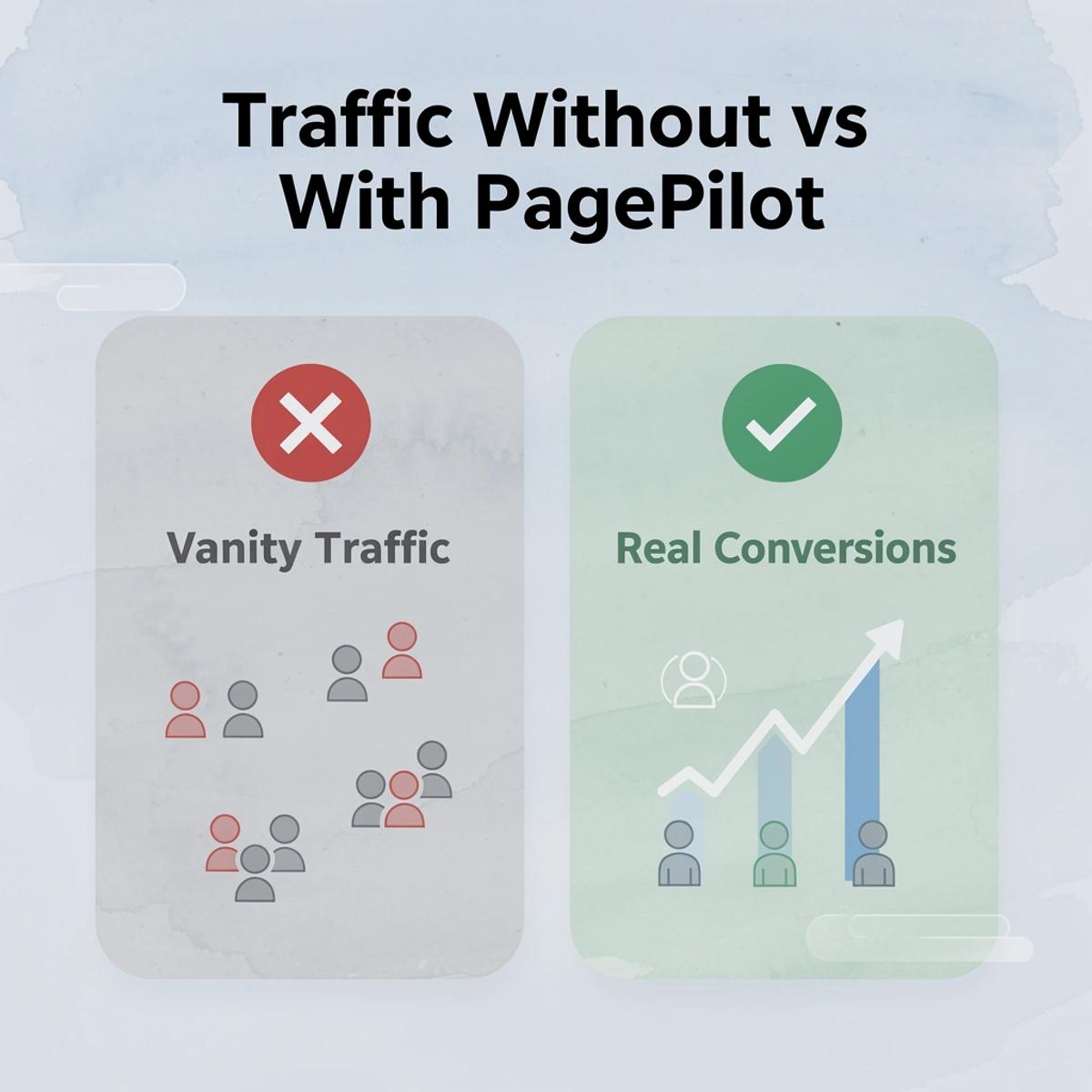
- Page Creation
- Without PagePilot: Requires developers to build pages
- With PagePilot: Self-serve page generation in minutes
- Conversion Optimization
- Without PagePilot: Pages may not be optimized for conversion
- With PagePilot: Conversion-focused layouts designed to persuade visitors
- Theme Management
- Without PagePilot: Risk of disrupting the Shopify theme during changes
- With PagePilot: Seamless integration with the existing theme
- Traffic Utilization
- Without PagePilot: Organic traffic may go to waste
- With PagePilot: Traffic is better positioned to convert into sales
How does PagePilot turn organic search investment into a real feedback loop?
Most merchants rewrite pages one at a time while competitors test three new angles in the same week. PagePilot lets you generate pages from a competitor or supplier URL, apply AI-produced copy and images, and launch something that looks intentional rather than templated. That speed transforms your organic search investment into a feedback loop in which customer behavior shapes your next move rather than guesswork.
Start a FREE Trial and Generate 3 Product Pages with Our AI Page Builder today
If your Shopify store is getting organic traffic but not making enough sales, PagePilot can help you close the gap between visibility and conversion. Start a free trial today and enter a competitor or supplier URL to generate up to three product pages at absolutely no cost. You'll create customized product pages, upgrade your product visuals, and uncover new positioning angles to convert more of the SEO traffic you've already earned.
"The gap between visibility and conversion is where revenue is lost — PagePilot is built to close it."
🎯 Key Point: You don't need more traffic — you need better product pages that turn the visitors you already have into paying customers.
💡 Tip: Use your competitor or supplier URL during the free trial to instantly generate up to 3 fully optimized product pages — no design skills required.
Customized Product Pages
- Free trial benefit: Up to 3 product pages generated instantly
Upgraded Product Visuals
- Free trial benefit: Professionally styled imagery
New Positioning Angles
- Free trial benefit: Discover untapped conversion hooks and messaging opportunities
SEO Traffic Conversion

- Free trial benefit: Turn existing visitors into buyers more effectively
Related Reading
- Yotpo Alternatives
- Best Shopify Theme For Seo
- Best Seo App For Shopify
- Lucky Orange Alternatives