

A Shopify theme does far more than set the visual tone of a store. It directly influences page speed, mobile responsiveness, structured data, and how search engines crawl and index product pages, all of which shape organic rankings and revenue. Choosing the best Shopify theme for SEO is one of the highest-leverage decisions a store owner can make to drive consistent traffic without relying on paid ads. The right theme creates the foundation, but converting that traffic requires pages built to perform. Stores that pair a strong SEO theme with well-structured product and landing pages see the clearest results. For merchants ready to act on that, PagePilot offers an AI page builder designed to help build high-converting pages optimized for both search engines and real shoppers.
Summary
- Site speed is one of the most direct factors linking a Shopify theme to search performance. Google's own research found that bounce probability rises by 32% when load time increases from 1 second to 3 seconds, and jumps to 90% at 5 seconds. A theme carrying excessive animation scripts, oversized assets, and redundant code quietly drives visitors away before they reach a single product page.
- Mobile-first indexing means Google evaluates the mobile version of a store when determining rankings. With mobile devices accounting for over 60% of global ecommerce traffic, themes that treat mobile layout as secondary rather than primary create friction that affects both user behavior and Google's page experience score. Awkward navigation menus and poorly scaled images on smaller screens are not minor design issues; they are ranking factors.
- Structural clarity separates genuinely SEO-friendly themes from ones that simply load fast. Poor heading hierarchy, missing schema compatibility, and navigation patterns that bury collection pages three clicks deep all create crawlability problems that compound over time. Search engines reward logical H1-to-H2 structure, crawlable breadcrumb trails, and internal links that clearly signal relevance between product pages and collections.
- The five themes that consistently perform well for Shopify SEO each solve a different problem. Dawn offers a lean, performance-focused codebase built directly by Shopify. Turbo handles large catalogs without speed degradation. Prestige balances visual richness with structural clarity for brand-driven stores. Booster consolidates app functionality inside the theme to reduce external script load. Warehouse organizes deep catalogs in ways that help search engines discover and index more of the product inventory.
- Organic search accounts for 53% of all website traffic, which means the pages sitting on top of a theme carry as much SEO weight as the theme itself. Rigid themes that lock content into fixed templates create a ceiling when product pages need stronger copy, different layouts, or campaign-specific landing pages. Themes that provide a clean technical foundation without resisting modification tend to support better long-term performance than those that look impressive but constrain what can be built on top of them.
- A 1-second delay in page load time can reduce conversions by 7%, which means theme choice and page quality are directly connected to revenue, not just rankings. Merchants who treat theme selection as a visual decision and then try to retrofit SEO later often discover the structural limitations only after traffic stagnates or conversion rates plateau. The most durable approach is to choose a theme for what it enables rather than for what it displays out of the box.
- PagePilot's AI page builder fits into this by generating brand-quality product and landing pages that work alongside any Shopify theme without altering the existing setup, bridging the gap between a technically sound theme foundation and pages built to convert the traffic that foundation attracts.
Does Your Shopify Theme Really Affect SEO?
Your Shopify theme affects SEO by shaping critical technical conditions — speed, mobile responsiveness, structural clarity, and how cleanly search engines read your pages — rather than serving as a direct ranking lever.
"Your theme is the foundation of your store's technical SEO — it doesn't rank you, but it determines whether search engines can efficiently crawl, read, and reward your content." — SEO Best Practices
🎯 Key Point: Your Shopify theme is not a magic ranking button — it's a technical enabler that controls how well search engines can access and interpret your store.
⚠️ Warning: Choosing a slow, bloated, or poorly coded theme can silently sabotage your SEO performance even if your content and keywords are perfectly optimized.
Page Speed
- How Your Theme Affects It: Clean, lightweight code loads faster, boosting rankings
Mobile Responsiveness
- How Your Theme Affects It: Responsive themes satisfy Google's mobile-first indexing
Structural Clarity
- How Your Theme Affects It: Proper heading hierarchy helps search engines parse content
Crawlability

- How Your Theme Affects It: Clean HTML output ensures bots can efficiently read every page
Where the theme performance actually shows up
How fast your site loads directly affects its visibility in search results. Google's research found that bounce probability rises by 32% when load time increases from 1 second to 3 seconds, and by 90% at 5 seconds. A theme laden with animation scripts, oversized assets, and redundant code drives visitors away before they see your product.
Mobile responsiveness compounds this problem. Google uses mobile-first indexing, so the mobile version determines ranking. A theme that collapses navigation awkwardly on phones or renders product images incorrectly creates friction that affects both user behavior and page experience scores. These concerns directly determine whether a visitor stays or leaves within 10 seconds.
Why is a theme not the whole SEO strategy?
The mistake most merchants make is treating their theme as the entire SEO strategy. Two stores with identical themes produce different search results due to content quality, keyword targeting, and internal linking. A fast theme with thin product descriptions and duplicate copy still ranks poorly because Google ranks pages, not themes. The theme is the framework; what you build on it determines visibility.
What hidden costs come from choosing the wrong theme?
Most store owners pick a theme that looks good, then add SEO later. The hidden cost emerges when building custom landing pages or product pages: merchants discover their theme is too rigid to work with outside tools without breaking the design. Choosing a theme compatible with an AI page builder matters because high-converting pages often require more than what the built-in templates offer.
Which question should you actually be asking about your theme?
The right question is not "which theme ranks best?" but "which theme gives me a stable, flexible foundation so the pages I build on top can do the real work?" Speed and mobile usability are baseline. Flexibility separates a theme that ages well from one that limits growth.
The signals that separate a genuinely SEO-friendly theme from one that merely looks the part are far more precise than most guides reveal.
What Makes a Shopify Theme SEO-Friendly?
Speed is the entry fee, not the advantage. According to the saadahmedturk.com Best SEO Themes for Shopify Guide, 53% of mobile users leave sites that take longer than 3 seconds to load. A slow theme hurts sales before product pages even get a fair chance. What makes a truly SEO-friendly theme different is how it is built: how it handles headings, shows content to search engines, and gives pages room to work well.
"53% of mobile users leave sites that take longer than 3 seconds to load — meaning a slow theme is actively costing you customers before they see a single product." — saadahmedturk.com Best SEO Themes for Shopify Guide
🔑 Takeaway: A 3-second load threshold is not a suggestion — it is the line between a bounce and a sale. Every fraction of a second your theme wastes is lost revenue.
💡 Tip: When evaluating a Shopify theme, test its load speed first. A visually stunning theme that loads slowly will always underperform a fast, well-structured theme in both SEO rankings and conversion rates.
SEO Theme Factor

- Page Load Speed 53% of mobile users abandon pages slower than 3 seconds
- Heading Structure Helps search engines understand page hierarchy and content
- Content Visibility Ensures crawlers can read and index your pages correctly
- Page Architecture Gives product pages the structural room to rank effectively
How does poor heading hierarchy create SEO problems?
A polished, fast-loading theme can still create SEO problems through poor heading hierarchy, missing schema compatibility, or navigation that buries key collection pages three clicks deep. Search engines reward clarity: logical H1-to-H2 structure, crawlable breadcrumb trails, and internal links that connect product and collection pages. Themes that skip this structure force merchants to use workarounds that accumulate over time.
Why does clean code reduce crawl errors and rendering delays?
Clean code matters because everything needs a place for fast retrieval and fewer errors. Themes loaded with redundant scripts, bloated CSS, or poorly structured HTML create rendering delays that browsers and crawlers penalize. Technical debt accumulates quietly, and by the time rankings stall, the theme itself is rarely the first suspect.
The flexibility question most merchants skip
Most merchants evaluate themes by their appearance. The better question is: how much does this theme limit what I can build on top of it? Rigid themes that lock layout, limit customization, or conflict with external page builders create a ceiling on brand quality and conversion performance. A theme that allows flexible, brand-quality landing pages alongside its native structure is worth far more than one that looks impressive but resists modification.
Why does mobile-first design matter more than desktop appearance?
According to the saadahmedturk.com Best SEO Themes for Shopify Guide, mobile devices account for over 60% of global ecommerce traffic. The best themes prioritize mobile layout as the main canvas with desktop as a secondary adaptation. Merchants who choose such themes find that mobile page performance, tap target sizing, and readable typography work seamlessly.
What happens when theme constraints limit how your catalog can grow?
Most merchants improve their product pages by working within their theme's constraints, adjusting fonts and layouts to appear intentional. As product lists grow and sales demands increase, this approach creates problems. Tools like AI page builder generate brand-quality product pages and landing pages in minutes. PagePilot works with any theme without altering existing elements.
The themes that endure were chosen for what they let you do, not for how they look.
Related Reading
- Shopify Marketing Automation
- How To Set Up Email Marketing On Shopify
- Shopify Email Marketing Vs Klaviyo
- Shopify Social Media Marketing
- How To Advertise a Shopify Store
- Shopify Social Media Marketing
- Seo Marketing Shopify
5 Best Shopify Themes for SEO
Five themes consistently deliver strong SEO performance: Dawn, Turbo, Prestige, Booster, and Warehouse. Which one you pick depends on how big your store is, how many products you have, and what you specifically need.
"Five themes consistently rise above the rest for SEO performance — Dawn, Turbo, Prestige, Booster, and Warehouse — each built to serve different store sizes and needs."
Dawn
- Best For: Small to mid-size stores
- Key SEO Strength: Lightweight, fast load times
Turbo
- Best For: High-traffic stores
- Key SEO Strength: Speed-optimized architecture
Prestige
- Best For: Premium/luxury brands
- Key SEO Strength: Clean structure, rich metadata
Booster
- Best For: Conversion-focused stores
- Key SEO Strength: Built-in SEO + performance tools
Warehouse
- Best For: Large product catalogs
- Key SEO Strength: Scalable, crawl-friendly layout
🎯 Key Point: Not all Shopify themes are built equal — these 5 themes are the top-tier choices specifically proven to support strong SEO outcomes.
🔑 Takeaway: Your ideal theme isn't just about looks — it's about store size, product volume, and your specific SEO priorities. Choosing the wrong theme can silently hurt your search rankings.

1. Dawn The Underrated Workhorse
Many store owners overlook Dawn because it's free, assuming it lacks quality. That's incorrect. Built directly by Shopify, Dawn prioritizes performance: fast load times, clean mobile rendering, and Core Web Vitals scores that premium themes often struggle to match. Its minimalist architecture keeps the codebase lean, supporting search engine crawlability and page speed without additional optimization work.
What makes Dawn a strong choice for lean, performance-focused stores?
Dawn's strength comes from what it leaves out: no extra animations, heavy scripts, or feature layers that add unnecessary weight. For new stores or small-to-medium catalogs, that restraint is a competitive advantage. The tradeoff: merchants needing highly differentiated storefronts will hit Dawn's design ceiling quickly and require external tools to extend it.
2. Turbo Built for Scale
Turbo, developed by Out of the Sandbox, was designed for stores with thousands of products and high traffic. Its page rendering system handles large catalogs without slowing down, and its navigation tools help search engines index deep product pages more efficiently.
Turbo costs a lot of money. Smaller stores with catalogs under a few hundred products rarely see measurable SEO gains to justify the expense.
3. Prestige When Brand Presentation Is the Conversion Strategy
Fashion, beauty, and luxury brands face a specific problem: the visual richness that drives purchasing decisions can slow down a page. According to Elogic Commerce, a 1-second delay in page load time reduces conversions by 7%. Prestige navigates this challenge better than most visually oriented themes, but requires disciplined image compression and content optimization to maintain speed.
Prestige's collection structures and content layouts present lifestyle imagery while maintaining the structural clarity that search engines need to understand page hierarchy and product relationships, a significant benefit for brands where storytelling drives sales.
4. Booster Fewer Apps, Cleaner Performance
Dropshipping and conversion-focused stores often install apps that add scripts and increase load time on their Shopify store. Booster brings much of that functionality into the theme itself, reducing outside dependencies and maintaining performance.
A store can collect a dozen active apps over six months, each adding scripts to every page load. Booster reduces that fragmentation, which appeals to merchants focused on clean performance metrics. The tradeoff is configuration complexity: Booster's many built-in tools require longer setup and deliberate decisions about what to enable.
5. Warehouse Navigation as an SEO Asset
Large inventory stores face an SEO challenge that speed alone cannot solve. When a store carries thousands of products across dozens of categories, internal linking and organization determine how much of the catalog search engines discover and index. Warehouse was built around that problem, with advanced filtering systems and collection structures that make deep catalog pages accessible to both users and crawlers.
For stores selling electronics or industrial supplies, Warehouse's navigation architecture meaningfully improves search engines' understanding of product relationships and category depth. For a fifty-product store, it creates structural overhead without a corresponding benefit.
What does the theme actually enable for your store?
The useful question isn't which theme ranks best overall, but which one gives your store the flexibility to build quality brand pages without obstacles. BSSCommerce reports that 53% of all website traffic comes from organic search, meaning your pages are as important for SEO as the theme itself.
Why does theme rigidity become a bottleneck at scale?
Rigid themes that lock content into fixed templates create limitations. When a product page needs stronger writing, a more compelling layout, or a campaign-specific landing page, an inflexible theme becomes problematic. Successful stores choose themes that provide clean technical foundations while allowing pages to do the conversion work.
How does flexibility reveal the difference between a good theme and a limiting one?
The difference between a good theme and a limiting one becomes clear in how much freedom you have to build.
Why Product Pages Matter More Than Your Theme for SEO
Choosing an SEO-friendly Shopify theme is important, but it's only one piece of the puzzle. Search engines rank individual pages, not themes. Two stores using the same theme can achieve different SEO results depending on product page quality.
💡 Tip: Don't rely on your theme alone for SEO. Your product pages are where rankings are won or lost.
"Search engines rank individual pages, not themes. Two stores using the same theme can achieve different SEO results depending on product page quality." — Core SEO Principle

When someone searches for a product on Google, they see individual product pages — not themes. Google looks at page content, relevance, keyword targeting, product information, images, and user experience. While a theme affects technical performance, the content and structure of individual pages help search engines understand what a product is and who it's for.
🎯 Key Point: Your theme sets the foundation, but it's your product page content — titles, descriptions, images, and structure — that truly determines how well you rank.
SEO Factor
Page Speed & Technical Performance
- Controlled By Theme: ✅ Yes
- Controlled By Product Page: Partially
Keyword Targeting
- Controlled By Theme: ❌ No
- Controlled By Product Page: ✅ Yes
Product Descriptions & Content
- Controlled By Theme: ❌ No
- Controlled By Product Page: ✅ Yes
Image Alt Text & Relevance
- Controlled By Theme: ❌ No
- Controlled By Product Page: ✅ Yes
User Experience & Layout
- Controlled By Theme: ✅ Yes
- Controlled By Product Page: Partially
⚠️ Warning: Investing all your SEO effort into theme selection while neglecting product page optimization is one of the most common — and costly — mistakes Shopify store owners make.
Why do duplicate product descriptions hurt your search rankings?
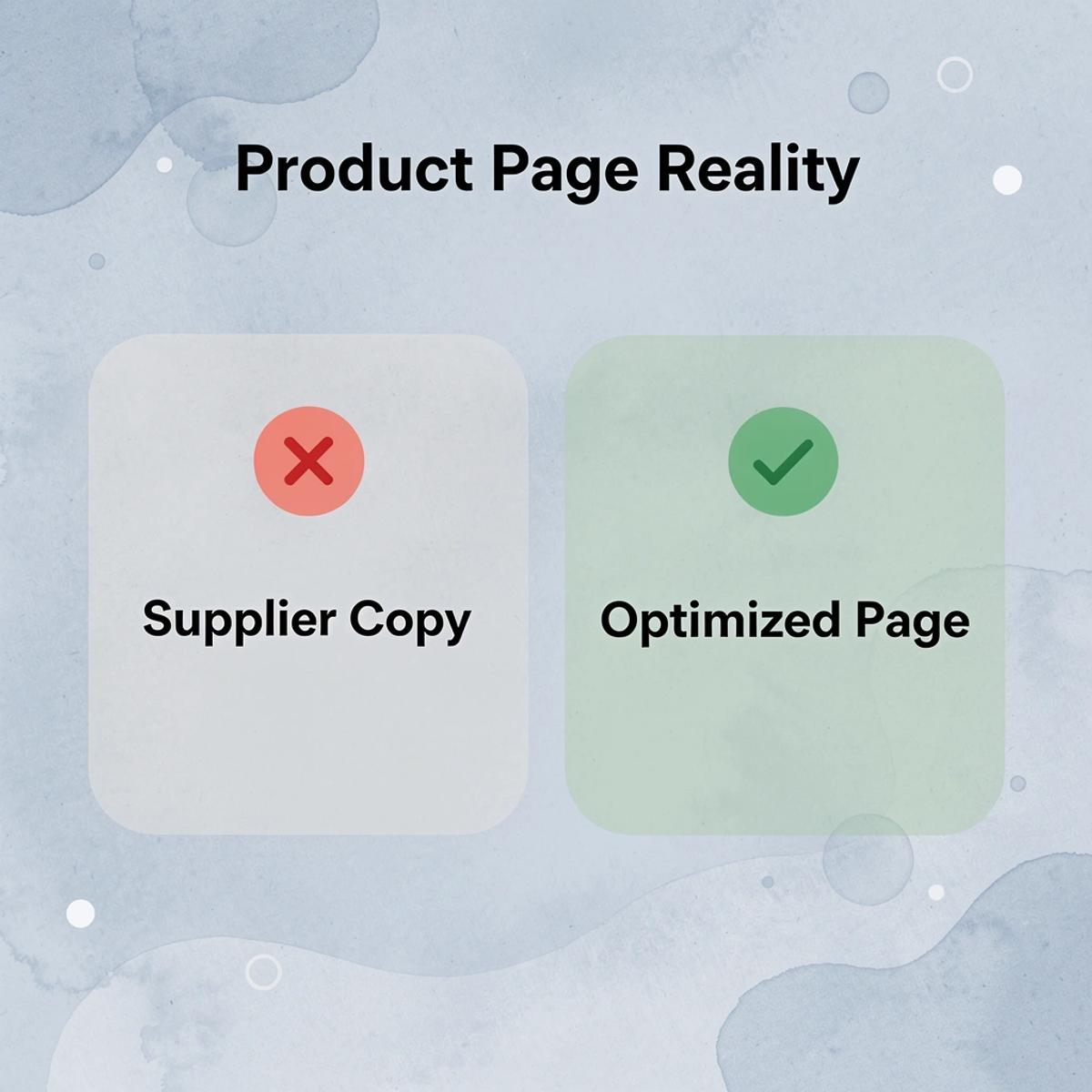
One of the biggest SEO mistakes ecommerce merchants make is copying supplier or manufacturer product descriptions. Many stores selling identical products publish the same descriptions and specifications, leaving little unique information for search engines to differentiate pages. Google hasn't stated that duplicate content triggers automatic penalties, but when multiple pages contain substantially the same information, Google must decide which version to show. As John Mueller explained, unique product descriptions help Google better understand and rank product pages, particularly when products are similar.
Strong product descriptions do more than explain features: they help search engines understand products while helping shoppers decide whether to buy. Unique descriptions allow merchants to target relevant search terms, highlight benefits, address customer questions, differentiate from competitors, and create more valuable content than supplier catalogs. This matters because ecommerce SEO is highly competitive; when dozens of stores sell similar products, unique content becomes a key differentiator.
What makes a product page well-optimized for search engines?
A well-optimized product page gives search engines clear signals about its purpose through descriptive titles, relevant keywords, structured headings, product specifications, frequently asked questions, benefit-focused content, and related product recommendations. These elements help search engines understand relevance while improving the shopping experience. Stores with better-structured product pages rank stronger for relevant searches, even when competing on the same theme.
Product images matter more than many store owners realize. According to Salsify's 2026 Consumer Research, 61% of shoppers say product images and videos are the most important elements when deciding whether to buy. Earlier research found 66% of shoppers want at least three product images before making a purchase decision. Optimizing image file sizes, alt text, and quality improves page performance and accessibility.
A product page should attract visitors and keep them engaged. Visitors who spend time reading descriptions, viewing images, and exploring related products send positive signals that the page meets their needs. Pages that provide useful information and positive user experiences better satisfy search intent than pages with thin or generic content.
How does product page quality affect conversions alongside SEO?
SEO traffic only becomes valuable when visitors take action. The best product pages combine search optimization with conversion optimization by helping shoppers move confidently toward purchase. According to Salsify's 2025 Consumer Research, 54% of shoppers have abandoned purchases because of inconsistent product information, while 71% have returned products that didn't match their descriptions. A product page that ranks well but fails to answer questions or build confidence will struggle to generate meaningful sales.
Can a fast theme compensate for weak product page content?
A fast, well-designed Shopify theme supports SEO by improving speed, mobile usability, and navigation.
Even the fastest theme cannot overcome weak product content. If your store relies on duplicate supplier descriptions, generic product images, poor keyword targeting, and thin product pages, switching themes won't produce meaningful SEO gains.
Stores that perform well in search results focus on creating unique product pages, stronger imagery, better customer experiences, and persuasive content. Themes provide the foundation, but product pages determine your rankings, traffic, and conversions.
Common Shopify SEO Mistakes Store Owners Make
Many Shopify merchants focus on the wrong SEO areas, getting distracted by theme comparisons, SEO apps, and technical tweaks while overlooking factors with a bigger impact on rankings and conversions. Understanding common mistakes helps you focus on what truly influences Shopify SEO performance.
"Most Shopify store owners spend time on surface-level fixes while high-impact SEO fundamentals — the factors that actually move rankings — go unaddressed." — SEO Industry Insight
⚠️ Warning: Chasing SEO apps and theme upgrades is one of the most common traps Shopify merchants fall into — these changes rarely deliver the ranking improvements store owners expect.
💡 Tip: Before making any SEO change, ask yourself: Does this directly impact content quality, site authority, or user experience? If not, it's likely a low-impact distraction.
Common Distraction: Theme comparisons
Higher-Impact Alternative: Page speed optimization
Common Distraction: SEO apps
Higher-Impact Alternative: Keyword-targeted content
Common Distraction: Technical tweaks
Higher-Impact Alternative: Backlink building
Common Distraction: Meta tag obsession
Higher-Impact Alternative: Product page copy quality
🔑 Takeaway: Recognizing and avoiding these common Shopify SEO mistakes is the essential first step toward focusing your energy on strategies that deliver real, measurable results.

Does switching to an SEO-friendly theme actually improve rankings?
One common mistake is assuming an "SEO-friendly" theme will automatically improve rankings. Most modern Shopify themes already provide the basic technical foundation needed for SEO: fast loading speeds, mobile responsiveness, clean navigation, and proper site structure. A theme can support SEO, but it cannot create rankings on its own. Merchants often spend weeks evaluating themes while neglecting product page quality and content strategy. Improving existing product content typically produces better results than switching themes.
Why are supplier product descriptions hurting your store's SEO?
Using supplier descriptions is the most damaging Shopify SEO mistake, especially for dropshipping stores. When dozens of stores use identical product descriptions, search engines have little reason to rank one above another. Generic supplier content focuses on technical specifications rather than addressing customer questions and benefits. Unique product descriptions allow merchants to differentiate products, target relevant keywords, address customer concerns, improve search relevance, and build buyer confidence. Stores that invest in original product content gain a significant advantage over competitors that rely on copied information.
How does poor image optimization affect SEO and conversions?
Many store owners focus heavily on text content while overlooking images' importance for SEO and conversions. Large image files slow page loading speeds, and missing alt text reduces accessibility and image search visibility. Poor-quality images, inconsistent visuals, or supplier photos used across competing stores undermine trust. Effective image optimization involves compressing files, using descriptive file names, adding alt text, maintaining high quality, and showcasing products from multiple angles. A strong image strategy supports both SEO and conversion performance.
What role does internal linking play in a Shopify store's visibility?
Internal linking plays an important role in ecommerce SEO, yet it's often overlooked. Internal links help search engines find pages, understand site structure, and distribute authority throughout the store while helping shoppers discover related products and navigate easily. Many Shopify stores miss opportunities through related product sections, collection pages, blog content, buying guides, product comparisons, and category navigation. Without strong internal linking, important pages receive less visibility from both search engines and customers.
Why does treating content as an afterthought undermine your SEO?
Store owners often spend considerable money on design but neglect content. Search engines use content to determine what a page is about and when to display it in search results. A beautiful product page with thin, generic content will underperform a well-optimized page that addresses customer needs. SEO-supporting content includes product descriptions, collection page copy, FAQs, specifications, buying guides, blog content, and customer-focused information. Design should enhance content, not replace it.
How can testing product page variations improve SEO performance?
Many merchants believe their first product page version is optimal. Product page performance often improves through testing different approaches to content, messaging, layout, and positioning. Key conversion and engagement drivers include headlines, descriptions, benefit-focused copy, images, calls to action, layouts, social proof placement, and offer positioning. Merchants who regularly test product page variations gain insights into what resonates with customers and drives better results.
The biggest Shopify SEO mistake is ignoring product content
Most Shopify SEO mistakes stem from focusing on technical details while neglecting product content. Themes, apps, design elements, and SEO settings help, but they cannot compensate for weak product pages. Search engines rank pages based on relevance, usefulness, and whether they answer user queries.
Top-performing stores excel at creating unique product content, optimizing images, building strong site structures, and continuously improving product pages rather than relying on expensive themes or numerous SEO tools.
Avoiding these mistakes strengthens your SEO foundation and creates more opportunities for both rankings and conversions.
How PagePilot Helps Shopify Stores Build Better Product Pages Faster
Choosing the right Shopify theme improves site speed and user experience, but the bigger question is what content appears on your pages. Many merchants spend weeks researching themes and tweaking design, only to fill stores with the same supplier descriptions and images used by competitors—resulting in stores that look different but offer little unique value.
"Many merchants spend weeks researching themes, only to fill stores with the same supplier descriptions and images used by competitors—resulting in stores that offer little unique value." — Intelligent Retail
🎯 Key Point: A visually polished theme means nothing if your product content is identical to every other store selling the same items. Differentiation starts with copy, not design.
🔑 Takeaway: The real competitive advantage for Shopify merchants isn't a better-looking storefront—it's unique, high-converting product page content that competitors can't simply copy and paste.
Theme & Design
- Impact on Differentiation: Visual distinction only — easily replicated
Supplier Descriptions
- Impact on Differentiation: Zero uniqueness — shared across competitors
Original Product Copy
- Impact on Differentiation: High impact — impossible to duplicate
Custom Images & Content
- Impact on Differentiation: Strong SEO & conversion signal
How does PagePilot speed up product page creation for Shopify merchants?
PagePilot's AI Page Builder helps Shopify merchants create product pages that convert customers faster than manual creation. Instead of spending hours researching competitors and writing descriptions, merchants can provide a competitor or supplier URL, and the AI Page Builder generates a complete product page designed to convert visitors and keep them engaged.
This solves a major problem in ecommerce SEO: duplicate content. Rather than using supplier descriptions that appear on dozens of competing stores, merchants can create unique product copy that better explains benefits, answers customer questions, and helps them stand out in competitive markets.
How does PagePilot improve product visuals and testing speed?
PagePilot improves product presentation through its AI Product Image feature. Many supplier-based stores use identical product images, making it difficult to build trust and brand identity. PagePilot upgrades visuals, helping merchants create more compelling presentations without relying entirely on standard supplier assets.
Speed of testing is another advantage. Successful ecommerce growth requires testing multiple products, offers, and positioning strategies, but traditional page creation workflows make testing slow and resource-intensive. PagePilot allows merchants to quickly generate and launch pages, enabling faster experimentation and refinement based on real-world performance.
What does PagePilot ultimately help Shopify merchants achieve at scale?
PagePilot helps Shopify merchants improve conversion potential and content quality at scale. Rather than spending countless hours creating pages manually or publishing generic supplier content, the AI page builder enables merchants to create compelling product pages, differentiate their stores, and launch faster.
Related Reading
- Best Shopify Marketing Apps
- Best Shopify Email Marketing Apps
- Shopify Marketing Strategies
- Best Marketing Tools for Shopify
- Best Shopify Marketing Agency
Start a FREE Trial and Generate 3 Product Pages with Our AI Page Builder today
A well-chosen Shopify theme gives you a clean technical foundation, but the pages you build on it determine whether visitors stay, trust you, and buy. Building product pages by hand consumes far more time than most merchants realize — time better spent on growth, marketing, and scaling.
"The pages you build on your theme decide whether visitors stay, trust you, and buy — not the theme itself."
💡 Tip: No matter how polished your Shopify theme looks, underperforming product pages will cost you conversions daily.
⚠️ Warning: Manual page building is one of the biggest hidden time drains for Shopify merchants — don't let it slow down your store's growth.

PagePilot works with any Shopify theme without changing your existing setup, generating brand-quality product pages in minutes. Start your free trial today and create your first three product pages at absolutely no cost — no credit card required.
✅ Best Practice: Use PagePilot's AI Page Builder to go from zero to three fully built product pages before spending a single dollar — it's the lowest-risk way to see real results fast.
Building Method
- Manual page building
- Time Required: Hours per page
- Cost to Start: Your time
- PagePilot AI Builder
- Time Required: Minutes per page
- Cost to Start: Free trial
- Hiring a designer
- Time Required: Days to weeks
- Cost to Start: $$$ upfront
Related Reading
- Best Seo App For Shopify
- Yotpo Alternatives
- Lucky Orange Alternatives