


Most tools that call themselves an AI agent can talk about your store. Fewer can actually touch it.
That's the line this guide draws.
Ecommerce AI agents differ mainly in how much they can do on their own. Some only suggest or analyze. Others can create content, make changes, and carry several connected tasks through from start to finish.
Recommending a price change carries less risk than changing the price automatically. The same goes for returns. Drafting a reply is one thing. Processing the return is another.
That level of autonomy is what determines the order of the best AI agents for ecommerce below.
Quick answer: best ecommerce AI agents in 2026
Treat this ranking as a starting order, not a scoreboard. Shopify Sidekick, Gorgias, Klaviyo, and PagePilot each answer a different job. Match the tool to the job first, then use the rank to break ties.
What is an AI agent for ecommerce?
An ecommerce AI agent is an AI system that can use store data, tools, and integrations to complete tasks for a merchant or shopper, not just generate a recommendation.
That includes agents that can edit products, analyze sales, create discounts, recommend products, resolve customer questions, cancel orders, process returns, launch marketing campaigns, manage subscriptions, build product pages, and publish products.
An AI assistant tells you what to do. An AI agent can use tools to help do it.
Don't read that as fully hands-off, though. Most of the capable ecommerce agents still require approval before anything consequential hits a live store.
How we evaluated these agents
Each agent below was checked against the same eight questions. Rather than turn that into a hidden score, the answers show up directly in the access, approval, and maturity table further down the page.
Access to real store data. Products, customers, orders, inventory, marketing data, performance history.
Ability to take action. Change something, publish something, issue something, create something, update another system.
Workflow depth. One isolated action, or several connected steps.
Ecommerce specialization. Built around real ecommerce workflows, or bolted onto a general assistant.
Integrations. Works across a merchant's existing stack, or stands alone.
Human controls. Review or approval before consequential actions go live.
Platform fit. Shopify only, enterprise commerce, or cross-platform.
Production maturity. GA, public beta, private beta, or experimental.
1. Shopify Sidekick: best overall AI agent for Shopify merchants
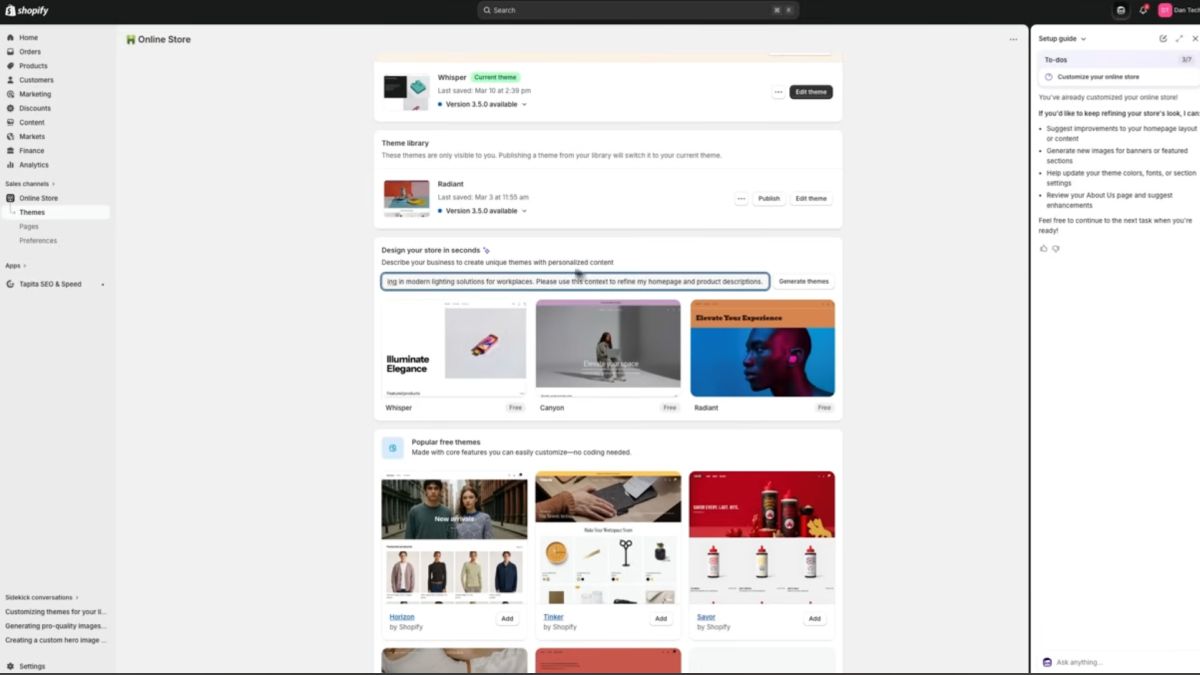
Shopify Sidekick lives inside Shopify Admin, so merchants don’t have to explain their catalog, store setup, or recent performance every time they ask for help.
That native context is its biggest advantage. Sidekick can interpret a natural-language request, use Shopify data to work out what needs changing, and prepare or carry out supported actions inside the same admin.
Best for: Shopify merchants who want one general-purpose AI assistant for running and improving an existing store.
What Sidekick can do
- Create and edit product content. Sidekick can generate product entries and descriptions directly inside Shopify.
- Suggest pricing. It can use store and product context to recommend pricing rather than simply generating generic copy.
- Analyze store data. Merchants can ask questions about performance in plain English and get structured insights from Shopify data.
- Generate and edit images. Sidekick can create product visuals, remove backgrounds, and place products into new scenes without leaving Shopify.
- Improve image metadata. It can analyze product images and generate alt text using the visual and product context.
- Help customize the storefront. Sidekick can suggest themes, color palettes, and other changes based on how the merchant describes the store.
- Reuse workflows with saved skills. Repeated instructions can be saved and triggered again without rebuilding the full prompt each time.
- Work across supported apps. Shopify’s app intents let Sidekick connect with compatible third-party apps instead of limiting every workflow to Shopify’s own tools.
Sidekick is also becoming more proactive. Sidekick Pulse, currently in early access for eligible merchants, can analyze store data and surface personalized recommendations without waiting for a prompt, while longer-running tasks can continue after the merchant leaves the chat and return when they're ready for review.
Shopify still keeps the merchant in control. Sidekick can prepare and execute supported changes, but Shopify requires approval before store changes are applied.
A typical request might look like:
Analyze this product, suggest a more competitive price, rewrite the description, remove the background from the main image, and give me a cleaner studio-style version.
That example captures Sidekick’s main strength. The product, store data, editing tools, and final changes all already live in the same system.
Custom Shopify apps
Sidekick can also generate custom Shopify apps from natural-language requests. This feature currently requires the Grow, Advanced, or Shopify Plus plan and is available on desktop.
Biggest advantage
Sidekick starts with Shopify context already available. Merchants can move from a question or idea to an actual store change without copying information between an AI assistant and Shopify Admin.
Biggest limitation
Sidekick stays inside the Shopify ecosystem. It’s a store-management assistant, not a replacement for specialized customer-support agents, lifecycle-marketing platforms, or tools built around product research before a product reaches Shopify.
2. Gorgias AI Agent: best for ecommerce customer support automation
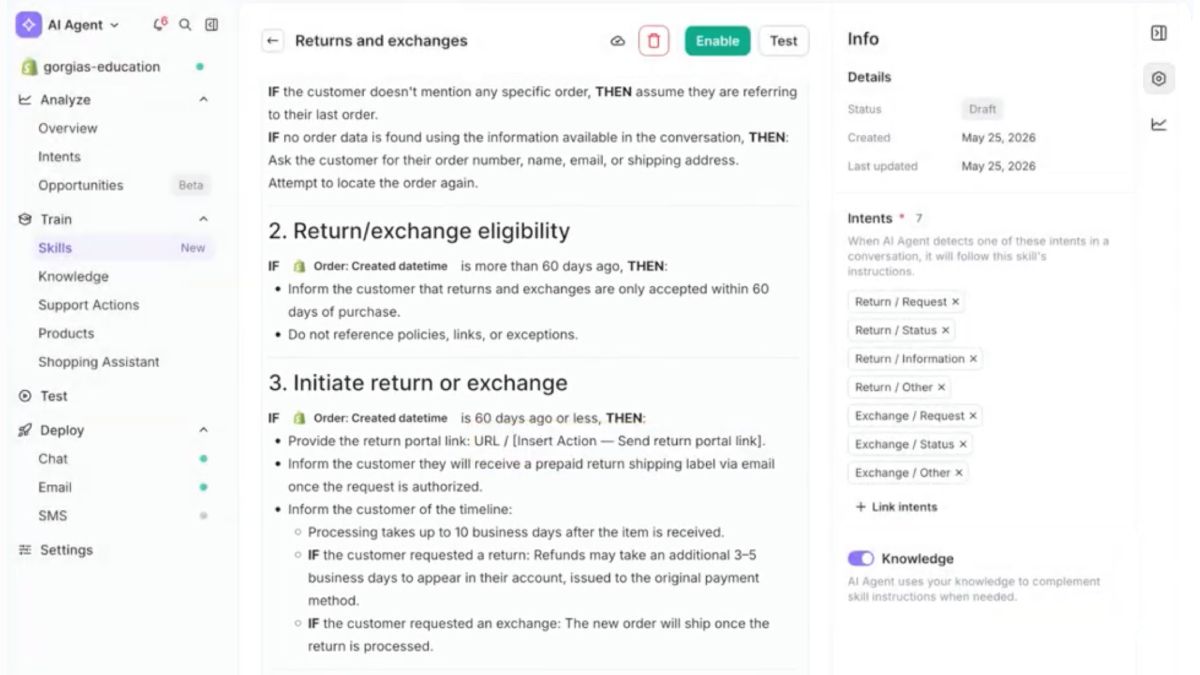
Gorgias AI Agent can do more than answer a support question. It can use connected ecommerce apps to carry out the action needed to resolve the request.
That is the useful distinction for stores with meaningful support volume. A customer can ask to change a shipping address, cancel an order, pause a subscription, or handle another supported request, and the AI can complete the action instead of handing the ticket to a human.
Best for: Shopify stores that want AI handling both the conversation and the operational step behind it.
How Gorgias Actions work
Gorgias connects to apps through its App Store. Once an app is authenticated, Gorgias exposes the actions that app supports.
Those actions don't run automatically just because the integration exists. They have to be added to a Skill or Guidance so the AI Agent knows:
- Which action it can use
- When it should use it
- Which conditions have to be met
- Which connected app or apps are involved
For example, a merchant can create a shipping-address Skill that tells the AI when an address can be changed and gives it access to the relevant action in the connected ecommerce system.
A single action can also include steps across more than one connected app.
What Gorgias AI Agent can handle
With the right integrations and Actions configured, Gorgias AI Agent can support workflows such as:
- Order tracking
- Product questions
- Product recommendations
- Returns and cancellations
- Shipping-address changes
- Subscription changes
- Replacement or reshipment requests
- Other support tasks exposed by connected apps
For irreversible actions, such as cancelling an order or skipping a subscription, Gorgias can require customer confirmation before the action runs.
For example:
Customer: I entered the wrong shipping address.
Instead of replying with instructions for changing it, the AI Agent can use an authenticated action in the connected app to update the address itself, provided that action has been added to the relevant Skill or Guidance.
Biggest advantage
Gorgias connects support conversations to operational actions. The customer doesn't have to receive an answer and then wait for a human to complete the actual task.
Biggest limitation
Its autonomy has to be configured. Connecting an app alone isn't enough. Merchants still need to define the Actions, Skills, Guidance, and conditions that tell the AI what it is allowed to do and when.
Gorgias AI Agent also currently requires a connected Shopify store for its Chat experience, so it isn't the same autonomous support layer for BigCommerce, Magento, or WooCommerce.
3. Klaviyo AI Agents: best for marketing + customer lifecycle
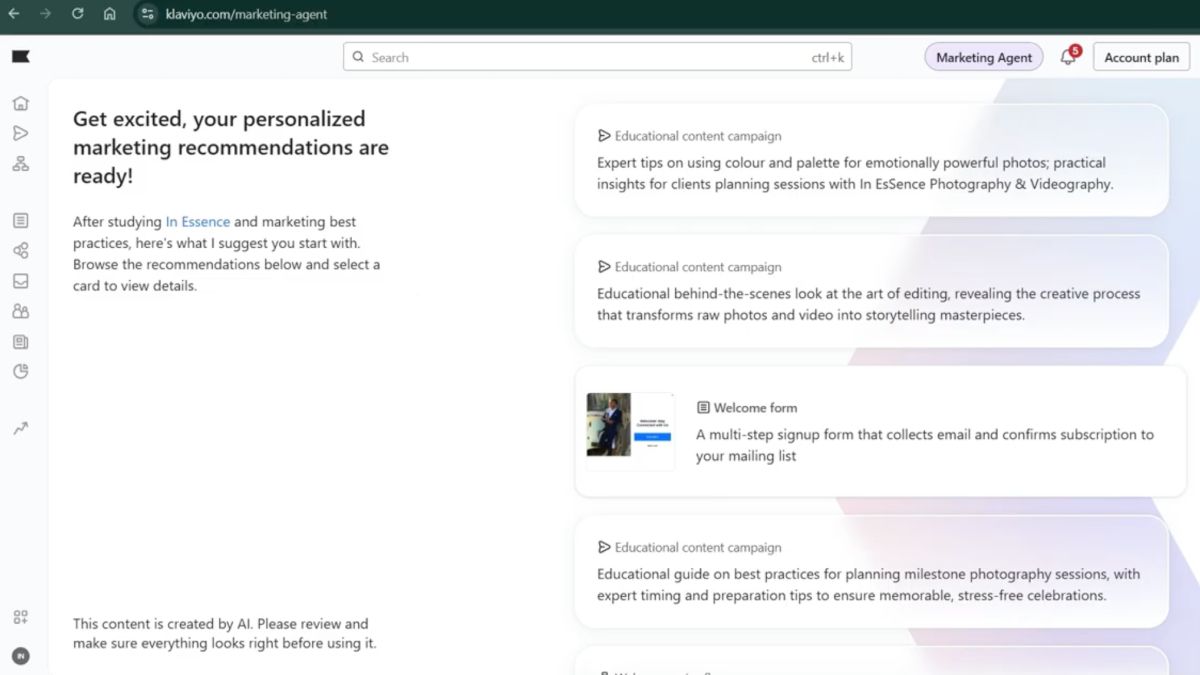
Klaviyo splits the work between two AI agents. Composer handles marketing, while Customer Agent handles shopper conversations and service.
That gives stores one AI layer for creating campaigns and another for interacting with customers using the same broader Klaviyo customer context.
Klaviyo Composer
Composer starts with the brand and customer data already inside Klaviyo.
It can use information from the connected website, brand library, performance data, and customer profiles to recommend and build marketing work. Merchants can define their logo, colors, fonts, tone of voice, and marketing language before Composer creates anything.
From there, Composer can help with:
- Campaign and flow creation
- Customer segmentation
- Audience selection
- Email and SMS content
- Performance analysis
- Marketing recommendations
- Recurring marketing tasks
For example:
Build a spring reactivation campaign for customers who haven't purchased in 90 days across email and SMS.
Composer can build the audience logic, campaign structure, content, and channel setup around that request.
The marketer still reviews what it creates before launch. In practice, Composer can prepare a campaign or flow inside Klaviyo, but the human decides when it goes live.
That approval layer is useful here because the AI can do much of the setup without independently sending customer-facing marketing.
September 2026 update
Klaviyo expanded Composer and Customer Agent on September 9, 2026.
Composer added SQL-backed analysis, scheduled recurring tasks, reusable Skills, direct segment editing, and mobile access. Those additions push it beyond one-off campaign generation and toward ongoing marketing workflows.
Klaviyo Customer Agent
Customer Agent works on the customer-facing side.
It can answer product questions, recommend products, track orders, support returns and exchanges, manage subscriptions, and escalate conversations to a human when needed.
It works across chat, email, SMS, and WhatsApp. Klaviyo also expanded language support to more than 100 languages in September 2026, with voice support announced as an upcoming capability.
Biggest advantage
Klaviyo covers both sides of the customer relationship. Composer helps the marketing team create and manage campaigns, while Customer Agent handles shopper conversations using customer and commerce data from the same ecosystem.
Biggest limitation
Composer is still in public beta and keeps the marketer in the approval loop before customer-facing work launches. It automates much of the preparation, but it isn't an autonomous marketing system that sends whatever it creates without review.
4. PagePilot MCP + AI assistant: best for product research and product-launch automation
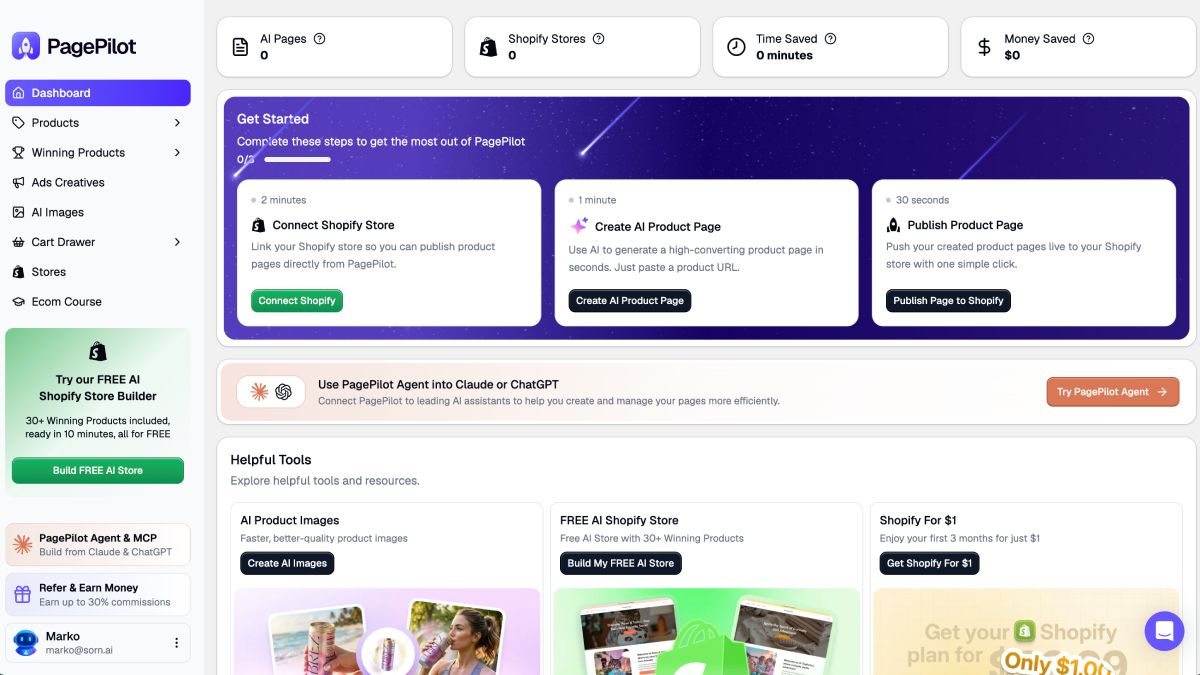
PagePilot MCP isn’t a standalone AI agent. It gives an MCP-compatible assistant such as ChatGPT, Claude, or Claude Code access to PagePilot’s ecommerce tools, so the assistant can help build and publish products rather than only tell you what to do.
It’s especially useful for Shopify merchants, dropshippers, performance marketers, agencies, and teams that launch or test products frequently. (internal link: PagePilot MCP: What It Is, What It Can Do, and Every Prompt You Can Run, confirm URL).
Anyone with a PagePilot account can connect MCP, with no waitlist or beta invite. Building pages, publishing to Shopify, generating AI images, and using the product-research tools require a paid Lite plan or above. ChatGPT also needs developer mode enabled.
PagePilot’s MCP setup page creates the API key and provides the configuration needed for the supported AI client.
What PagePilot MCP can do
- Research products. PagePilot’s product-research tools can be accessed through the AI conversation. Keep any more specific research claims tied to features PagePilot has separately confirmed.
- Build product pages. Create a PagePilot product page from a product source and choose the language, positioning, and template. PagePilot supports 33 languages, and templates such as Bloom, Greens, Honey, Clarity, Aura, Legacy, Stone, and Cotton can be selected by exact name.
- Edit the offer. Change page copy, prices, options, and variants through the conversation.
- Generate product images. Create AI images and replace existing page images. These use the same image allowance as the PagePilot dashboard and are limited to four images per request.
- Publish to Shopify. Send the finished page to a store that is already connected to PagePilot. The assistant can create a new Shopify product or update one it previously published.
The workflow can begin before the product exists in Shopify. Research, page creation, offer changes, images, and publishing can stay inside the same AI conversation.
For example:
Using PagePilot MCP, research a product opportunity, build a French product page with the Bloom template, set the price to 39.99, replace three images with lifestyle creatives, and publish it to my store.
PagePilot doesn’t silently make every change. Claude and ChatGPT can show an approval prompt before write actions such as changing prices, editing variants, generating images, or publishing.
Users can choose “always allow,” but PagePilot adds its own safeguards as well. It reads the current page before editing, asks before spending AI image credits, and backs up an existing Shopify product before overwriting it.
There are also clear boundaries. MCP can’t currently:
- Add, remove, or reorder page sections
- Change colors, fonts, or broader design settings
- Edit SEO settings
- Create advertorials or standalone pages
- Browse the template gallery
- Upload the user’s own images
- Connect Shopify stores
- Delete or duplicate pages
Those jobs still happen inside PagePilot itself. MCP handles the building and publishing workflow, while the dashboard remains the place for deeper design and page management.
Biggest advantage
PagePilot MCP can take a product from research or source material to a published Shopify product without forcing the user to move between an AI conversation, a page builder, and Shopify for every step.
Biggest limitation
PagePilot MCP is intentionally focused on product-page creation and launch. It doesn’t replace customer-support agents, lifecycle-marketing platforms, fulfillment tools, or the full PagePilot dashboard.
Turn Your AI Assistant Into a Product-Launch Workflow With PagePilot MCP. Connect ChatGPT or Claude to PagePilot MCP and go from "find me a product" to a published Shopify page in one conversation.
5. Salesforce Agentforce Commerce: best for enterprise agentic commerce
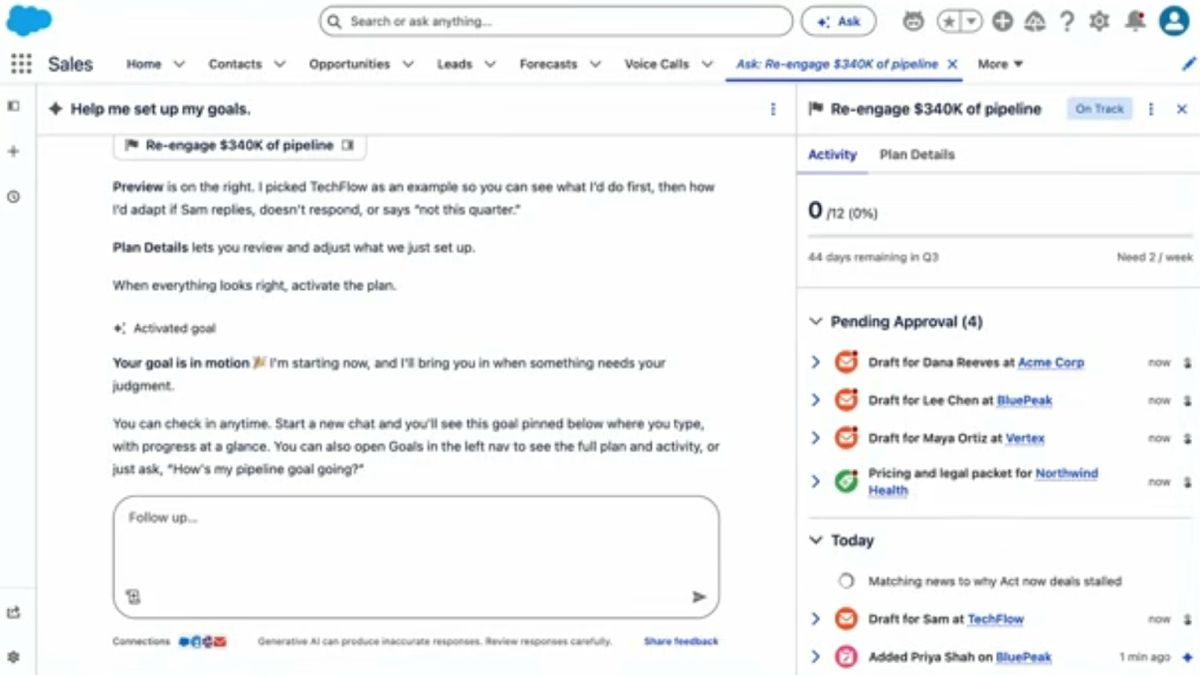
Best for: Large B2C and B2B organizations already running on Salesforce.
Salesforce confirmed in its July 2026 release that Agentforce Commerce now includes three generally available commerce agents.
What the commerce agents do
Shopper Agent handles customer-facing shopping conversations using live catalog, inventory, and order context.
Buyer Agent focuses on B2B purchasing workflows, where account data, product availability, and buying processes are more complex.
Merchant Agent works on the operational side, helping commerce teams with tasks such as catalog organization and merchandising.
Together, they sit across a much broader Salesforce commerce stack that can include B2C Commerce, B2B Commerce, order management, payments, and point of sale.
Why Agentforce is built differently
Agentforce is designed around enterprise context rather than isolated prompts.
Agents can work with Salesforce records, business rules, connected systems, and reusable Skills. Teams can then extend those agents with tools such as AgentScript and Studio when an out-of-the-box workflow isn’t enough.
Salesforce is also putting more emphasis on what happens after an agent goes live. Its observability tools let teams review conversations, identify recurring failures, and adjust how agents behave instead of treating deployment as the end of the project.
That makes Agentforce more relevant when AI needs to operate across several departments and systems, not just complete one ecommerce task.
For example:
On the customer side, Shopper Agent could use live product, inventory, and order data to answer a question such as:
I need a waterproof jacket in medium that can arrive before Friday. Show me what’s available and help me place the order.
For B2B commerce, Buyer Agent could handle a request such as:
Reorder the same packaging supplies as last quarter, but increase the quantity by 20% and check whether our contracted pricing still applies.
Those examples show the real distinction. Agentforce can use enterprise data and business rules across merchandising, purchasing, orders, and customer interactions.
Biggest advantage
Agentforce can connect commerce agents to the wider Salesforce data and workflow environment. For an enterprise already using Salesforce across commerce, service, sales, and operations, the agent doesn’t have to work from a separate copy of the business context.
Biggest limitation
That breadth comes with enterprise-level setup and governance. A smaller Shopify merchant looking to launch products, automate support, or build campaigns usually doesn’t need an agent platform designed to coordinate workflows across a large Salesforce environment.
6. ChatGPT + Shopify plugin: best conversational interface for Shopify management
The Shopify plugin brings real store actions into ChatGPT. It can create a new Shopify storefront or connect to an existing store, then read and change supported store data from the conversation.
That makes it useful for merchants who already spend time in ChatGPT and want to handle routine Shopify work without constantly switching back to the admin.
What it can create or change
The plugin can:
- Create and update products, including prices, variants, SKUs, images, and status
- Create and update manual or smart collections
- Check and set inventory by location
- Create percentage discount codes
- Add product images
- Create or change pages, blogs, navigation, metafields, markets, and translations through the Shopify Admin API
What it can change still depends on the permissions and data access the merchant approves.
What stays read-only
Orders, customers, and analytics can be queried from ChatGPT, but the plugin doesn't write back to those areas.
A merchant can ask for recent orders, inspect customer purchase history, or analyze sales performance. Refunds, cancellations, returns, order edits, and customer-record changes still happen in Shopify Admin.
For example:
@Shopify show me which products have fewer than 10 units left across my locations. Then update the description and price for the first product.
The first part reads live store data. The second makes an approved change to the product record.
The plugin can also start earlier than that. A merchant without a store can describe the business they want to launch, generate storefront previews in ChatGPT, and claim one as a new Shopify store.
Biggest advantage
The plugin puts meaningful Shopify actions inside a general-purpose AI environment. Merchants can move from analysis to an actual catalog, inventory, collection, or discount change without leaving ChatGPT.
Biggest limitation
It isn't a replacement for Shopify Admin or Sidekick. The plugin can't refund or cancel orders, process returns, change payments or tax settings, edit the live theme directly, or finish every part of store setup. Shopify explicitly positions the admin as the main place to manage the business.
Ecommerce AI agents compared
A "No" here means not its purpose, not a failing grade. Gorgias was never built to launch products, and PagePilot was never built to run support tickets.
Access, approval, and maturity
These tools all “take action,” but they don’t get that authority in the same way. Some are native to the commerce platform, some act through connected apps, and others only gain access after the merchant explicitly exposes certain tools or permissions.
Shopify Sidekick
Sidekick starts with the most native context because it already lives inside Shopify Admin. It can read store data, work across supported Shopify functions, and use compatible third-party apps through app intents.
Merchants still stay in control of store changes. Sidekick can prepare and carry out supported work, but Shopify requires approval before changes are applied.
Sidekick is generally available. Some newer capabilities sit behind higher plans or specific surfaces, including custom app generation on Grow, Advanced, and Plus. Shopify is also pushing Sidekick beyond one-off prompts with saved skills, longer-running tasks, and proactive features such as Weekly Digest.
Gorgias AI Agent
Gorgias gets its authority from the apps a merchant connects to it.
That access is deliberately structured. An integration alone doesn’t let the AI do whatever it wants. Actions have to be authenticated and then attached to a Skill or Guidance that tells the agent when and how to use them.
That means a shipping-address change, subscription pause, or cancellation can happen inside the support conversation, but only after the merchant has defined the workflow. Gorgias can also require customer confirmation for irreversible actions and hand conversations to a human when needed.
Its core AI Agent is live, while some channels such as Instagram and Facebook Messenger remain less mature.
Klaviyo Composer and Customer Agent
Klaviyo separates marketing autonomy from customer-service autonomy.
Composer can analyze performance, build campaigns and flows, edit segments, and prepare customer-facing work, but the marketer still decides when that work goes live. That human approval layer is intentional, especially while Composer remains in public beta.
Customer Agent operates more directly with shoppers. It can answer questions, recommend products, handle supported service workflows, and hand the conversation to a person when needed.
So Klaviyo’s two agents sit at different levels of autonomy. Composer prepares and recommends marketing work. Customer Agent is designed to resolve more of the customer interaction itself.
PagePilot MCP
PagePilot MCP gives an external AI assistant such as ChatGPT, Claude, or Claude Code access to PagePilot’s product-building tools.
Anyone with a PagePilot account can connect it, with no waitlist or beta invite. The build, research, image-generation, and Shopify-publishing features require a paid Lite plan or above.
The approval model is clearer than the earlier draft suggested. Write actions such as changing prices, editing variants, generating images, or publishing are surfaced for approval by the AI client. Users can choose “always allow,” but PagePilot adds its own safeguards as well. It reads the current page before editing, asks before spending image credits, and backs up a Shopify product before overwriting it.
Its access is also intentionally bounded. MCP can build and ship product pages, but deeper design work, SEO settings, template browsing, section management, and store connections still happen in the PagePilot dashboard.
Salesforce Agentforce
Agentforce sits at the enterprise end because access and approval are tied to the organization’s own Salesforce data model, business rules, and governance.
Agents can work across commerce, service, sales, and operational systems, while companies decide which actions require approval, which run automatically, and which data each agent can use.
The maturity question here goes beyond whether the agent is generally available. Salesforce also provides tooling for observability, testing, optimization, and gradual rollout, so enterprise teams can monitor how agents behave after deployment and tighten or expand their authority over time.
Shopify Plugin for ChatGPT
The Shopify plugin gives ChatGPT direct access to supported Shopify data and actions, but its write permissions are narrower than Sidekick’s native reach.
ChatGPT can create or update products and collections, change inventory, create discounts, and work with other supported Admin API objects. Orders, customers, and analytics remain read-only.
That boundary is important. The plugin can analyze an order or inspect customer history, but refunds, cancellations, returns, and customer-record changes still belong in Shopify Admin.
Permissions come through the connected Shopify and OpenAI accounts, so the plugin is useful for merchants who want to work from ChatGPT without giving it unrestricted control over the store.
Best AI agent for dropshipping
For dropshipping and rapid product testing, PagePilot MCP paired with an AI agent is particularly useful because the workflow can start at product discovery instead of requiring an existing catalog.
A typical workflow might look like this:
Find products currently scaling on Facebook. Pick the highest-margin one. Build a landing page using the Bloom template. Set the price to 39.99. Replace three images with lifestyle creatives. Publish the page to your Shopify store.
The useful part is how much of the launch process stays in one workflow. Product research can feed directly into page creation, pricing, creative changes, and publishing instead of moving between several separate tools.
Find, Build and Launch Your Next Product With AI. Go from a winning-product search to a live Shopify page without opening a design tool.
AI assistant vs AI agent vs ecommerce automation
- AI assistant. Generates answers or content. Example: here's how I would improve your product page.
- Automation. Executes a predefined rule. Example: if inventory falls below five, send an alert.
- AI agent. Interprets a goal, chooses the right tool, and performs a supported action. Example: find products with low inventory and flag which ones need reordering based on sales velocity.
- Multi-agent or tool ecosystem. Different agents handle different parts of the operation. PagePilot launches the product. Klaviyo markets it. Gorgias supports the customer. Shopify Sidekick runs the store.
Can one AI agent run an entire ecommerce store?
Not very well, at least not yet. Different tools specialize in different layers of ecommerce.
The emerging model isn't one super-agent doing everything. It's specialized agents sharing access to the tools they need, which leads directly into how MCP fits the picture.
AI agents vs MCP servers for ecommerce
An AI agent is the part that interprets what you want and decides what to do next. An MCP server gives that agent access to the tools needed to carry out those actions.
ChatGPT or Claude can serve as the agent interface. PagePilot MCP then exposes PagePilot’s ecommerce capabilities inside that conversation.
So a prompt like “find a winning product and launch it” can move beyond planning. The AI interprets the request, while PagePilot MCP handles the actual ecommerce tasks behind it, such as research, page creation, edits, and publishing.
The simplest way to think about it is that the agent decides what needs to happen, and the MCP server gives it the tools to make it happen.
What should you look for in an ecommerce AI agent?
- Real integrations. Can it access your actual store, or does it require copy and paste?
- Write capabilities. Can it take an action, or only recommend one?
- Ecommerce-specific context. Does it understand products, variants, inventory, customers, orders, returns, discounts, and conversion?
- Multi-step workflows. Can it chain actions together, or only complete one at a time?
- Human approvals. Especially for refunds, order cancellations, pricing, publishing, and customer-data changes.
- Auditability. Can you see what the agent did, why it did it, and which tool it used?
- Data permissions. Does it respect existing user and store permissions?
- Specialization. A narrowly specialized agent often beats a general one at the one job it was built for.
Are ecommerce AI agents worth it?
Ecommerce AI agents are worth it when they automate a frequent, measurable workflow that currently eats up repetitive human time. That covers high support volume, frequent product launches, marketing campaigns that take real manual effort, and repeated store operations, especially once the agent connects directly to the systems already in use.
They matter less when a workflow happens once a month, when human judgment has to dominate the decision, when the agent can only generate a suggestion, or when a person still has to copy every output into another platform by hand.
A simple way to model it.
Hours saved, plus additional revenue, plus reduced response time, minus tool cost, minus supervision cost.
Are ecommerce AI agents actually autonomous?
No, usually only within defined boundaries. Even the most capable 2026 ecommerce agents lean on permissions, guardrails, confirmation steps, human review, and restricted actions.
Shopify Sidekick doesn't apply store changes without merchant approval. Gorgias can require customer confirmation before an irreversible action like cancelling an order or skipping a subscription. Klaviyo Composer currently requires a marketer to approve its work before it goes live.
That's not a weakness. For consequential ecommerce operations, controlled autonomy beats handing an agent the Shopify password and walking away.
What is the best ecommerce AI agent for your store?
Shopify Sidekick is the strongest starting point for merchants who want one general AI assistant inside Shopify. It covers day-to-day store tasks without adding another platform to manage.
From there, the better choice becomes more specialized. Gorgias AI Agent is built around customer support, so it makes more sense for stores dealing with a high volume of tickets. Klaviyo AI Agents are more useful when the priority is marketing automation across email, SMS, and customer journeys.
PagePilot MCP with ChatGPT or Claude fits a different workflow. It is better suited to teams that test products frequently, build and launch pages quickly, or run dropshipping operations where product research, merchandising, and execution move together.
For merchants who specifically want to work from ChatGPT, the Shopify plugin brings store management into that interface. At the enterprise end, Salesforce Agentforce Commerce is designed for much more complex commerce environments with broader infrastructure, data, and workflow requirements.