

Store owners who study Shopify product page examples often discover that their current page builder is holding them back. Whether frustrated with slow load times, limited templates, or clunky editors, many find that PageFly and similar tools no longer meet their needs. The best alternatives prioritize speed, flexibility, and ease of use to help businesses build high-converting pages without technical headaches.
Smart store owners are turning to solutions that eliminate the time-consuming drag-and-drop process entirely. Instead of spending hours wrestling with design elements, modern tools analyze successful page structures and automatically create optimized layouts. For businesses ready to streamline their page creation process, PagePilot's AI page builder offers intelligent design that understands what converts in specific niches.
Table of Contents
Most Store Owners Don’t Have a Page Builder Problem
What People Actually Mean by “PageFly Alternatives”
15 Best PageFly Alternatives (By Use Case)
Why Most Alternatives Still Don’t Fix the Problem
What Actually Improves Conversion Rates
How PagePilot Helps You Test and Win Faster
Start a FREE Trial and Generate 3 Product Pages with Our AI Page Builder today
Summary
- Most store owners searching for PageFly alternatives are not actually frustrated with their page builder's features. They are frustrated with how long it takes to test what converts. When building a single product page consumes four hours, you are optimizing for design satisfaction rather than conversion rate discovery. The real constraint is testing velocity, not creative control. Stores that test five variations per week learn what works faster than competitors who spend the same time perfecting one page.
- Switching page builders rarely improves conversion rates because the workflow stays identical across tools. You still start with templates, manually customize sections, and spend hours refining layouts before publishing. Even with a new interface or broader feature set, the time investment per page remains the same, which caps how many variations you can test weekly. When shared templates and common design patterns make different stores look nearly identical, you end up competing harder on price and traffic volume instead of letting differentiated pages do the selling.
- A/B testing can improve conversion rates by up to 300% according to Fermat Commerce, but only when you test frequently enough to generate statistically meaningful data. Most stores never reach that threshold because manual page building throttles their testing cadence. High-performing stores treat product pages as hypotheses rather than finished assets, launching multiple variations with different psychological triggers and offer structures, rather than debating which single approach might work better. Every variation increases the probability of finding a winner, and that probability compounds with each new test.
- Technical performance matters as much as messaging for conversion optimization. Website Speedy research shows that a 1-second delay in page load time can reduce conversions by 7%, yet most stores focus exclusively on copy or design while ignoring speed, mobile responsiveness, and render times. Stores that win optimize across all dimensions simultaneously because they test enough variations to isolate what actually drives behavior change, rather than guessing which single factor matters most.
- Over 50,000 Shopify stores use PageFly, according to smind.io, but most still struggle with speed because manual building limits the number of ideas they can test per week. The pattern is consistent: stores that can only launch one or two pages weekly cannot generate enough data to understand what converts. Meanwhile, competitors testing five variations in the same timeframe learn faster, find winning angles sooner, and capture market share while slower stores are still adjusting button colors.
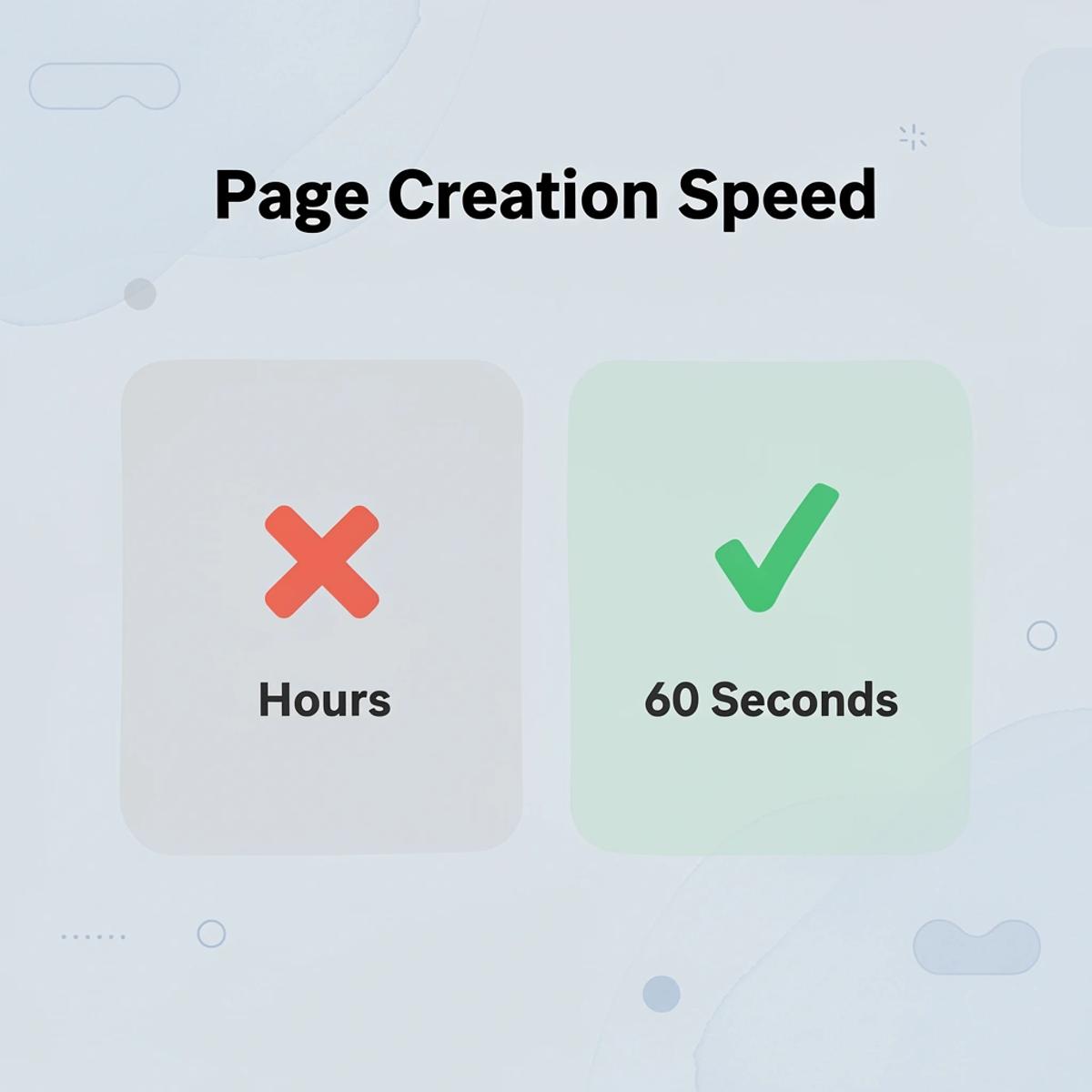
- AI page builder addresses this by compressing page creation from hours to under 60 seconds, generating multiple variations with different psychological triggers automatically, so you can test ideas live instead of debating which might work better.
Most Store Owners Don’t Have a Page Builder Problem
The problem is not your page builder. When you spend four hours building a single product page, you're solving for design satisfaction, not conversion rate. These rarely align. The real problem is how long it takes to test what works and get people to buy.
🎯 Key Point: Time spent perfecting design doesn't equal time spent optimizing for sales.
Jeff Shore reports that 75% of home buyers start their search online, yet most builder websites fail to convert that traffic into sales. Store owners refine the same page layout with minor headline changes and image swaps, mistaking activity for progress. Conversion rates stay flat because the underlying offer, positioning, or psychological trigger remains unchanged.
"75% of home buyers start their search online, yet most builder websites fail to turn that traffic into sales." — Jeff Shore, 2025
⚠️ Warning: Small design tweaks won't move the needle if your core offer and positioning remain unchanged.

Why does testing velocity matter more than features?
Manual page builders force you into a slow workflow: start with a template, adjust sections, tweak copy, swap images, and publish. That process takes hours, so you test fewer ideas per week. Instead of launching five different angles for the same product, you launch one and spend days optimizing it. The math does not work in your favor.
SR Analytics found that retailers who improve their data infrastructure can grow revenue by up to 25%. The same logic applies to page testing: if you cannot test quickly, you cannot learn what works. Without rapid testing, pages become identical because everyone uses the same templates and structure. Switching builders does not solve this.
How does slow testing create predictable failure cycles?
The cycle becomes predictable: build a page, watch it underperform, switch to a new builder, rebuild the same idea with slightly different fonts and colors. Nothing fundamentally changes because the constraint was never the tool's feature set, but how fast you could move from hypothesis to live test.
Tools like AI page builder shift the equation. Instead of manually dragging elements for hours, PagePilot's AI page builder delivers intelligent page creation, building optimized layouts in under a minute. When you can launch a new product page in 60 seconds instead of four hours, you test 20 variations in the time it used to take to build one. Speed compounds into insight, and insight drives revenue.
Until you shift focus from which builder has better templates to how fast you can test better ideas, results stay the same. Once you see how velocity changes the game, the builder debate becomes irrelevant.
What People Actually Mean by “PageFly Alternatives”
When someone searches for "PageFly alternatives," they want relief from slow execution and pages that look identical to competitors. The tool is where that pain becomes visible.

🎯 Key Point: The category breaks into three distinct approaches that solve different problems.
Drag-and-drop builders like PageFly, Shogun, and GemPages offer maximum design control—customize every element, adjust spacing pixel by pixel, and build exactly what you envision. But that control demands time; every page requires manual construction, slowing down how many variations you can test weekly. Template-based tools like Zipify Pages reduce that workload with pre-built, conversion-focused layouts, but your pages start looking like everyone else's because thousands of stores use the same templates.
"Control and speed represent the fundamental trade-off in page building—you can optimize for one, but rarely both simultaneously."
⚠️ Warning: Choosing the wrong approach for your team's capacity can bottleneck your entire conversion optimization process.
The third category changes the workflow entirely
AI-driven page generation tools shift focus from design flexibility to testing speed. Instead of dragging elements for hours, you generate pages from competitor URLs or supplier listings, then refine what matters. The workflow compresses from hours to minutes because the tool handles structure, copy, and conversion psychology automatically. Tools like our AI page builder combine page generation, product discovery, and ad creative creation, enabling smarter testing across the entire funnel.
Why do most tool comparisons miss the point?
People evaluate these tools based on feature counts, integrations, or design flexibility, but miss the actual constraint: how quickly each approach lets you move from product idea to live test.
The goal is not to build a perfect page, but to find one that converts. This requires running multiple tests with different angles, offers, and psychological triggers.
How does testing speed create a competitive advantage?
When you can test only one page layout per week because each build takes four hours, you compete with one hand tied behind your back. Your competitor who can launch five variations in the same timeframe learns faster, finds winning angles sooner, and captures market share while you adjust button colors.
Speed creates an information advantage that, over time, translates into revenue. The search for "PageFly alternatives" reflects a need for faster iteration and stronger differentiation: the two factors that determine whether your product page converts or gets scrolled past.
Related Reading
- Does Shopify Host Websites
- Is It Worth Buying a Prebuilt Shopify Store
- Shopify Product Page Customization
- What is Custom Liquid Shopify
- How to Customize a Shopify Website
- Shopify Speed Optimization
15 Best PageFly Alternatives (By Use Case)
Choosing a page builder means deciding what you value most: control, speed, or differentiation. The tools below are grouped by what they solve for, since the right builder depends entirely on your constraint.

🎯 Key Point: Your biggest limitation—whether it's time, technical skills, or budget—should drive your page builder choice, not just feature lists.
"The best page builder is the one that removes your biggest bottleneck while fitting your workflow." — Web Development Best Practices, 2024
💡 Pro Tip: Before comparing features, identify whether you need maximum customization, fastest deployment, or unique design capabilities—this will eliminate 80% of options immediately.
1. PagePilot
PagePilot eliminates the design phase entirely. Input a competitor or supplier URL, and the system generates a complete product page with rewritten copy, restructured layout, and enhanced visuals.
How does PagePilot change dropshipping workflows?
Instead of spending hours dragging elements, you generate multiple variations in minutes and test different psychological angles at scale.
This changes how dropshippers work. You stop building one perfect page and start testing five imperfect ones, because iteration velocity matters more than initial polish. According to smind.io, over 50,000 Shopify stores use PageFly, but most struggle with speed because manual building limits the number of ideas they can test weekly. PagePilot AI compresses page creation from hours to under 60 seconds, letting you discover what converts faster than competitors, while still tweaking templates.
Best for
Fast iteration, dropshipping, and testing multiple offers at scale
2. Shogun Page Builder
Shogun is an advanced traditional builder offering structured page creation, built-in A/B testing, and deeper analytics than most competitors. You can customize layouts precisely, run split tests, and track performance without third-party tools. The steeper learning curve yields greater control.
Every page needs to be built by hand, which limits the number of weekly variation launches. Choose Shogun if perfection matters more than speed.
Best for
Brands that want control plus built-in testing and analytics
3. GemPages
GemPages balances flexibility with ease of use through a large template library, conversion-focused elements like upsells and bundles, and an intuitive editor. It suits stores seeking customization without a steep learning curve.
The challenge remains the same as any manual builder: you still spend hours per page, limiting how much testing you can do.
Best for
Users who want flexibility without a steep learning curve
4. EComposer
EComposer feels like a natural part of Shopify because it was built that way. The live editor works quickly, the interface matches Shopify's layout, and built-in features like Ajax cart and cross-sells reduce the need for extra apps. AI content support helps you write copy faster, though you still build layouts by hand.
The goal is to make things easier while keeping you in control. Each page still requires manual work, which limits how many versions you can test in the same timeframe.
Best for
Users who want a smooth, Shopify-native building experience
5. LayoutHub
LayoutHub focuses on speed through pre-designed blocks and layouts. Instead of building from scratch, you assemble pages using ready-made sections, making it ideal for beginners who need to launch quickly without extensive customization knowledge.
The downside is that things look the same. When thousands of stores use the same blocks, your pages start looking familiar to customers who shop at multiple stores selling similar products.
Best for
Beginners who want to build pages fast without heavy customization
6. Zipify Pages
Zipify is built around high-converting templates based on real e-commerce data. You start with sales-optimized structures for product pages and funnels, eliminating guesswork.
The limitation is standardization. When you use proven templates, thousands of other stores use them too. Your page converts better than a poorly designed custom build, but it still resembles competitors' pages using the same system. Differentiation requires customization, which reintroduces the time constraint.
Best for
Users who want proven layouts backed by conversion data
7. Beae Landing Page Builder
Beae focuses on simplicity and ease of use. It offers a clean interface, mobile-responsive templates, and a generous free plan. New users can learn the platform quickly and create pages without difficulty.
The downside is that it lacks advanced features. Beae works well for basic product pages, but more complex layouts or customization needs require a different tool.
Best for
Beginners seeking an easy-to-use builder with solid templates
8. Foxify AI Landing Page Builder
Foxify combines templates with AI-assisted generation, letting you start with structured layouts and use AI to generate content and sections. This hybrid approach balances speed and structure, though it doesn't match fully AI-driven tools.
You get faster page creation without sacrificing manual editing, but you still spend time assembling and refining variations, limiting how many you can test each week.
Best for
Users who want faster page creation without sacrificing templates
9. Instant AI Page Builder
Instant AI Page Builder creates pages and sections quickly using AI while allowing manual edits. With 294 reviews, it demonstrates growing adoption among stores seeking faster page creation without sacrificing control.
The workflow sets up the structure and writing automatically, then lets you make changes. You work faster than with manual builders while retaining full control.
Best for
Users who want to speed up page creation while maintaining control
10. Zeno AI Page Builder
Zeno offers lightweight AI-assisted page creation focused on simplicity and speed. It prioritizes launching quickly over extensive customization, making it faster for product pages than larger builders, though with fewer features.
The trade-off is depth. Zeno works well for straightforward pages, but complex layouts require more manual work. Choose Zeno if speed matters most; choose a different tool if you need advanced features.
Best for
Users who prioritize speed over advanced customization
11. Pagetify
Pagetify is a performance-focused builder with reusable sections, SEO-friendly structures, and conversion elements. It sits between traditional builders and lightweight tools, offering more control than simple templates but less complexity than advanced editors.
You build pages that load fast and rank well, but you still build them manually. The process is smoother than starting from scratch, though it requires time investment.
Best for
Users who care about SEO and structured page performance
12. Atlas AI Store Builder
Atlas uses AI to create store sections and layouts, helping users launch pages quickly without extensive design work by handling structure and content.
The advantage is speed: you can generate pages faster than manual builders allow. The limitation is customization—designs that are specific require refinement of the AI output, which reintroduces time constraints.
Best for
Users who want AI-assisted store building at scale
13. Section Store
Section Store gives you high-converting sections you can add directly to your Shopify theme, keeping your store lightweight without heavy apps that slow load times.
The trade-off is flexibility. You get pre-built sections rather than full page control. Section Store works best if your theme is solid and you need better sections. For full page customization, you'll need a different tool.
Best for
Users who want improvements without adding heavy apps
14. AfterShip Page Builder
AfterShip's builder combines drag-and-drop functionality with performance optimizations, including fast load times and built-in analytics. It handles multiple needs competently without specializing in any single area.
The advantage is versatility: you get design control, performance optimization, and analytics in one tool. The disadvantage is that it doesn't excel at any single function the way specialized tools do.
Best for
Users who want a mix of performance and ease of use
15. Replo
Replo is built for fast-growing and enterprise brands. It offers highly customizable, performance-optimized pages and integrates seamlessly with modern Shopify workflows. You can build complex layouts that load fast and convert well, though the learning curve reflects that complexity.
Replo works best for teams with design and technical resources. Solo operators or small teams may find it overwhelming, while scaling brands needing enterprise-level customization will see the most value.
Best for
Scaling brands that need advanced customization and performance
Key Takeaway
All 15 of these tools work within Shopify, but they solve different problems: some offer control, others speed, and still others differentiation. The right choice depends on which helps you test faster and find what converts sooner.
Most builders assume you want more design options, but the real constraint is how many ideas you can test before your competitors figure out what works.
Why Most Alternatives Still Don't Fix the Problem
Switching from PageFly to another builder rarely improves conversion rates because the tool is not the problem: the workflow is. You rebuild the same page in a different interface, spend the same hours dragging sections, and launch the same number of variations per week. The outcome stays flat because the process never changed.

🎯 Key Point: The fundamental issue isn't your page builder—it's how you approach optimization and testing workflows.
"Tool switching without process improvement leads to the same results in a different interface." — Conversion Optimization Research, 2024

⚠️ Warning: Most teams waste weeks migrating to new platforms when they should be fixing their testing methodology and optimization process instead.
Why do most store owners stay trapped in optimization cycles?
According to Art of Data Engineering, 70% of data teams spend more time fixing problems than building new things. The same pattern emerges with e-commerce page creation: most store owners fix underperforming pages rather than test new ideas.
You change headlines, adjust spacing, and swap product images—making small improvements within a narrow range of ideas. The underlying offer, positioning, and psychological triggers remain unchanged, so conversion rates stay stuck in the 1.4% to 2.5% range regardless of which builder you use.
Why does switching page builders maintain the same time investment?
Switching builders doesn't change the workflow: template → manual customization → hours refining layouts → publish. The interface and feature set differ, but time per page stays constant, limiting weekly test volume. Testing one or two pages weekly generates insufficient data to identify what converts. Competitors testing five variations in the same timeframe learn faster, find winning angles sooner, and capture market share while you adjust button colors.
How do shared templates affect competitive differentiation?
Most builders use shared templates and common design patterns, creating convergence where different stores look nearly identical. When your page doesn't look visually different from competitors, you compete on price, traffic volume, or brand recognition instead of letting the page itself drive sales, putting pressure on margins and acquisition costs.
Why does iteration speed matter more than features?
The real constraint is not design flexibility or feature depth: iteration speed. If generating a new page variation takes four hours, you can test only a handful of ideas per month, which is insufficient for meaningful improvements in conversion rates in competitive niches where winning stores constantly test new psychological triggers and offer structures.
Tools like AI page builder compress page creation from hours to under 60 seconds by automatically handling structure, copy, and conversion psychology. PagePilot lets you test 20 variations in the time it takes manual builders to test one, accelerating learning and revenue discovery.
What actually drives conversions beyond speed?
The harder question is: what drives conversion rates once you remove the speed bottleneck?
Related Reading
- Hire Someone to Build Shopify Store
- Shopify User Experience
- How to Add Products to Shopify
- How to Design Shopify Website
- How to Create a New Page Template in Shopify
- How to Create a Landing Page on Shopify
- Shopify Mobile Optimization
- How to Add a Review Section on Shopify
What Actually Improves Conversion Rates
Running lots of experiments quickly. To improve customer purchases, you need to run enough tests to identify which ideas, offers, and page layouts work best with your audience. According to Fermat Commerce, A/B testing can improve conversion rates by up to 300%, but only if you test frequently enough to generate statistically meaningful data. Most stores test too slowly to reach that threshold.
"A/B testing can improve conversion rates by up to 300%, but only if you test frequently enough to generate statistically meaningful data." — Fermat Commerce
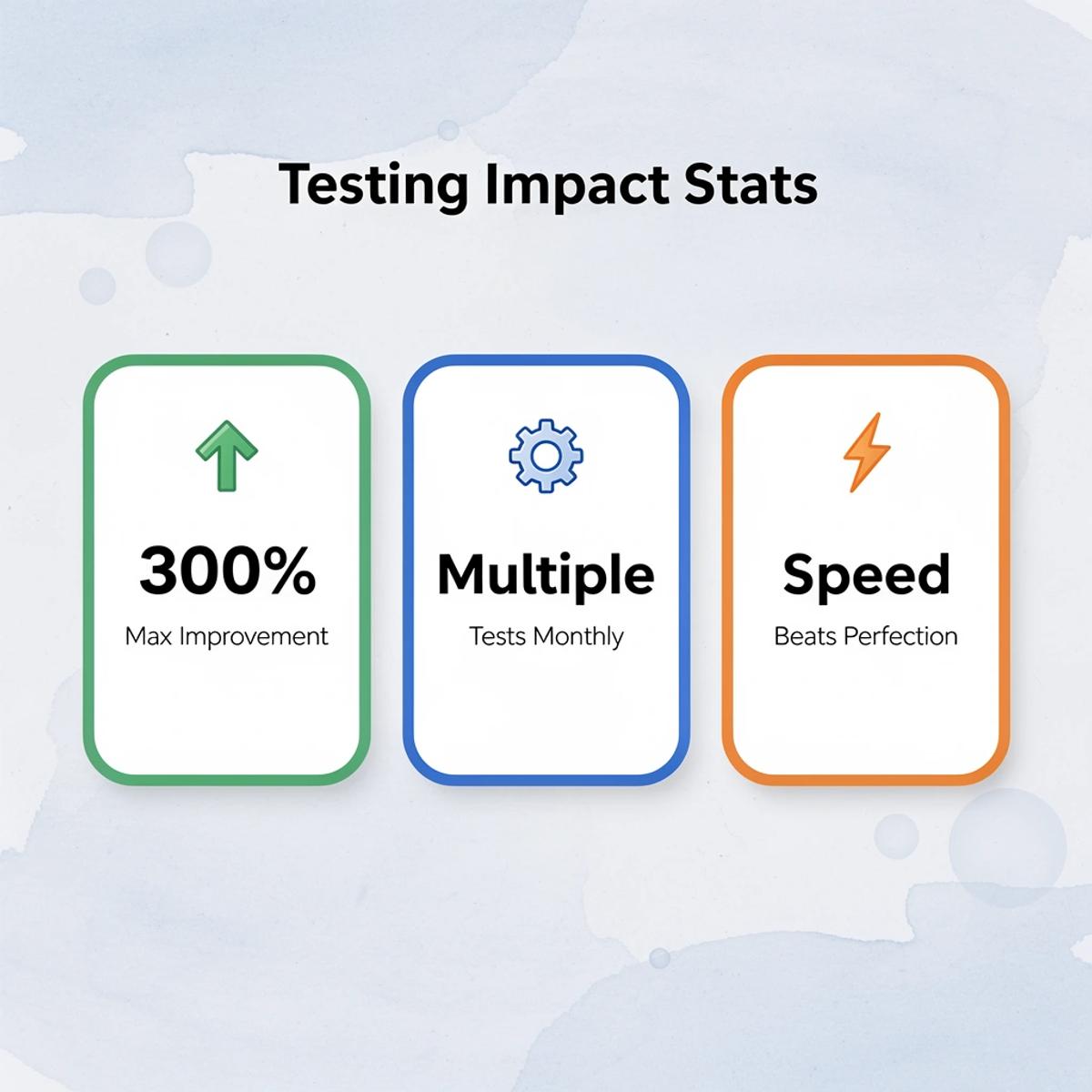
🎯 Key Point: The real secret isn't finding the perfect test — it's running enough tests at the right speed to discover what actually works for your specific audience.
🔑 Takeaway: Speed of experimentation beats perfection of individual tests. The stores that see the biggest conversion improvements are those that can run multiple A/B tests per month, not those that spend months perfecting a single test.

Why does testing velocity determine learning speed?
Stores that improve conversions launch multiple variations quickly, rather than perfecting a single page over weeks. They test different psychological angles—scarcity versus social proof, benefit-driven versus feature-focused copy—and upgrade visuals and messaging so pages differentiate from competitors.
Each test either confirms what works or eliminates what doesn't. Every variation increases your probability of finding a winner, and that probability compounds with each new test you run.
How do successful stores approach product page testing?
Successful stores treat product pages as ideas to test, not finished work. One store might test five different ways to show value in a week; another might test three different visual layouts with identical copy. The common thread is volume.
When you test one idea per week, you need 20 weeks to gather insights that a faster competitor collects in four. That gap widens because they keep learning while you keep building.
How do AI page builders accelerate the testing process?
Platforms like AI page builder create pages in under 60 seconds, not hours. PagePilot automatically generates multiple versions with different psychological triggers, then tests them live rather than debating which might work.
The conversion rate is not fixed; it shows how well your page matches what users are looking for, and that match is nearly impossible to predict before you try.
Why do most stores miss critical performance factors?
Research from Website Speedy shows that a 1-second delay in page load time reduces conversions by 7%.
Most stores focus only on copy or design while ignoring speed, mobile responsiveness, or render time. Winners optimize across all areas simultaneously by testing enough variations to identify what drives behavior change.
What does a proper iteration structure look like?
Before: one product page built over two days, small headline changes over time, no clear sign of what works. After five variations launched in a day, different hooks and layouts tested, one clear top performer emerges within 72 hours.
The difference is how you set up iteration. You stop trying to design the perfect page at the start and find it faster than competitors who are still guessing.
How PagePilot Helps You Test and Win Faster
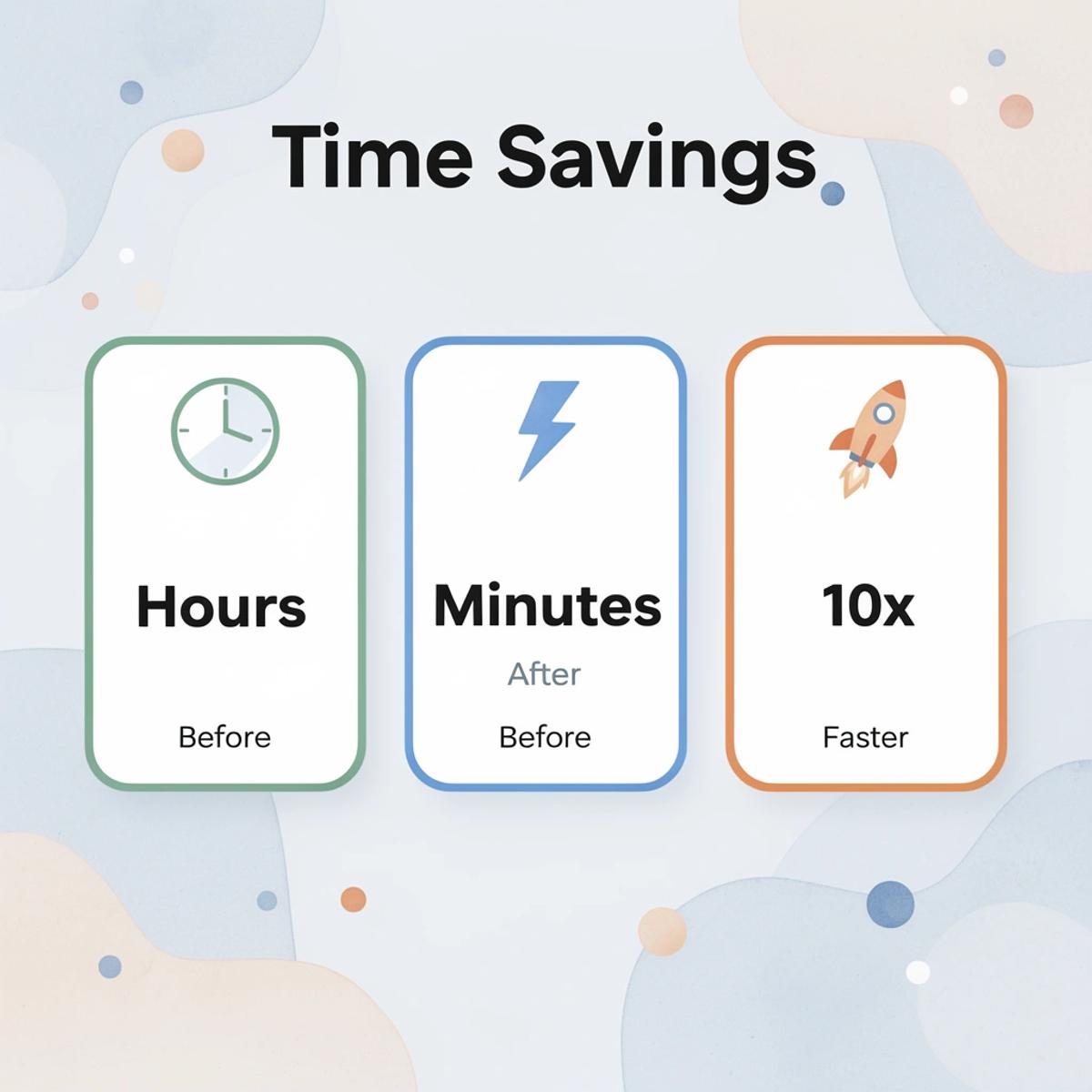
The problem isn't about design quality: it's about how fast you can build. Most tools require manual construction, section by section. PagePilot fixes this by starting with content rather than an empty page. Enter a competitor or supplier URL, and our AI page builder creates a complete product page with structure, copy, and positioning already done, reducing hours of work to minutes.
🎯 Key Point: PagePilot eliminates the manual building process by using competitor intelligence to create ready-to-launch pages in a fraction of the time.
"PagePilot transforms hours of work into minutes by leveraging competitor URLs to build complete product pages with structure, copy, and positioning already optimized." — PagePilot AI Technology
💡 Tip: Instead of starting from scratch, use competitor analysis as your foundation—PagePilot's AI does the heavy lifting while you focus on customization and optimization.
Speed alone is not enough
If you only recreate existing pages, you compete on the same playing field. PagePilot upgrades the output by rewriting product copy for differentiation and enhancing images so you're not using the same visuals as competitors. This creates a faster-to-produce, more distinct page.
The real advantage emerges in testing. Since page creation is no longer the bottleneck, you can launch multiple variations quickly: different hooks, angles, and offers. Instead of committing to one idea and refining slowly, you test several ideas simultaneously and let performance decide.
Testing velocity changes the game
This directly solves the biggest problem: time. Instead of spending hours building a single page and hoping it works, you test multiple approaches in the same timeframe and identify what converts.
You find what works faster than competitors, but are still stuck in manual workflows. But knowing how to test faster matters only if you start.
Start a FREE Trial and Generate 3 Product Pages with Our AI Page Builder today
If slow testing is your bottleneck, launch multiple product page variations without having to rebuild from scratch. Start a free trial of PagePilot and generate your first 3 product pages, including copy and visuals, to test angles immediately and find what converts.

🎯 Key Point: Page creation friction delays testing. When it takes hours, you postpone until you feel certain—but certainty requires test results. Our PagePilot free trial removes this barrier by generating pages in under 60 seconds, letting you start learning today. Three pages provide enough variation to test different psychological triggers (scarcity versus social proof, benefit-driven versus feature-focused) and see what truly resonates with your audience.
"Speed generates the data that informs better decisions. Stores that improve conversion rates don't wait for perfect strategy." — PagePilot Conversion Research, 2024
💡 Warning: Stores that improve conversion rates don't wait for a perfect strategy. They test imperfect variations quickly because speed generates the data that informs better decisions. Your competitor is launching pages, gathering signals, and refining while you evaluate builders. That gap widens daily.