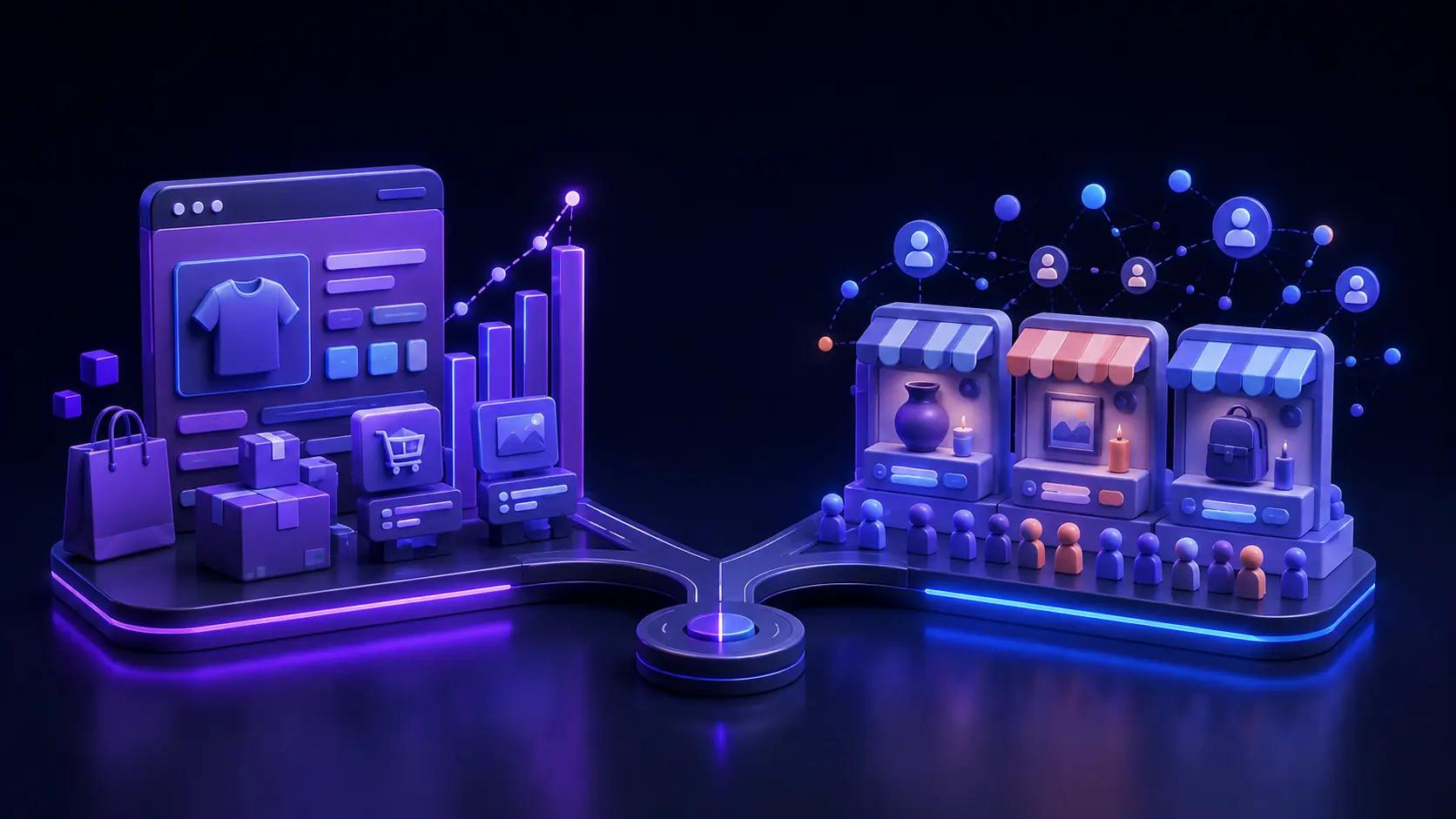

A candle maker lists her first dozen jars on Etsy on a Tuesday night. By the weekend, three have sold to strangers she's never advertised to. That's the appeal in one sentence: list a product, reach shoppers who are already browsing, and make real sales without building a website first. Six months and a few hundred orders later, the question changes shape. Repeat customers are emailing to ask if she has a website. A wholesale buyer wants a proper invoice. And she's started wondering whether she's building a brand, or just renting a very good storefront on someone else's street.
That's the actual decision behind Shopify vs Etsy, and it rarely shows up as a spreadsheet comparison. It shows up as a seller standing at a crossroads: keep relying on marketplace demand, or start building something you actually control. The quick version: Etsy is usually easier for starting. Shopify is usually better for scaling.
A lot of sellers end up running both, with Etsy as the discovery channel and Shopify as the store they own. If Shopify is your next step after Etsy, PagePilot helps you build stronger product pages faster once you get there.
Shopify vs Etsy: The Short Answer
Choose Etsy if you sell handmade, vintage, custom, or craft products and want built-in buyer discovery without building a full site first. Choose Shopify if you want to build a brand, run ads, improve product pages, own your customer data, and scale past what marketplace search can offer. Use both if Etsy already brings in sales but you want a Shopify store for repeat purchases, email and SMS growth, paid traffic, and better margins over time.
Start with Etsy for discovery, then use Shopify and PagePilot to build the brand experience you own.
What Is Etsy?
Etsy is a marketplace where sellers list products in front of an audience that's already browsing. It built its name on handmade, custom, vintage, and craft goods, and that reputation still drives a lot of its organic search traffic. A shopper searching Etsy for "walnut cutting board" or "custom pet portrait" is already in buying mode, and the marketplace puts your listing next to theirs without you spending a dollar on ads.
That convenience comes with structure. Etsy runs on listing-based selling rather than a full storefront, and sellers pay fees on listings, transactions, payments, and optional advertising. Branding, checkout, and the customer journey are largely shaped by Etsy's own page templates rather than the seller's. Product categories and marketplace standards also apply, and it's worth being upfront about one restriction in particular: Etsy's seller policies specifically limit dropshipping and reselling outside a narrow set of allowed cases, since the platform is built around items sellers make, design, or personally source.
Sellers with broader ecommerce ambitions, including private-label or dropshipping models, usually need Shopify instead, and our breakdown of the best apps for dropshipping and wider best dropshipping software roundup cover that model in more depth.
What Is Shopify?
Shopify is an ecommerce platform for building and running your own online store: your domain, your product pages, your checkout, your data. Unlike Etsy, it doesn't hand you a built-in audience. The seller is responsible for generating traffic through SEO, paid ads, email, social, affiliates, influencers, and repeat-customer marketing.
In exchange for that extra work, Shopify gives sellers a full app ecosystem, customizable product pages and collections, native checkout, analytics tied directly to their own customer data, and far more room to scale a brand rather than just a sales number. It's more responsibility, but it's responsibility over things Etsy simply doesn't hand you: pricing structure, upsells, email capture, and the actual look and feel of the buying experience.
Sellers weighing how to build that store have options too, from AI-first tools to manual page builders, and our AI store builder pricing breakdown and best Shopify page builders roundup both cover that decision.
Shopify vs Etsy: Key Differences at a Glance
Should I Sell on Shopify or Etsy?
Sell on Etsy if...
You're testing a handmade, custom, vintage, craft, or printable product. You want access to shoppers already browsing a marketplace. You don't want to build a full ecommerce website yet. You're comfortable following marketplace rules. You're okay with limited control over branding and the customer journey. You want a lower-friction way to validate demand before investing further.
Sell on Shopify if...
You want to build a standalone brand. You want your own domain and storefront. You plan to run paid ads. You want to collect email and SMS subscribers. You want full control over product pages and landing pages. You sell products that don't fit neatly into Etsy's marketplace categories. You want to scale past marketplace search, with more control over upsells, bundles, cart experience, and repeat purchase flows.
Use both if...
Etsy already brings sales, but you want an owned store too. You want to reduce dependency on Etsy search specifically. You want to build a customer list outside the marketplace. You want to send repeat customers somewhere you control. You want Etsy to stay a discovery channel while Shopify becomes your brand hub.
Is Shopify Better Than Etsy for Scaling a Brand?
Usually, yes. Shopify gives sellers more control over the pieces that matter once a business starts scaling: brand identity, domain authority, product pages, navigation, checkout experience, customer data, email and SMS, paid traffic campaigns, conversion rate optimization, bundles, upsells, post-purchase flows, and analytics tied to real attribution.
Etsy can absolutely scale sales. What it scales less well is the brand itself. On Etsy, shoppers often remember Etsy first and the seller second, the same way a shopper remembers "I bought it on Amazon" more readily than the brand name on the box. On Shopify, the entire point is for shoppers to remember the brand, not the platform underneath it.
Shopify vs Etsy Fees: Which Is Cheaper?
"Cheaper" depends on sales volume, traffic source, ad spend, app costs, and whether built-in marketplace demand is worth paying for. It's not a simple either-or.
Etsy cost structure
Etsy charges $0.20 per listing, and listings expire after four months, so an active shop is paying small, recurring listing fees just to stay visible. On top of that sits a 6.5% transaction fee on the listing price plus shipping and gift wrapping, plus payment processing fees. Etsy Ads are optional and budget-controlled, but Offsite Ads work differently: shops under $10,000 in trailing 365-day sales pay a 15% fee on attributed orders unless they opt out, while shops that cross $10,000 are automatically enrolled at a 12% fee for the life of the shop. Etsy Plus, an optional subscription, adds a further monthly cost for sellers who want the extra tools.
Shopify cost structure
Shopify's core cost is a monthly plan, plus payment processing. Shopify states there are no setup fees, but third-party transaction fees can apply if a seller uses a payment provider other than Shopify Payments. Beyond the base plan, costs can include paid themes, apps for email, SMS, reviews, and upsells, a domain, and any page builder or conversion tools the store adds on top. Our full breakdown of how much it costs to build a Shopify website walks through what a realistic budget looks like once all of that is added up.
Simple cost takeaway
Etsy can feel cheaper at the start, since there's no full ecommerce site to build and marketplace traffic is already there. Shopify tends to become better value as a seller grows, because the brand gains more control over repeat purchases, customer data, margins, product pages, and paid traffic performance, the things that compound over time in a way marketplace fees don't. Our AI store builder pricing comparison is a useful reference once you're pricing out that move.
Shopify vs Etsy for Traffic and Discovery
Etsy gives sellers access to an existing marketplace, but every listing competes inside that marketplace against near-identical products, often on price alone. Shopify hands sellers no built-in marketplace traffic at all, but in exchange lets them build channels they hold: Shopify SEO, Google Shopping, Meta and TikTok ads, influencer partnerships, email and SMS, content marketing, affiliate programs, and a growing base of repeat customers who come back without needing to be found again.
Etsy helps with discovery. Shopify helps with ownership.
Shopify vs Etsy for Branding and Customer Control
This is one of the biggest differences between the two, and it's easy to underestimate until you're living inside it. On Etsy, the platform's page structure controls most of the buying experience, marketplace comparison shopping is always one tab away, and checkout, along with the rest of the customer journey, is largely out of the seller's hands.
Shopify flips that. Sellers get their own domain, a custom homepage, custom product pages, dedicated landing pages for campaigns, email and SMS capture built into the checkout flow, custom navigation, brand story pages, and room for bundles, upsells, a cart drawer, and CRO sections designed around the specific product being sold.
For Shopify sellers, product page quality matters more than it ever did on Etsy, because the store has to convert its own traffic without a marketplace's built-in trust doing the heavy lifting. PagePilot helps sellers build stronger product pages faster with AI product descriptions, visuals, page sections, and Shopify-focused conversion elements, without needing a designer on staff.
If you're deciding between that AI-first approach and a more manual builder, PagePilot vs GemPages and PagePilot vs Shogun both walk through the trade-offs.
Shopify vs Etsy for Product Pages and Conversion
Etsy listings are quick to create, but Shopify product pages offer far more control over how a product sells. A Shopify seller can test page layout, hero sections, product images, product descriptions, trust badges, FAQs, reviews, sticky add-to-cart sections, bundles, and offer structure, none of which Etsy's listing format really allows.
This is exactly where a lot of Etsy-to-Shopify sellers stumble. They move their products over but keep the marketplace-style product description that worked fine surrounded by Etsy's trust signals. Shopify needs a stronger standalone page, because the store has to earn that same trust on its own. Turn Etsy-style listings into high-converting Shopify product pages with AI, using AI-generated Shopify product descriptions and guidance on writing high-converting Shopify product descriptions with AI.
What Shopify product pages need that Etsy listings often don't
Clear product positioning above the fold. A strong hero section. Benefit-led product description rather than a features list. Product images and lifestyle visuals. Reviews and social proof. Shipping and returns information. FAQs. Trust signals. A sticky cart or easy add-to-cart button. Mobile-first design. And a clear offer and pricing structure that doesn't rely on comparison shopping to make sense. Guides like best Shopify apps to increase conversion rates and how to reduce bounce rate on Shopify product pages go deeper on closing that gap.
Shopify vs Etsy for Paid Ads
Etsy isn't always the right destination for paid traffic, because the seller has limited control over the full page, checkout, retargeting, and customer capture that ad spend usually needs to pay off. Shopify is generally the stronger choice here, since sellers can send paid traffic to a custom product page, a dedicated landing page, a bundle offer, or a campaign-specific page built around a single ad angle.
If you're spending money on Meta, TikTok, Pinterest, or Google ads, you need a page you can actually control and optimize, not a listing template shared with every other seller in the category. That's one of the strongest practical reasons to move from Etsy to Shopify, or run both side by side. Our guides on high-converting landing pages and how to optimize a landing page for lead generation cover the fundamentals either way.
Any product claims made in paid campaigns should also stay inside the FTC's online advertising rules, regardless of which platform hosts the page.
Shopify vs Etsy for SEO
Etsy SEO is marketplace SEO: optimizing listing titles, tags, attributes, categories, and reviews to compete inside Etsy's own search engine, while borrowing some benefit from Etsy's overall marketplace authority. Shopify SEO is website SEO: optimizing collection pages, product pages, blog content, internal links, structured data, and overall site architecture to build long-term organic visibility for the brand's own domain, following the same ecommerce SEO best practices Google documents for any online store.
It's more work than relying on Etsy's search engine, but it's work that compounds toward something the seller owns outright. Building category pages, product pages, blog content, and landing pages on a Shopify store creates visibility that can rank well beyond any single marketplace listing.
Can You Move From Etsy to Shopify?
Yes. A seller can move from Etsy to Shopify by exporting Etsy listings, importing products into Shopify, setting up collections, checking variants and images, building out a storefront, importing reviews where possible, connecting analytics, setting up email capture, and deciding whether to keep the Etsy shop active alongside it.
Etsy to Shopify migration checklist
Do not just import your listings; rebuild them into Shopify pages designed to convert on their own. Sellers who'd rather hand-build that page have manual options worth comparing too, including best PageFly alternatives and best GemPages alternatives.
Should You Leave Etsy Completely?
Not necessarily, and this doesn't have to be an immediate either-or decision. If Etsy is bringing in profitable sales, the smarter move is usually to keep it running while building Shopify as the owned brand channel alongside it.
A reasonable path: start on Etsy to validate product-market fit, build out Shopify once demand is proven, use Shopify for paid traffic, repeat customers, bundles, and brand storytelling, and keep Etsy active as a discovery channel for as long as it stays profitable. Plenty of sellers run this exact setup indefinitely rather than treating it as a temporary bridge. Once Shopify is generating its own momentum, research into dropshipping products with high profit margin is a natural next step for testing beyond what Etsy's rules would ever allow.
Where PagePilot Fits for Etsy Sellers Moving to Shopify
The hard part of moving from Etsy to Shopify was never really the product import. It's creating pages that can convert without Etsy's marketplace trust doing the work for you. PagePilot helps turn products into stronger Shopify pages faster: generating Shopify product pages with AI, improving product descriptions, creating better product visuals, building landing pages for paid ads, adding conversion-focused sections, testing one-product store pages, and improving bounce rate and mobile experience, all without needing a designer or developer on the payroll.
Etsy helps sellers get found. Shopify helps sellers own the brand. PagePilot helps Shopify product pages convert.
If you land on Shopify and want to compare manual page builders directly, Shogun page builder pricing and GemPages vs PageFly are both worth a look before committing to one.
Shopify vs Etsy: Pros and Cons
Shopify vs Etsy: Final Verdict
Etsy is better for starting, validating demand, and reaching marketplace shoppers. Shopify is better for scaling, owning the customer relationship, running ads, improving product pages, and building a real ecommerce brand. Many sellers should use both, but Shopify should become the long-term hub if the goal is brand growth rather than just marketplace sales.
If you're moving from Etsy to Shopify, don't just copy your Etsy listings into a basic store and expect the same results. Your Shopify product pages need to do more work on their own. Ready to move from marketplace selling to brand building? Build your Shopify product pages faster with PagePilot.